
WhatsApp is fast. That is exactly why so many construction teams use it.
A site manager asks for a delivery. A director says yes in a message. A subcontractor sends a price. The buyer replies with a thumbs-up. On a busy day it feels efficient because nobody has to wait for a formal process.
The problem is that WhatsApp is a conversation channel, not a control system. It is excellent for asking questions, sharing photos, and keeping work moving. It is poor at preserving the commercial detail that purchase order control depends on.
If the business treats chat messages as the place where orders are approved, it usually ends up with missing references, unclear values, forgotten variations, and invoices that arrive with more confidence than evidence.
For small and mid-sized contractors, the answer is not to ban WhatsApp. The answer is to stop letting WhatsApp carry the authority record.
Why WhatsApp creates control problems
WhatsApp is useful because it is informal. That informality is also the risk.
A message thread can contain:
- A quote from one supplier
- A request from site
- A quick approval from a director
- A later change to the scope
- A photo of the delivery
- A reminder that the job is urgent
All of that may be commercially relevant, but none of it is structured in a way accounts can rely on later.
The common failure modes are predictable:
- The order was approved in chat but never turned into a purchase order.
- The purchase value changed after the thumbs-up because the supplier added extra items.
- The job reference was mentioned in one message but not carried into the invoice.
- The site team ordered something for the right project but the wrong cost code.
- Accounts only discovered the conversation when the invoice arrived.
By then the team is trying to reconstruct a commercial decision from scattered messages.
Chat should request the order, not hold the order
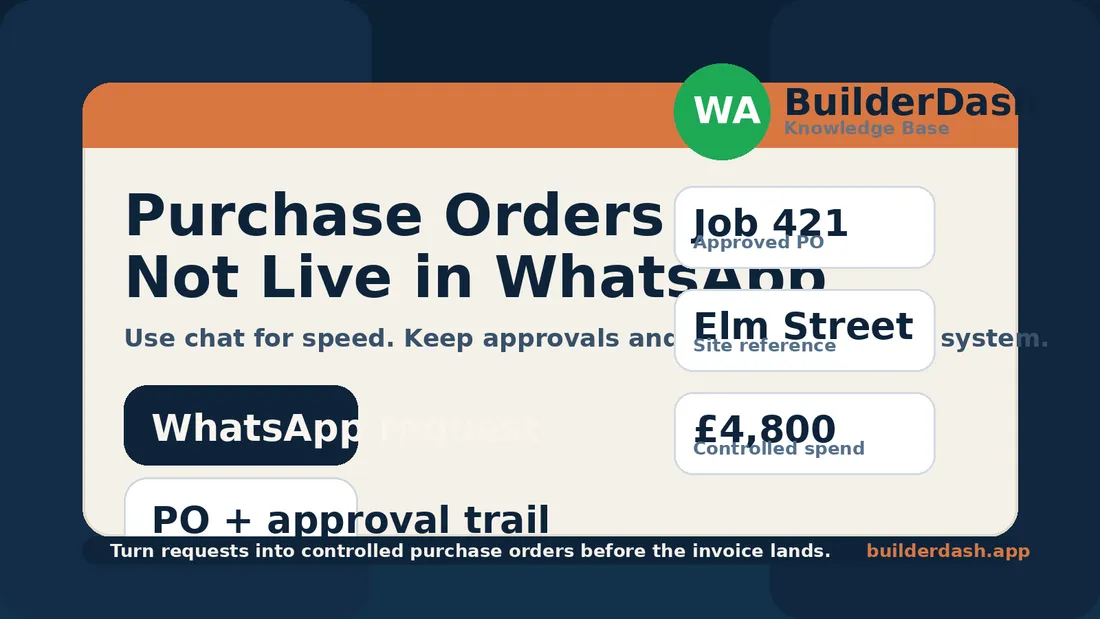
The clean rule is simple: WhatsApp can request or confirm work, but the purchase order should live somewhere else.
That does not mean every conversation has to stop. It means the business decides when a chat becomes a formal commitment.
A practical workflow looks like this:
- Site or project staff raise the need in WhatsApp if that is the fastest way.
- The buyer or approver turns the request into a proper purchase order.
- The PO gets a job reference, supplier, value, and approval status.
- The supplier receives the PO, not just a message screenshot.
- Any later changes are recorded as a revision or variation.
- Accounts checks the invoice against the PO before payment.
That sequence keeps the speed of chat without losing the commercial record.
What gets lost when the PO lives in chat
A WhatsApp thread may feel complete to the people involved, but it usually misses the details that matter later.
The missing pieces are often:
- The exact purchase value
- The approved job or site reference
- The date the approval was given
- Who actually approved it
- Whether the approval covered extras or only the base order
- Whether the supplier was told to proceed or only asked to quote
- Whether the message thread was later edited, buried, or split across several chats
Once the invoice arrives, those gaps become expensive.
Accounts may not know whether the invoice is valid. A project manager may remember saying yes, but not the number. The director may be asked to approve a cost they no longer remember seeing.
That is not a people problem. It is a process problem.
Make the approval rule explicit
If your team uses WhatsApp for site communication, the business needs a clear rule for when a chat message is not enough.
A useful rule is:
- A WhatsApp message can request the spend.
- A PO number is required before the supplier starts work or delivers materials.
- A thumbs-up or “go ahead” in chat is not the same as formal approval.
- Any extra value must be approved again.
- The approved PO is the record that accounts uses.
That sounds obvious, but many teams have never written it down.
Without the rule, people assume the chat message is sufficient. That works until the project becomes busy, the approver is away, or the supplier invoices from memory rather than from a formal order.
Keep the job reference with the order
In construction, the job reference is not admin decoration. It is the thing that tells accounts where the cost belongs.
If a WhatsApp thread says “order the plasterboard for Elm Street” but the PO does not carry the correct project code, the invoice may reach the right inbox and still land on the wrong job.
That creates three problems at once:
- Job costing becomes unreliable.
- Site managers see the wrong remaining budget.
- Directors make decisions on incomplete information.
The fix is straightforward: when the request is turned into a PO, the project or site reference must be captured in the formal record, not left in the chat thread.
Control variations before they become WhatsApp noise
WhatsApp often becomes the place where scope changes are negotiated casually.
A supplier may say the extra cutting will only add a small amount. A site manager may agree because the job is under pressure. A director may see the message later and think it was only an update, not a commercial change.
That is how overspend creeps in.
Variations need the same discipline as the original order:
- What changed?
- Who approved the change?
- What is the revised value?
- Does the supplier have the revised PO?
- Is the original value still visible for comparison?
If the answer to those questions lives only in chat, the business is depending on memory. That is a weak control on a busy site.
Use WhatsApp for speed, BuilderDash for the record
WhatsApp still has a place.
It is useful for:
- Alerting the office that something needs ordering
- Sharing a photo of what is required
- Confirming site access or delivery timing
- Chasing a response when a request is urgent
What it should not be used for is the final commercial record.
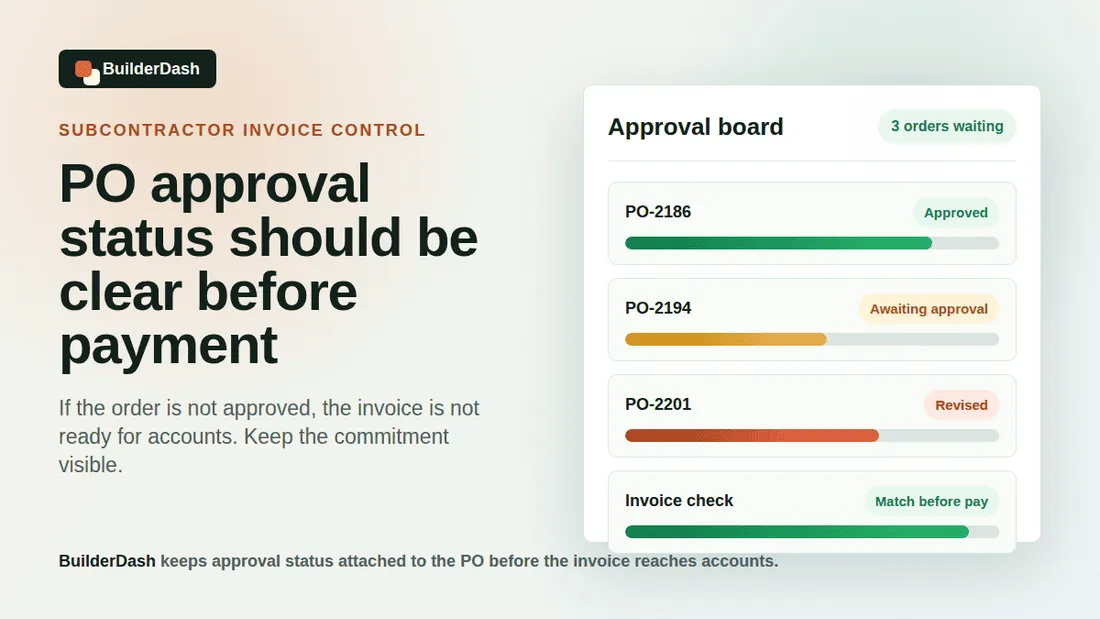
BuilderDash is the better place for that because it can hold the approved PO, job reference, status, supporting notes, and invoice check in one place. The conversation can still happen in WhatsApp, but the control record sits with the job.
That separation is important. It means the business can move quickly without letting speed erase accountability.
What a clean workflow looks like
For a small contractor, the workflow does not need to be complicated.
A practical setup might be:
- Site raises the need in WhatsApp.
- Buyer creates the PO in BuilderDash.
- Approver confirms the value and job reference.
- Supplier receives the PO by email or portal.
- Site confirms delivery or completion.
- Accounts matches the invoice to the PO and evidence.
- Any change is logged as a new approval, not a casual message.
If the business follows that pattern, WhatsApp remains the communication layer and the commercial record stays structured.
What to do with existing chat history
Many contractors already have months or years of order history sitting in WhatsApp.
You do not need to clean up every old thread before improving the process. Start with new spend.
A useful transition plan is:
- Stop treating a chat approval as final on its own.
- Require a PO number for all new spend above a set threshold.
- Ask site staff to paste the PO number back into the thread if they use chat to confirm the order.
- Keep the approved record inside the system, not in screenshots.
- Review any high-value or recurring supplier thread first.
That gives the team a workable change without trying to rebuild the past.
How BuilderDash helps
BuilderDash helps construction teams turn a WhatsApp request into a controlled purchase order workflow.
Instead of leaving approvals scattered across message threads, the business can keep the job reference, PO status, approval trail, and invoice check together. That makes it easier for accounts to see what was actually authorised and easier for directors to see where spend is drifting.
The practical value is simple:
- Fewer missing PO numbers
- Less time chasing the office for context
- Better job costing
- Clearer approval history
- Less risk of paying an invoice that was never properly authorised
A quick check for your team
Ask these questions about your current process:
- Are orders ever approved only in WhatsApp?
- Can accounts find the formal PO without chasing site?
- Do job references survive from chat to invoice?
- Are variations logged, or just discussed?
- Can the business tell the difference between a request, an approval, and a final order?
If the answers are inconsistent, WhatsApp is probably doing too much work.
The practical rule
Use WhatsApp to move the conversation along.
Use BuilderDash to hold the approval, the PO, and the record that accounts will rely on later.
That one separation is often enough to stop small spend decisions turning into large invoice problems.
Suggested internal links
- /knowledge-base/construction-purchase-order-software-control-spend/
- /knowledge-base/standardise-construction-accounts-before-automation/
- /knowledge-base/control-purchase-order-overspend-construction-variations/
- /knowledge-base/project-codes-site-references-materials-invoices/
Suggested call to action
If your purchase orders are still living in WhatsApp threads, move the approval and job reference into BuilderDash before the invoice arrives.
Run your projects properly with BuilderDash.
One system for every enquiry, job, quote and invoice — built for project-based trades, not reactive call-outs.