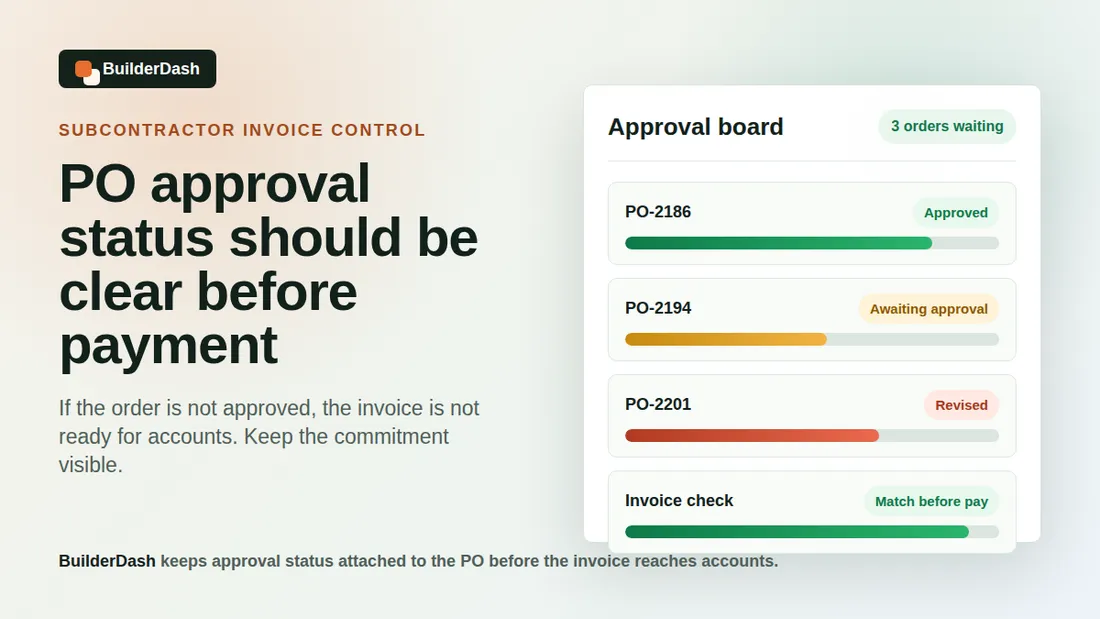


A subcontractor invoice should not arrive as a mystery for accounts to solve.
In a clean workflow, the office can see who ordered the work, what was approved, which job it belongs to, whether the value changed, and whether the invoice is ready for payment. If those pieces are missing, the invoice may still be valid, but it is not easy to process safely.
That matters in construction because the risk is rarely limited to one invoice. A weak process can affect cash flow, job cost visibility, and the relationship between site teams and accounts. It also creates avoidable chasing at month end when no one can remember which extra work was agreed, who signed it off, or whether the invoice is for the original order or a revised scope.
The rule is simple: no invoice without a traceable commitment
A clean subcontractor invoice workflow starts before the invoice is raised.
The business needs a traceable commitment record that answers four questions:
- What work was requested?
- Who approved it?
- What value was approved?
- Which job or site does it belong to?
If those answers live in different places, the invoice becomes harder to trust. If they live in one record, the invoice can be matched quickly and fairly.
That is the difference between processing costs and controlling them.
What the office should be able to see
Before a subcontractor invoice is paid, accounts should be able to check the following without chasing three people by email:
- Supplier name
- Purchase order number
- Job reference or site reference
- Approved scope of work
- Approved value
- Any variation or revised value
- Invoice number and invoice date
- Retention or part-payment position, if relevant
- Approval status
If any of that is unclear, the invoice needs a query rather than a payment.
This does not mean the office should block every invoice. It means payment should follow evidence, not memory.
Separate the steps instead of merging them
Many construction businesses blur the steps together.
Someone asks for work on site.
A manager says yes.
The subcontractor does the work.
An invoice arrives.
Accounts is expected to work backwards from the invoice and reconstruct the approval.
That is where errors creep in.
A cleaner workflow separates the stages:
- Request the work.
- Raise the purchase order.
- Approve the value and scope.
- Record any variation before it becomes a dispute.
- Match the invoice to the approved commitment.
- Query anything that does not fit.
- Release payment only when the record is clear.
If the business follows that order, the invoice is simply the final step in a controlled process.
Partial invoices need extra care
Subcontractors often invoice in stages.
That is normal, especially on longer jobs or where the work is tied to progress on site. The problem is not partial invoicing itself. The problem is losing track of what has already been billed and what remains open.
A clean workflow keeps the following visible:
- Original PO value
- Value already invoiced
- Value still outstanding
- Any approved variation
- Any disputed or unapproved amount
Without that visibility, a small interim invoice can hide a much larger commitment still waiting to hit accounts. It can also make the job look healthier than it really is if the commitment is not reflected in the current cost view.
Variations should not sit in somebody’s memory
Construction teams are good at solving problems quickly. The downside is that quick decisions often stay informal for too long.
A site instruction may be agreed in principle, but the value is not updated.
A subcontractor may carry out extra work, but the approved amount is not revised.
A project manager may remember the conversation, but the office cannot see it when the invoice lands.
That is why variations need to stay attached to the original PO.
If the approved commitment changes, the record should show:
- the original amount
- the reason for change
- the revised amount
- who approved the change
- when the approval happened
If the original and revised values are not both visible, accounts can no longer tell whether an invoice is within scope or already over the line.
What a good query process looks like
Not every invoice should go straight through.
The clean answer to a mismatch is a documented query, not a vague “park it” message.
A useful query record should state:
- what is wrong
- what part is accepted
- what part is disputed
- who owns the next action
- when the next review will happen
That keeps the accepted value visible for job costing while the disputed part is resolved.
It also stops the office from paying around the problem just to keep the inbox clear.
How BuilderDash helps keep the workflow tidy
BuilderDash is useful when the business wants one place to connect the request, approval, PO, and invoice check.
That matters because the process breaks down when people have to hop between WhatsApp, email, spreadsheets, and memory just to work out whether a subcontractor invoice is payable.
A better system gives the team a clear path from commitment to payment:
- the right job reference is attached early
- the approved amount is visible before the invoice arrives
- the approval status is easy to check
- variations stay linked to the original order
- accounts can process or query the invoice without guesswork
The goal is not more admin. The goal is fewer surprises.
A simple standard the team can follow
If you want a practical rule to enforce, use this:
If the invoice cannot be matched to a job, a PO, and an approved value, it does not move to payment.
That one rule forces the business to tighten up the workflow before the accounts team becomes the repair shop for poor site discipline.
Suggested call to action
If your subcontractor invoices still rely on inbox archaeology, BuilderDash helps keep the PO, approval, and invoice check together so accounts can move faster without losing control.
Run your projects properly with BuilderDash.
One system for every enquiry, job, quote and invoice - built for project-based trades, not reactive call-outs.