Why Approval Limits Should Follow Job Value, Not User Role
 BuilderDash20 Aug 2026 6 min read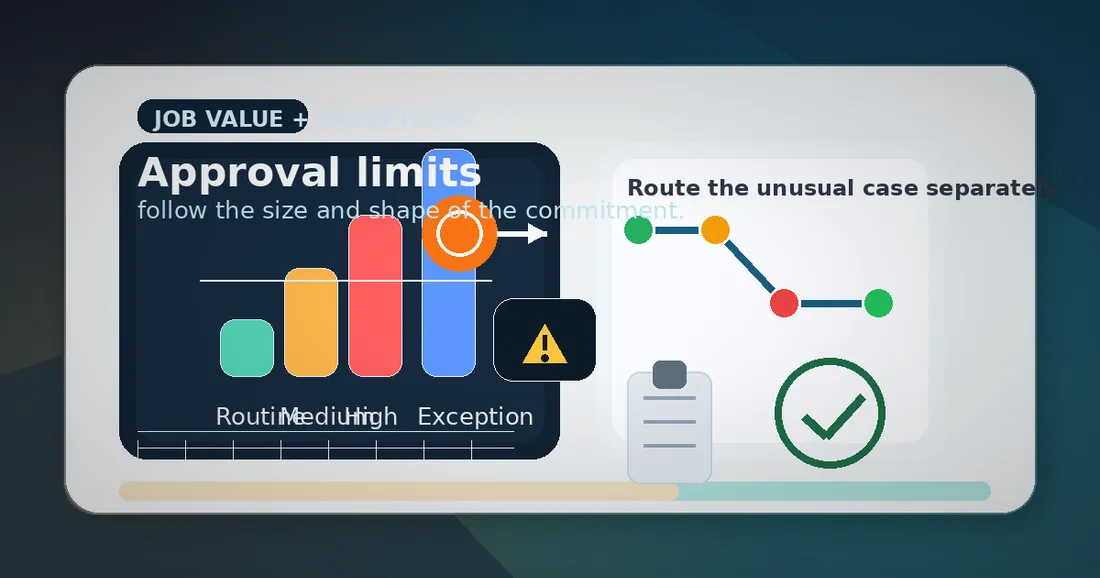
Role-based approval rules look neat on paper.
In a real construction business, they are often too blunt. A director may be the default approver for one type of spend even when the decision is routine. A project lead may be allowed to approve another order even though the value or exception makes it too risky. The result is either bottlenecks or blind sign-off.
The better rule is simpler: approval limits should follow job value and exception routing, not just user role.
Why role-only approval limits fall down
A user role tells you who someone is in the system.
It does not tell you:
- how large the commitment is
- whether the spend is within normal job behaviour
- whether the order is tied to a variation
- whether the request is split across more than one job
- whether the order has an unusual supplier, rate, or coding issue
If role is the only filter, the business can end up with two bad outcomes.
One is over-escalation, where routine orders are pushed too high up the chain and nobody wants to approve them quickly.
The other is under-control, where someone with the right title but not enough context signs off spend they cannot really judge.
Use job value as the first approval rule
Job value should usually be the first thing that decides the route.
That does not mean every business needs the same threshold. A small fit-out contractor and a larger main contractor will not use the same numbers. The point is that the band should reflect the size of the decision, not the seniority of the person who happened to open the record.
A practical pattern is:
| Spend type | Typical route | Why |
|---|---|---|
| Routine spend within normal band | Project lead or commercial lead | The decision is ordinary and can move quickly |
| Spend that crosses the job’s normal band | Senior commercial review | The commitment is large enough to affect margin or cash flow |
| Spend that is high value and unusual | Director or senior commercial review | The order needs both value control and judgement |
The exact thresholds are for the business to set. What matters is that the route changes because the commitment changes.
Route exceptions separately
Some orders should not follow the normal path at all.
An exception is not just a bigger number. It is anything that makes the normal approval logic unreliable.
Common exceptions include:
- a variation that has not been fully agreed
- a split job allocation that needs checking
- an unpriced item that is only an estimate
- a new supplier that has not been used on the job before
- a rate change that does not match the original package
- a request that has no clear job reference
- a rush order that changes the usual buying process
Those cases need a separate route because the approver is not only deciding on value. They are also deciding whether the spend belongs on the job in the first place.
Role should still matter, just not by itself
This is not an argument against role-based permissions.
Role still matters because it tells the system who is eligible to approve, review, or escalate. But role should be the guardrail, not the whole decision.
Think of it like this:
- role decides whether a person can approve at all
- value decides how far the record should travel
- exception type decides whether the normal route is even suitable
That is much closer to how construction decisions actually work on site and in the office.
What the approver needs to see
An approval is only useful if the approver can make a sensible decision from the record.
Before sign-off, the approval screen or record should show:
- the job reference
- the supplier or subcontractor
- the value or rate basis
- the reason the spend is needed now
- any related variation or exception note
- who will check the invoice later
- whether the order is replacing or revising an earlier commitment
If those details are missing, the system may still produce an approval, but it will not produce control.
Keep the exception note visible
If an order is exceptional, the exception needs to stay attached to the approval.
That matters because the reason for the approval often gets lost after the first yes. Weeks later, accounts sees a cost but not the reason it bypassed the normal route. Site remembers a conversation, but not the decision. The commercial team can see the value, but not the context.
When the exception note travels with the commitment, everyone can see why it was routed that way and whether the decision still holds.
A practical setup for smaller contractors
You do not need a complex approvals matrix to do this well.
Start with three simple rules:
- Define a value band for routine approvals.
- Define what counts as an exception.
- Define who reviews each exception type.
That is usually enough to make approval routing more useful without making the process heavy.
You can then add a few secondary rules:
- a higher band for cumulative job spend
- a stricter route for variations
- a separate reviewer for split allocations
- a tighter check for new suppliers
The goal is not to slow everything down. It is to stop the wrong people approving the wrong commitments for the wrong reason.
A simple check before you approve
Before a purchase order or invoice commitment moves forward, ask:
- Is the value within the normal band for this job?
- Is there any exception that changes the route?
- Is the job reference correct and specific?
- Is the approver the right person for this kind of commitment?
- Is the decision visible enough for accounts to use later?
- If this is unusual, has it been sent to the right reviewer?
If the answer to any of those is unclear, the record needs more information before approval.
Why this matters for job costing
Approval limits are not just a process question.
They affect what the business thinks it has committed, what the job really owes, and how much confidence the team has in the live cost position.
If routine spend is delayed by the wrong approval route, the team wastes time.
If unusual spend is approved without the right exception check, the business loses control of margin and creates avoidable queries later.
The best system keeps both problems in view.
How BuilderDash helps
BuilderDash helps because the job value, approval route, and exception trail can stay together in one live record.
That makes it easier to:
- route routine spend to the right approver
- escalate unusual commitments without guesswork
- keep exception notes visible
- protect job cost control without building a slow approval queue
In other words, the approval path reflects the job, not just the user.
Suggested internal links
- Construction Purchase Order Software: How Small Contractors Control Spend Before Invoices Arrive
- Why Directors Should Not Be the Accounts Approval Bottleneck
- How to Control Purchase Order Overspend and Variations in Construction
- What Construction Businesses Should Standardise Before Automating Accounts
Call to action
If your approvals still depend on role alone, tighten the rules before the next commitment lands. BuilderDash helps you route by value and exception so the right person sees the right order at the right time.
Run your projects properly with BuilderDash.
One system for every enquiry, job, quote and invoice - built for project-based trades, not reactive call-outs.