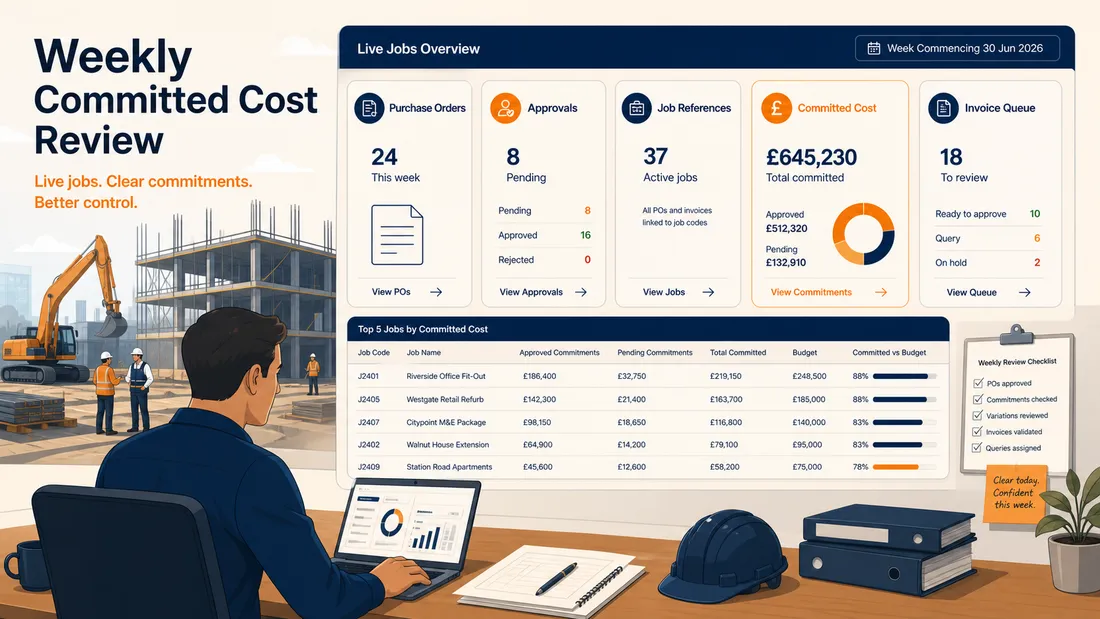
Why Fit-Out Teams Need Tight PO Discipline Before Approving Subcontractor Invoices
 BuilderDash3 Sept 2026 7 min read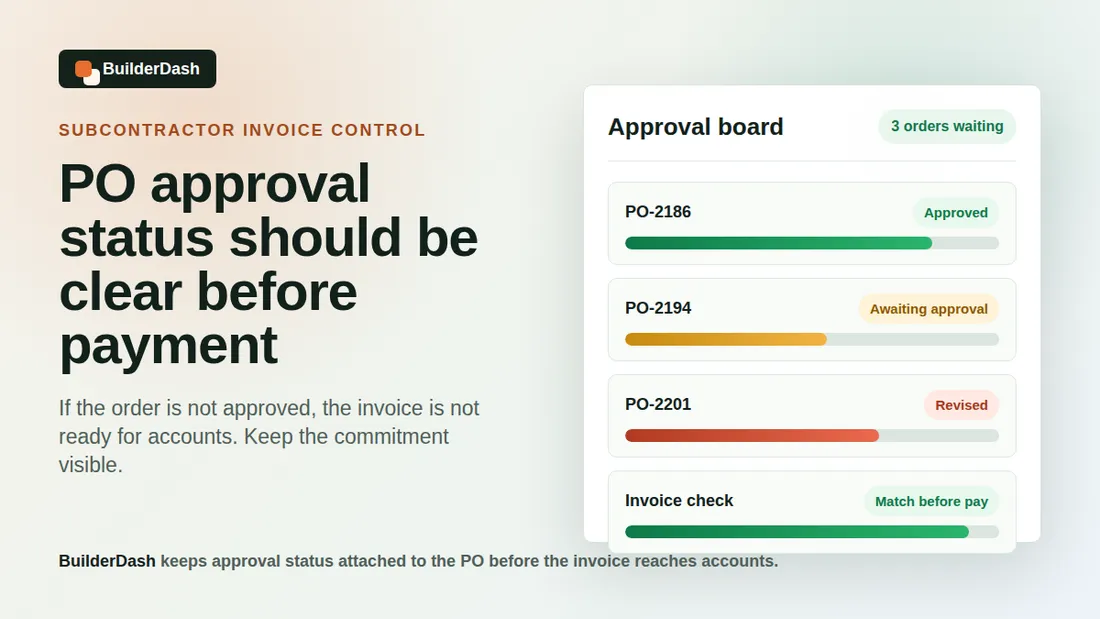
Why fit-out invoices are harder to approve cleanly
Fit-out and refurbishment jobs rarely stay still for long.
The original scope changes after strip-out, access shifts, a client adds an extra room, and a subcontractor may return with a revised claim that includes more than the first purchase order covered. By the time the invoice reaches accounts, the work may well be valid, but the paper trail is often out of step with what happened on site.
That is where approval goes wrong.
If the business treats the invoice as the main record and the purchase order as an optional extra, the team ends up approving spend from memory. That might feel quick, but it is a poor control for a live fit-out project where multiple trades, zones, and change requests all overlap.
The answer is not more bureaucracy. It is tighter purchase order discipline before the first invoice arrives.
What PO discipline actually means
A disciplined PO process does not mean every job must be painfully formal.
It means the business can answer a few simple questions before it approves a subcontractor invoice:
- What was the subcontractor asked to do?
- Which job, zone, or area does it belong to?
- Who approved the commitment?
- What value was authorised?
- What changes were agreed after the original order?
- Is the invoice asking for the same thing, or something different?
If those answers are unclear, approval becomes guesswork.
For fit-out and refurbishment contractors, that usually shows up in a few familiar ways:
- a ceiling package starts with one room and expands into three
- a drylining subcontractor invoices for additional works that were never revised on the PO
- dayworks are added without a clear instruction or sign-off
- snagging or aftercare appears on an invoice even though the original order was for completed install work only
When the purchase order trail is loose, accounts cannot tell whether the invoice is routine, revised, or simply wrong.
What a useful subcontract PO should say
A subcontract purchase order should do more than name the supplier and show a number.
At a minimum, it should make these details visible:
- the subcontractor name
- the job reference
- the area, zone, floor, or room where relevant
- the agreed scope
- any exclusions or assumptions
- the approved value
- the person who approved it
- whether retention, stage payments, or dayworks apply
That level of detail matters because many fit-out packages are not single-line jobs. They are often a series of smaller commitments that only make sense when the original scope and later changes are still attached to the same record.
If the invoice later lands without that context, the business has to reconstruct the story from emails and memories. That slows approval and increases the chance of paying something that should have been queried first.
How to handle invoices when the PO trail is weak
Sometimes the invoice arrives before the paperwork is tidy.
That does not automatically mean the work should not be paid. It does mean the invoice should not move into approval until the business has checked what was actually agreed.
Use a simple decision rule:
- if the work matches the original approved PO, approve it
- if the scope changed, attach the variation and revise the commitment first
- if the invoice includes extra work with no instruction, hold it and query it
- if the invoice is missing key evidence, keep it pending until the record is complete
That last point matters. A missing variation sheet is not the same as a pricing dispute. A missing approval is not the same as a job cost error. Those issues should be visible as different blockers, not all pushed into one generic "queried" bucket.
A cleaner approval flow for subcontractor invoices
A simple workflow is usually enough if it is followed consistently.
1. Raise the PO before the work starts
The order should exist before the subcontractor begins where possible. That gives the team a baseline for value, scope, and approval.
2. Record changes as they happen
Fit-out work changes quickly. If the scope expands, the original PO should not silently absorb the change. A variation or revised order should show what moved, why it moved, and who agreed it.
3. Check the invoice against the latest approved position
Accounts should compare the invoice with the latest agreed order, not the first version that happened to be saved.
4. Keep exceptions visible
If the invoice exceeds the approved value, includes a new area, or contains unapproved dayworks, that exception should be obvious. The approver should not have to infer it from the line items.
5. Only release it when the evidence is complete
If the invoice is ready, approve it. If it is not, keep it in a visible pending or query state with a named owner and a clear next step.
That keeps the workflow moving without losing control.
Why this matters so much on fit-out and refurbishment work
Fit-out and refurbishment projects are especially prone to invoice confusion because the job structure is fragmented.
One subcontractor may cover only a floor or a zone. Another may return for snagging. A third may add a small extra scope after a client walkaround. The team is often moving quickly to keep the programme on track, which means invoice control can end up lagging behind site activity.
That is where poor PO discipline hurts:
- accounts cannot match the invoice quickly
- commercial teams spend time decoding what was actually agreed
- site teams get pulled into avoidable queries
- directors become the fallback approver for routine checks
The business then pays in time, not just in money.
Good PO discipline avoids that by making the invoice approval step boring in the best possible way. The check should be routine, visible, and fast when the paperwork is right.
What accounts should be able to see at a glance
Before approving a subcontractor invoice, accounts should not need to search multiple inboxes.
They should be able to see:
- the approved purchase order
- the latest revised value, if any
- the job reference and relevant area
- the approval status
- any variation or daywork notes
- whether the invoice matches the agreed scope
If that information is scattered, the approval process becomes slow and inconsistent. If it is connected, the team can make a cleaner decision much sooner.
BuilderDash keeps the trail together
This is the point where BuilderDash is useful.
By keeping purchase orders, approval status, invoice checks, and supporting notes tied to the same job record, BuilderDash helps fit-out and refurbishment teams approve subcontractor invoices against the right version of the truth.
That means:
- the order is visible before the invoice lands
- changes are easier to trace
- exceptions stay attached to the job
- accounts can see what is approved, what is waiting, and what still needs evidence
The result is not just tidier admin. It is a cleaner route from commitment to approval to payment, with less chance of paying the wrong thing simply because the paperwork drifted.
A short checklist before approving the next subcontractor invoice
Before you approve the next subcontractor invoice, check:
- Is there a live PO or subcontract order?
- Does the invoice match the agreed scope?
- Has any variation been recorded and approved?
- Do the values still sit within the authorised amount?
- Is the invoice linked to the right job, zone, or package?
- Is there any missing evidence that should hold approval?
If the answer to any of those is no, the invoice is not ready yet.
That is not delay for the sake of it. It is the discipline that keeps fit-out spend controlled while the job is still moving.
Suggested internal links: PO approval status for subcontractor invoices, clean subcontractor invoice workflow, purchase order revision mid-job, and stop spend slipping through email approval chains.
Suggested call to action: Use BuilderDash to keep the subcontract order, approval status, variation trail, and invoice check tied to the same job so accounts can approve with confidence.
Run your projects properly with BuilderDash.
One system for every enquiry, job, quote and invoice - built for project-based trades, not reactive call-outs.