What to Do When an Approved Purchase Order Never Reaches the Supplier
 BuilderDash29 Jul 2026 5 min read
Why an approved PO can still fail
It is easy to treat approval as the end of the process. In a construction business, it often is not.
A director, project manager, QS, or commercial lead may approve a purchase order in the office, but if nobody actually sends the order to the supplier, the work can still drift. Site thinks the order is live. The supplier has not seen it. Accounts is expecting the paperwork to catch up later. Then the invoice arrives and everyone is working from a different version of events.
That gap is small, but it causes real problems:
- the supplier starts late because they never received the instruction
- the wrong item or rate gets supplied because the order was never confirmed
- site assumes the commitment is live when it is not
- accounts sees an invoice before the PO record is complete
- someone has to rebuild the story from email, messages, and memory
The fix is not to make approvals slower. It is to separate "approved" from "sent" so the business can see whether a commitment has actually left the office.
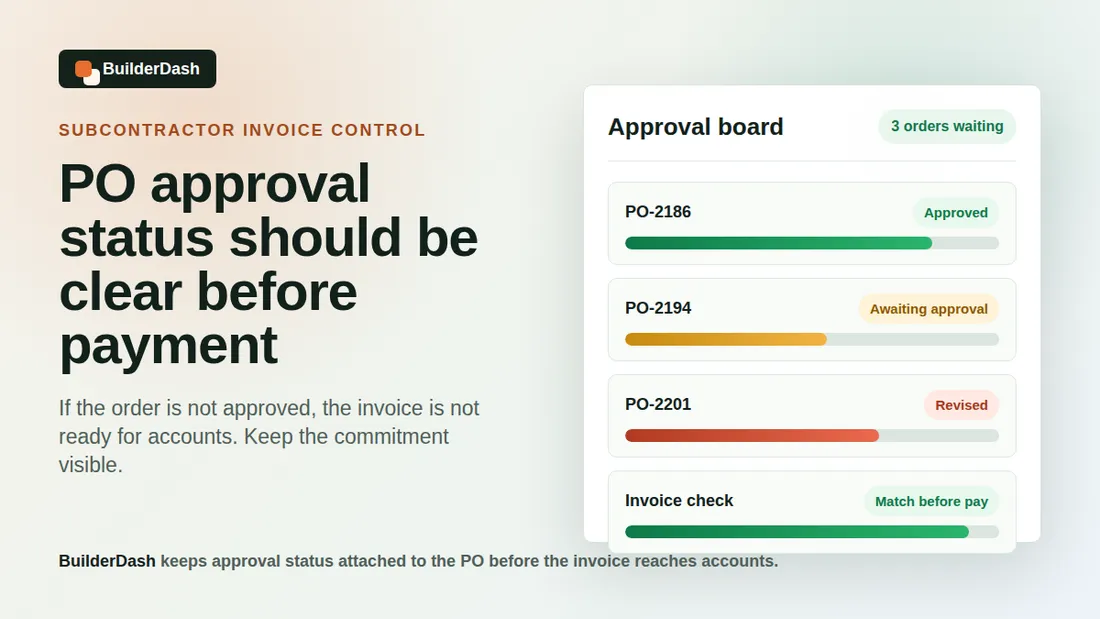
Track approval and dispatch separately
A PO that is approved but unsent is not the same as a PO that has been issued.
If the system only shows one status, the business loses a useful control point. A good workflow should make these states visible:
- draft
- awaiting approval
- approved
- sent to supplier
- acknowledged
- revised
Those states sound simple, but they solve a common construction problem. They let site, commercial, and accounts see whether the order is still waiting on an internal sign-off or whether the supplier has already received it.
That matters because a PO is not just a number. It is a commitment that needs to move from approval to issue before anyone can rely on it.
Check for supplier acknowledgement
Even if the order has been sent, it is still worth checking that the supplier saw it.
On busy jobs, orders can be sent to the wrong contact, lost in a cluttered inbox, or buried beneath earlier messages. If the supplier never acknowledges the order, the business may not know whether the materials, plant, or subcontracted work will arrive on time.
A useful issue check is straightforward:
- Confirm the PO was approved.
- Confirm it was sent to the right supplier contact.
- Confirm the supplier acknowledged receipt.
- Confirm the job reference and scope are correct.
- Confirm site knows the order is live.
If any of those steps are missing, the PO is not fully in circulation yet.
What happens when work starts before the order is issued
This is the point where the admin mistake becomes a commercial one.
If site tells a supplier to proceed before the PO is actually issued, the supplier may start work based on a verbal understanding. That can be workable for a day or two, but it creates risk if the invoice later comes back with a value, scope, or timing that the office never formally recorded.
The business should then ask:
- was the supplier told to proceed before the PO was sent?
- did the supplier rely on a call, message, or site conversation?
- is the approved value visible in the record now?
- does the invoice match the approved commitment or the informal conversation?
If the answer is not clear, the issue is not just a missing email. It is a missing control point.
Give accounts a clear rule for unsent orders
Accounts should not have to guess whether an approved PO has been issued.
If the invoice arrives and the PO has no sent status, the team needs a simple rule. For example:
- if the PO is approved but not sent, do not treat it as a live supplier commitment
- if the work has started anyway, log the exception and who authorised the start
- if the supplier is waiting, issue the PO immediately and note the delay
- if the invoice arrives before dispatch, query it rather than pretending the record was complete
That keeps the commercial story honest. It also stops accounts from posting costs against a record that only exists on paper inside the office.
Keep the send step visible in the job record
The send step is easy to overlook because it feels administrative.
In practice, it is one of the most useful details a team can record. Once the PO is issued, the business can see when the supplier was notified, who sent it, and whether the order was acknowledged. That is helpful when a job is delayed, when a delivery does not arrive, or when someone later asks why the supplier acted on a different assumption.
A practical PO record should show:
- the approved amount
- the date approval was given
- the date the PO was sent
- the recipient or supplier contact
- the acknowledgement status
- any revised values or follow-up notes
That makes it much easier to answer the question that matters later: was the supplier actually told to proceed?
How BuilderDash helps
BuilderDash is useful here because it lets the business keep the approval, issue status, job reference, and invoice check together in one workflow.
That means a PO is not just "approved" in someone’s head. The team can see whether it has been sent, whether the supplier is aware of it, and whether the invoice still matches the live record. For small and mid-sized contractors, that reduces the chance of informal approvals turning into messy month-end queries.
Bottom line
An approved PO that never reaches the supplier is not finished. It is a gap.
If the business separates approval from dispatch, checks for acknowledgement, and makes the send step visible to accounts, the control record becomes much more reliable. That protects job costing, avoids surprise invoices, and stops the office from assuming a commitment exists just because someone signed it off.
If your PO workflow still stops at approval, BuilderDash can help keep the issue, send, acknowledgement, and invoice check connected in one place.
Run your projects properly with BuilderDash.
One system for every enquiry, job, quote and invoice - built for project-based trades, not reactive call-outs.