Construction Industry Purchase Order Software: The Fields Every PO Should Capture
 BuilderDash10 Jul 2026 5 min read
Construction industry purchase order software only helps if it captures the right information on the first pass.
If the PO record is thin, the office ends up chasing context later. If it is complete, the same record can support approval, delivery, invoice matching, and job costing without anyone having to rebuild the story from messages or memory.
That is why the best PO software for contractors is not just a number generator. It is a control point.
Why the PO record matters
In construction, a purchase order is rarely just paperwork.
It is the point where a cost becomes real:
- a material order is placed
- a subcontractor is instructed
- a hire charge begins
- a variation is accepted
- a commitment enters the job
If the PO record is incomplete at that stage, the missing detail tends to reappear later as a payment query, a coding error, or an argument about whether the spend was ever approved.
That is why construction industry purchase order software needs to capture more than supplier name and value.
The fields every PO should have
At minimum, each PO should show:
- supplier or subcontractor name
- job, site, or project reference
- short scope description
- approved value or rate
- requested by
- approved by
- approval status
- date raised
- date approved
- links to related delivery notes, variation notes, or invoices
Those fields do a lot of work.
They tell accounts whether the cost is expected. They tell project managers whether the commitment is live. They tell directors what has actually been authorised.
Without them, the PO is just a placeholder.
Why generic PO tools fall short
Some systems are built around generic office purchasing. That can work for simple procurement, but construction adds detail that generic tools often ignore.
For example:
- a fit-out job may need room or zone references
- a refurbishment may need floor or package references
- a subcontract order may need scope exclusions
- a materials order may need delivery timing and site access notes
- a variation may need a clear link back to the original commitment
If the software cannot hold that information cleanly, the business will still end up storing it somewhere else.
And once the detail is split between systems, the PO stops being a reliable source of truth.
Approval status should be visible
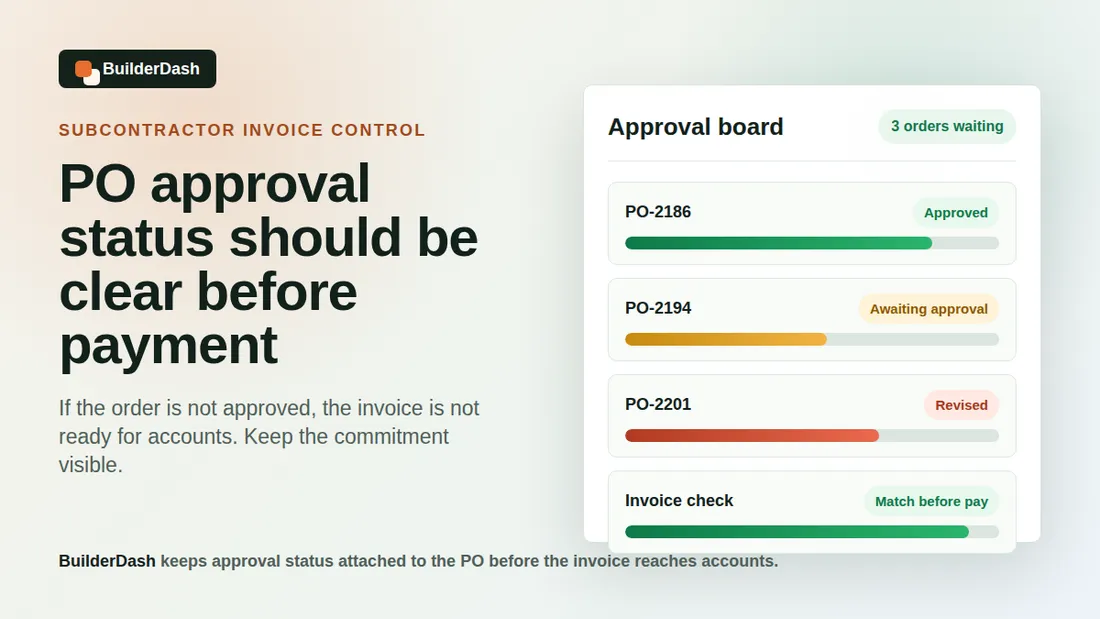
One of the most useful fields is the approval status.
A PO that has been requested is not the same as a PO that has been approved.
That sounds obvious, but many construction teams blur those states in practice. Someone messages a supplier to proceed. Someone else assumes it will be approved later. Accounts then sees an invoice and has to work backwards.
If the software shows clear statuses such as:
- Draft
- Awaiting approval
- Approved
- Rejected
- Revised
then the business can make a faster and safer payment decision.
Why dates matter
The date raised and date approved are not admin extras.
They show when the commitment became live, which matters if the team needs to understand:
- when a supplier was instructed
- whether spend was approved before delivery
- how long an order sat waiting for sign-off
- why an invoice arrived before the paperwork
That timeline is useful when directors are reviewing why a job drifted or why a payment run was delayed.
What accounts needs to see
Accounts do not need more detective work. They need a record that answers the obvious questions quickly.
Before paying an invoice, the team should be able to check:
- is the PO approved?
- does the invoice match the agreed value?
- is this a partial or final invoice?
- does the job reference match the job in the system?
- is the supporting evidence attached?
- has a variation changed the original value?
If those answers are hidden in email threads, the process slows down and errors creep in.
What happens when fields are missing
Missing fields cause real operational problems.
Common examples:
- no job reference, so the cost is coded to the wrong job
- no approval name, so no one is sure who authorised it
- no scope description, so the invoice cannot be checked against the original order
- no variation link, so the final value looks unexplained
- no delivery note, so the office cannot confirm what actually arrived
Every one of those issues creates extra work in accounts, and extra work usually means delay.
A simple standard helps the whole business
A good construction PO workflow is not complicated.
It is usually just consistent.
- Raise the PO with the right job reference.
- Record the supplier, scope, and value.
- Capture who requested and who approved it.
- Mark the approval status clearly.
- Attach evidence as the work progresses.
- Match the invoice back to the approved order before payment.
That standard gives the business something repeatable to work with.
How BuilderDash fits
BuilderDash helps keep the PO details, approval status, and invoice context together so the office does not have to reconstruct the record later.
That means the team can see what was ordered, who approved it, and which job it belongs to before the invoice reaches accounts.
The point is not to create more admin. The point is to make each PO useful after the day it was raised.
A quick checklist
If you are reviewing construction industry purchase order software, ask whether it can:
- keep job references attached from the start
- show approval status clearly
- support variations without losing the original order
- link supporting documents to the PO
- help accounts match invoices to the approved commitment
- give directors a live view of committed spend
If it cannot do those things, it may be a purchase order tool, but it is probably not giving you enough control.
The practical takeaway
The best construction industry purchase order software is not the one that creates the prettiest PO number.
It is the one that captures the right fields, keeps them visible, and makes the commitment traceable from site to accounts.
Suggested internal links
- /knowledge-base/software-to-manage-purchase-orders-construction-projects/
- /knowledge-base/po-approval-status-subcontractor-invoices/
- /knowledge-base/project-codes-site-references-job-costing-construction/
- /knowledge-base/construction-purchase-order-software-control-spend/
Suggested call to action
If your current PO process still leaves accounts guessing, use BuilderDash to keep the supplier, approval, job reference, and invoice in one record.
Run your projects properly with BuilderDash.
One system for every enquiry, job, quote and invoice - built for project-based trades, not reactive call-outs.