

Why PO revisions matter on live jobs
A purchase order is meant to describe what was agreed at the point the commitment was made. On a construction job, that commitment often changes. The scope grows, the supplier needs to substitute materials, access changes, or the site team discovers something that was not visible at order time.
That does not mean the original PO should disappear. It means the business needs a clear way to show what changed, who approved it, and how the revised value now affects job cost.
If the revision is handled badly, accounts gets a new number with no context. The supplier thinks the extra work is approved. The project manager remembers the discussion but not the exact wording. And the director ends up trying to reconstruct the story from email, WhatsApp, and a half-updated spreadsheet.
Keep the original commitment visible
The first rule is simple: do not overwrite the story.
When a PO changes, keep the original value and reference visible alongside the revision. That gives everyone a clean comparison:
- original approved amount
- revised amount
- reason for the change
- date the change was agreed
- who approved it
If the original order disappears, nobody can tell whether the new amount is a small correction or a major scope change. That matters for margin, audit trail, and supplier disputes.
Capture the reason for the change
A revised PO should answer one question clearly: why is the value different now?
Common reasons include:
- a quantity increase
- a material substitution
- a late design change
- access or phasing changes
- a client instruction that added work
- a correction to the original order
That reason should be written down in plain English, not buried in a vague subject line such as "updated PO". If the change is later challenged, the business needs a reason that still makes sense when someone opens the record weeks later.
Tie the revision to the right approval
Revisions are where approval discipline matters.
If the extra value is authorised by a project manager, director, or QS, the system should show that approval separately from the original order. Otherwise the office cannot tell whether the supplier has been told to proceed or whether someone only discussed the change informally.
A useful revision record should show:
- what changed
- whether the original commitment is still valid
- whether the extra value is approved
- whether any client variation or recharge is expected
- whether the supplier has received the updated order
That keeps the approval trail usable instead of turning it into a memory test.
Match later invoices to the revised order
The invoice check should always compare the invoice to the latest approved commitment, not just the first PO raised on the job.
That is important when:
- the supplier invoiced before the change was formally logged
- the invoice includes both the original value and the revised extra
- the invoice total now exceeds the original commitment
- the supplier issued a fresh invoice number instead of a credit note
Accounts should be able to see whether the invoice matches the original PO, the revised PO, or neither. If it matches neither, it should be queried before payment runs move on.
Avoid the spreadsheet patch-up
Many businesses handle this with a quick email chain and a spreadsheet note. That works until the job gets busier.
The spreadsheet version usually fails in the same places:
- the original amount gets overwritten
- the reason for the change is lost
- one person knows the supplier has the update, but nobody else does
- the invoice arrives against an old value
- month end becomes a hunt for missing context
By the time that happens, the cost is no longer just an admin problem. It is a job costing problem.
A simple mid-job PO revision workflow
If you want the process to stay manageable, keep it small and repeatable:
- Keep the original PO record.
- Create a revised version or change record.
- Write the reason for the change in one sentence.
- Record who approved it and when.
- Send the updated commitment to the supplier.
- Make sure accounts can see the latest approved value before posting any invoice.
That is enough to keep the commercial story together without adding unnecessary bureaucracy.
What this means for BuilderDash users
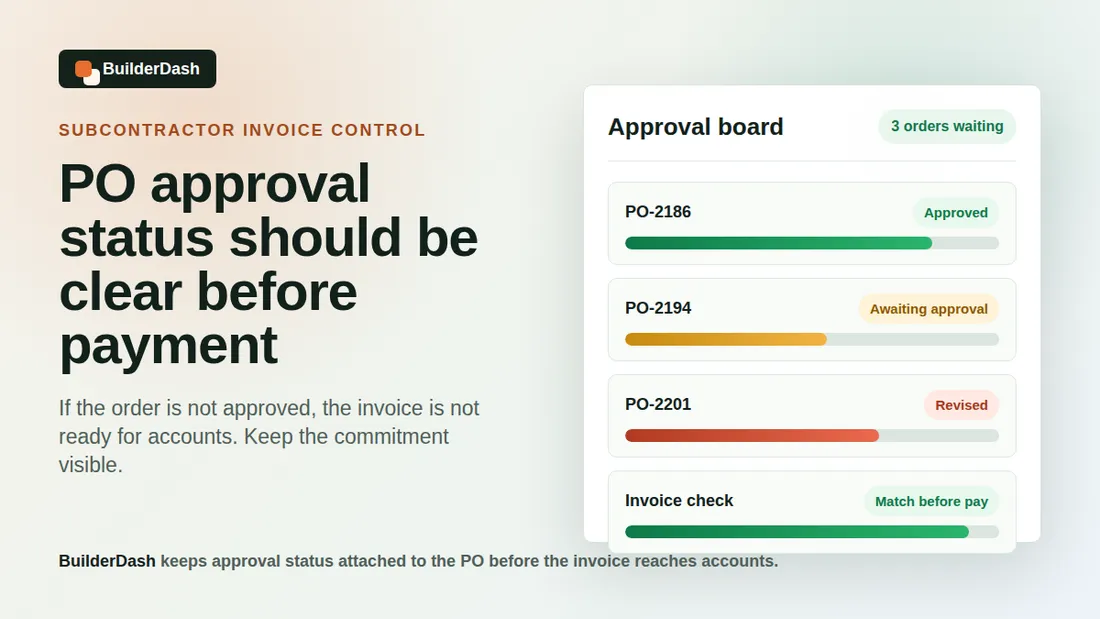
BuilderDash is useful here because it helps keep the purchase order, approval status, job reference, and later invoice check connected in one place. That makes it easier to see whether a revised commitment is genuinely approved or still waiting on sign-off.
For small and mid-sized contractors, the value is not just cleaner admin. It is fewer surprises at payment time and a better grip on what each live job really costs.
Bottom line
A revised PO is normal. A revised PO with no visible history is where problems start.
Keep the original value visible, log the reason for the change, record the approval, and make sure the invoice is checked against the latest commitment. If the business can do that consistently, PO changes stop becoming a month-end scramble.
If revised purchase orders are still being handled through emails and guesswork, BuilderDash can help keep the original commitment, the change record, and the invoice check in one workflow.
Run your projects properly with BuilderDash.
One system for every enquiry, job, quote and invoice - built for project-based trades, not reactive call-outs.