Software to Manage Purchase Orders for Construction Projects: What Actually Controls Spend
 BuilderDash10 Jul 2026 6 min read
An exact phrase like software to manage purchase orders for construction projects only matters if the software helps a contractor solve a real workflow problem.
For small and mid-sized builders, fit-out firms, and subcontractors, that problem is usually simple: spend gets committed on site before accounts can see it clearly. A PO is raised late, an approval happens in a message thread, or a supplier invoice arrives with no job reference and no obvious link back to the original order.
That is where good purchase order software earns its keep. It does not just create a number. It gives the business one visible place to record what was ordered, who approved it, which job it belongs to, and whether the invoice later matches what was agreed.
Why PO software matters in construction
Construction spend is messy because the work is moving while the paperwork is still catching up.
One job may include:
- materials from several merchants
- labour-only subcontractors
- plant hire
- skips and waste
- design changes and variations
- emergency buys that keep the job moving
Without a proper PO workflow, each of those costs can end up in a different inbox, chat thread, or notebook. By the time the invoice arrives, nobody is quite sure whether the spend was approved, partially approved, or only discussed.
That creates avoidable friction in accounts, and it makes job costing less reliable than it should be.
What the software actually needs to do
Not every purchase order tool is useful for construction. Some are built for generic office procurement and assume the user only needs a supplier name and a value.
A construction team needs more than that.
At minimum, the software should let you record:
- the supplier or subcontractor
- the job, site, or project reference
- the scope or description of the order
- the agreed value or rate
- who requested it
- who approved it
- the current approval status
- related invoice or delivery evidence
If those fields are present, the office can tell the difference between an order that is merely requested and one that is genuinely committed.
That distinction matters. A number on its own is not control. Visibility is control.
Where construction teams lose money
The largest losses rarely come from one dramatic mistake. They come from repeated small failures.
Common ones include:
- a site manager tells a supplier to proceed before the PO exists
- a director approves spend in WhatsApp and assumes it will be recorded later
- a subcontractor invoice lands without the original order attached
- a variation is agreed verbally but never linked back to the job
- partial invoices are paid without checking the remaining commitment
- the same cost is coded to the wrong job because nobody can find the original context
Each issue is manageable on its own. Together, they create margin drift.
That is why software to manage purchase orders for construction projects should be judged on workflow, not just interface. Can the team see approval status quickly? Can they tell which job the order belongs to? Can accounts match the invoice without chasing three people for context?
The approval step is the real control point
If the PO has not been approved, the cost should not be treated as committed.
That sounds obvious, but many construction businesses blur the line between:
- requested
- raised
- sent
- seen
- approved
- revised
Those states are not interchangeable.
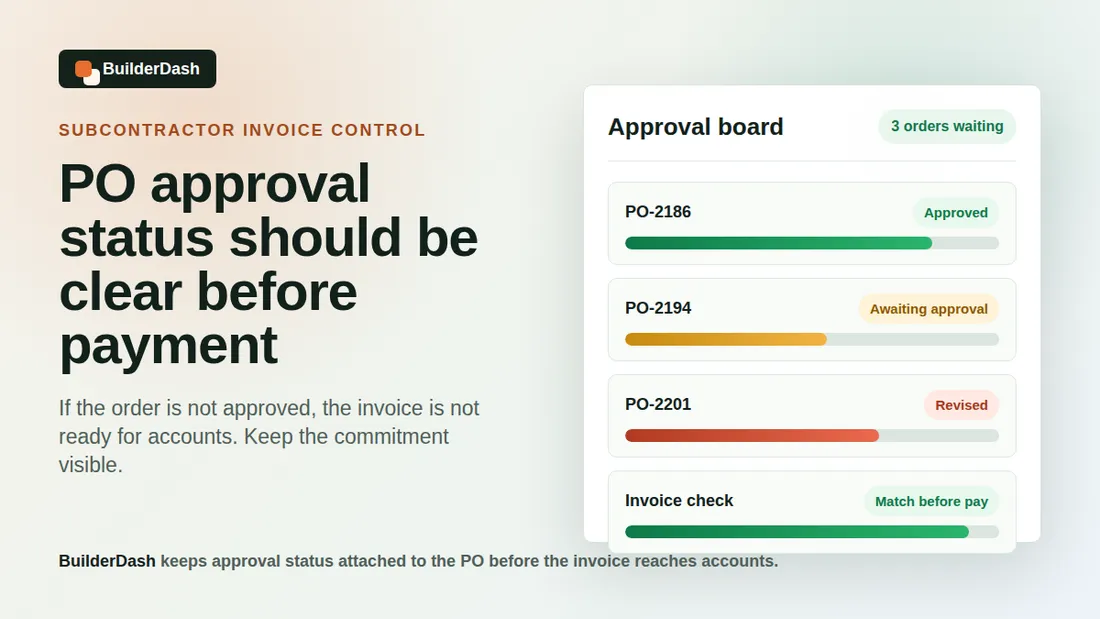
If the software makes the approval status visible, accounts can tell whether the invoice is ready to process or should be queried first. Project managers can see whether the commitment has actually been accepted. Directors can see what has been authorised without relying on memory.
This is especially important when a job is busy and several people are making decisions at once. The software should stop approval from becoming an informal habit.
Why job references need to be attached early
The best time to attach the job reference is when the PO is raised, not when the invoice lands.
If the job reference is missing until month end, someone has to rebuild the history from screenshots, emails, and conversation fragments. That is slow, and it is how costs get misposted.
For fit-out and refurbishment work, the reference may need to be even more specific. A room, zone, floor, or package reference can matter as much as the project name itself. The more precise the order record is from the start, the easier it is to match the invoice later.
That is one of the main reasons contractors look for software to manage purchase orders for construction projects instead of a generic purchasing tool. Construction needs context, not just a supplier list.
What accounts should be able to check
Before an invoice is paid, accounts should be able to see:
- whether the PO was approved
- whether the invoice matches the approved value
- whether there is a signed-off variation
- whether the invoice is partial or final
- whether the job reference is correct
- whether supporting evidence is attached
If any of those answers are unclear, the invoice should be queried rather than pushed through.
That does not slow the business down. It prevents bad spend from becoming a paid problem.
What a good workflow looks like
A simple and workable process usually looks like this:
- The site team identifies the need.
- The PO is raised with the correct job reference.
- The approver checks the value, scope, and exclusions.
- The PO is marked approved once the commitment is real.
- The supplier or subcontractor delivers the work or materials.
- The invoice is matched against the approved order.
- Any mismatch is queried before payment.
That sequence is boring in the best possible way. It gives the business a repeatable control process instead of a collection of exceptions.
How BuilderDash fits
BuilderDash is designed to keep purchase orders, approvals, invoices, and job references in one place so the team does not have to reconstruct the story later.
That means the office can see whether a cost is approved before it reaches accounts. Site teams can keep jobs moving without relying on scattered messages. Directors get a clearer picture of what has been committed across live work.
The point is not to add admin. The point is to reduce the number of times someone has to ask, “Who approved this?”
A practical checklist before you buy software
Before choosing software to manage purchase orders for construction projects, ask whether it can do these things:
- keep the job reference visible from the start
- show approval status clearly
- support variations without losing the original record
- help accounts match invoices to the approved order
- make partial billing easy to check
- give directors a live view of committed spend
If the answer is no, the tool may still issue POs, but it probably will not control spend.
The real takeaway
Construction businesses do not need more paperwork. They need a cleaner way to make sure a cost is approved, traceable, and tied to the right job before the invoice reaches accounts.
That is what software to manage purchase orders for construction projects should do.
Suggested internal links
- /knowledge-base/construction-purchase-order-software-control-spend/
- /knowledge-base/po-approval-status-subcontractor-invoices/
- /knowledge-base/project-codes-site-references-job-costing-construction/
- /knowledge-base/control-po-overspend-construction-variations/
Suggested call to action
If your current PO process still depends on messages, memory, and month-end chasing, use BuilderDash to keep approvals, job references, and invoices connected before spend becomes a surprise.
Run your projects properly with BuilderDash.
One system for every enquiry, job, quote and invoice - built for project-based trades, not reactive call-outs.