Why Consistent Project References Stop Construction Admin from Falling Apart
 BuilderDash17 Jul 2026 5 min read
One job can pick up three names before anyone notices.
The site team might call it by the client name, the office might use a project code, and a supplier might just refer to the delivery address or the package they were asked to price. None of those labels is wrong on its own, but once the paperwork starts moving, mismatched references make admin messy very quickly.
That is why consistent project references matter. They give everyone the same way to identify the job, so orders, approvals, invoices, and supporting documents all point to the same place.
Why project references drift so easily
Construction businesses rarely set out to be inconsistent. The drift usually happens because different people need different information at different times.
- Site teams want the fastest label they can use in a conversation.
- Commercial teams want a code that fits the job register.
- Suppliers want enough detail to deliver the right materials or start the right package.
- Accounts want a reference that makes invoice checking and posting straightforward.
If those labels are not aligned, the business spends time translating between them. That is where errors start.
What breaks when the same job has multiple names
The immediate problem is not just tidiness. It is control.
When the same job appears under different names, the office has to work harder to answer basic questions:
- Is this cost actually for the right project?
- Has the spend already been approved?
- Does the invoice match the original order?
- Is this a variation, a partial charge, or a fresh cost?
- Which folder, thread, or note has the supporting evidence?
If the answer is not obvious, the cost gets delayed, queried, or misposted. That is how a small reference problem turns into job costing noise.
Set one reference rule and keep it simple
You do not need a complicated naming convention. You need one that people will actually use.
A practical format usually includes:
- a unique project number
- the client or site name
- the area, package, floor, or zone if needed
- a variation suffix when the scope changes
For example:
BD-0247 | Riverside House | Level 02 | Joinery
If the job is a fit-out or refurbishment, the location detail may matter as much as the main project code. If it is a simpler job, the basic project number may be enough. The key point is consistency, not length.
Put the reference where the team already works
The reference only helps if it shows up in the places people actually use.
That means putting it on:
- purchase orders
- invoice notes
- approval requests
- email subject lines
- folder names
- delivery paperwork
- variation records
If the reference is visible in all of those places, nobody has to rebuild the story later.
Keep the original reference when the job changes
A job rarely stays exactly as it was first scoped.
The important thing is not to invent a new identity every time the work changes. Instead, keep the original reference visible and add a clear suffix or note for the change.
For example:
BD-0247 | Riverside House | Level 02 | JoineryBD-0247-V01 | Riverside House | Level 02 | Joinery variationBD-0247-V02 | Riverside House | Level 02 | Additional trim
That way the team can still trace the cost back to the original job while keeping the variation easy to spot.
What accounts should check before posting a cost
When an invoice arrives, accounts should be able to confirm the reference without digging through old messages.
The minimum checks are:
- does the job reference match the approved order or request?
- is the supplier using the same reference as the office?
- if the cost changed, is the variation recorded?
- if the invoice is partial, is that clear on the record?
- are the supporting documents attached or easy to find?
If any of those answers are unclear, the invoice should be queried before it reaches the ledger.
Why consistency matters even more on busy live jobs
The busier the programme, the more likely small reference errors are to spread.
One live job can have materials deliveries, subcontractor work, design changes, and site queries all happening at once. If each one is identified differently, the team ends up with a trail that is hard to follow and harder to trust.
Consistent project references do not remove the admin. They make the admin usable.
How BuilderDash helps keep references aligned
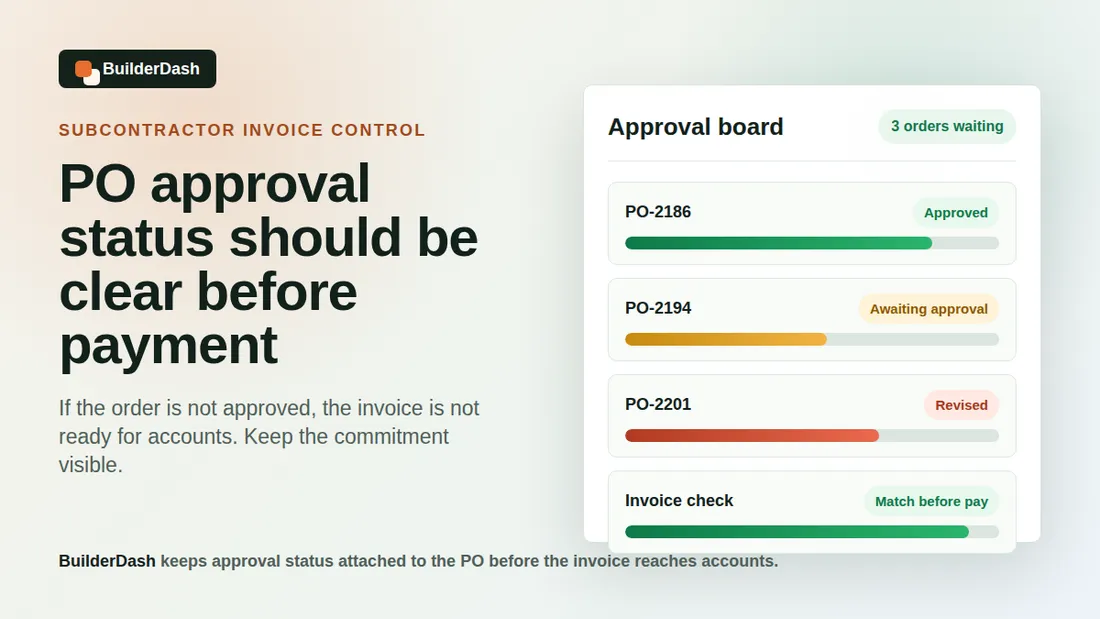
BuilderDash is designed to keep the job reference, approval, and cost record together in one place so the business does not have to stitch the history back together later.
That helps because the team can keep the same reference attached to the cost from the first request through to the final invoice check. It is easier for site teams, commercial managers, and accounts to work from the same record instead of three separate versions of the truth.
For construction businesses, that is the difference between chasing context and controlling it.
Suggested internal links
- Software to Manage Purchase Orders for Construction Projects: What Actually Controls Spend
- How to Build a Clean Approval Trail for Subcontractor Invoices
- Why Unapproved Variations Can Drain Cash Flow Before the Final Account
Practical takeaway
If the same job is called three different things, admin will eventually drift.
A simple reference rule, used consistently across site and office, keeps costs attached to the right job and makes every later check faster.
Call to action
If you want one place to keep project references, approvals, and job costs aligned, BuilderDash gives your team a cleaner way to record the job once and carry that reference through to the final invoice check.
Run your projects properly with BuilderDash.
One system for every enquiry, job, quote and invoice - built for project-based trades, not reactive call-outs.