
Supplier statements can be useful, but they can also become a blunt month-end pressure tool.
A supplier sends a statement. Accounts sees a balance. The supplier wants payment. The site team remembers some materials arriving, some credits being promised, and one invoice that may already have been queried.
If the business treats the statement as the source of truth, costs can slip onto the wrong job, disputed values can be paid too early, and duplicate invoices can make it into the payment run.
For construction businesses, the statement is only the starting point. The real control comes from checking each line against the purchase order, invoice, delivery evidence, job reference, and approval status.
Why statements cause problems in construction accounts
Supplier statements are usually organised around the supplier account, not the job.
That is the first problem.
A single materials supplier may be used across several live projects, call-outs, snagging visits, and small works jobs. The statement may show all unpaid invoices in one place, but it will not always explain which site each cost belongs to, whether the materials were ordered properly, or whether the invoice is already under query.
Common month-end problems include:
- invoices listed on the statement but missing from the accounts inbox
- invoices received twice under slightly different filenames
- credit notes promised but not yet issued
- materials charged to the wrong job or site reference
- split deliveries where only part of the order has arrived
- invoices included even though the PO was not approved
- old queried items being chased again without context
None of these are unusual. The issue is whether the team has a reliable way to spot them before the payment list is finalised.
Start by separating statement checking from payment approval
A statement should not automatically become a payment instruction.
The first step is to treat statement reconciliation as its own control point. The aim is to answer a few practical questions before anything moves towards payment:
- Do we have every invoice listed on the statement?
- Has each invoice been matched to the correct job or site?
- Is there an approved purchase order or other authorised commitment?
- Has the delivery, work, or service been checked?
- Are any lines duplicated, disputed, or awaiting credit?
- Is the balance ready for payment, or does it need a query first?
That keeps accounts from being pushed into paying a balance simply because it appears on a supplier statement.
Match each invoice to a job reference
The most important check is often the simplest: where does this cost belong?
Every statement line should be linked back to a job, project, site, or cost code. If the invoice cannot be tied to the right place, the business cannot rely on the job costing.
This matters on refurbishment and fit-out work because materials and subcontracted services often move quickly. A supplier invoice may look correct at account level, but one wrong job reference can distort margin on the project that actually carried the cost.
When a statement line has no clear job reference, it should be held for clarification rather than posted wherever the supplier account happens to sit.
Check the statement against purchase orders
The next question is whether the invoice was expected.
For each statement line, accounts should be able to see whether there is:
- an approved purchase order
- a revised PO covering any agreed change
- a clear authorised request if a formal PO was not raised
- a value that matches the commitment closely enough to approve
This is where a small contractor can lose control. If the PO is in one spreadsheet, the approval is in a WhatsApp thread, and the invoice is in an email inbox, statement checking becomes guesswork.
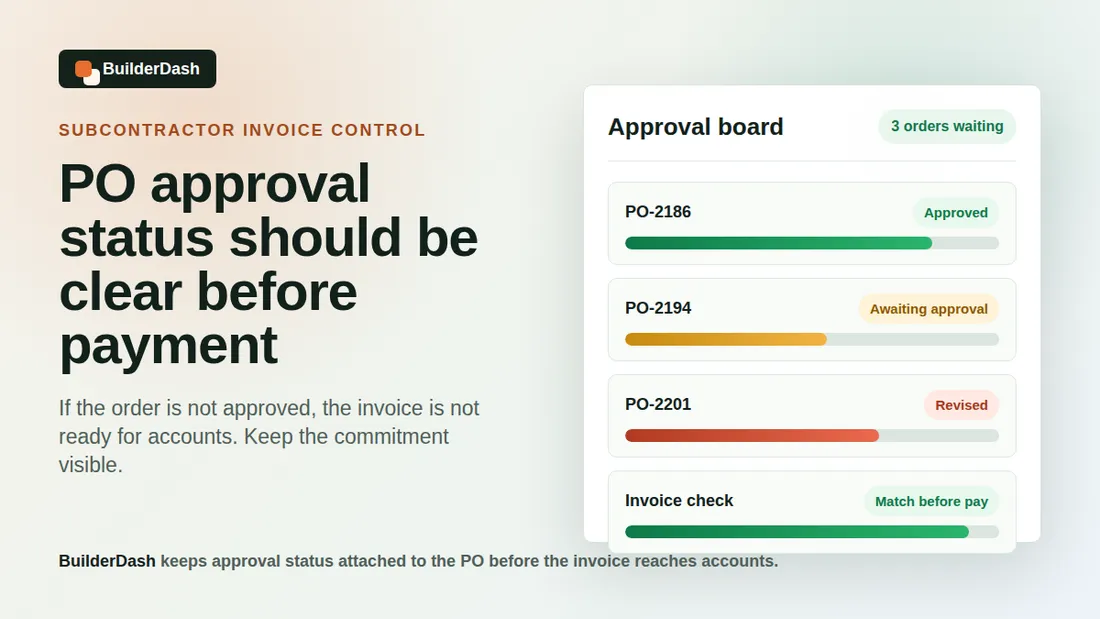
BuilderDash helps by keeping the order, approval, job reference, and invoice check closer together, so the statement can be tested against the actual buying trail.
Look for missing invoices before the payment run
Statements are useful for spotting invoices that have not reached the right person.
If a supplier statement includes an invoice that accounts has not seen, do not simply pay from the statement. Ask for the invoice and supporting detail first.
The invoice still needs the same checks:
- correct supplier
- correct invoice number
- correct VAT treatment where relevant
- correct job reference
- matching PO or authorised request
- delivery or completion evidence where needed
- no duplicate already logged elsewhere
Paying from a statement without the invoice may clear the supplier balance, but it weakens the audit trail and makes later cost checks harder.
Keep queried items visible
Disputed invoices are often where statement reconciliation falls apart.
A supplier may continue to show the full value on the statement even when part of the invoice is under query. If the accounts team cannot see the query history, the line can be paid just to get the statement cleared.
A better workflow records:
- the reason for the query
- who owns the next action
- the accepted value, if part of the invoice is not disputed
- the disputed value
- whether a credit note is expected
- when the supplier was last contacted
That keeps the cost visible without pretending the invoice is ready for payment.
Watch for credits and corrected invoices
Credit notes are easy to lose at month end because they often arrive after the original issue has been discussed.
When reconciling a supplier statement, check whether any line should have a credit note or corrected invoice attached. This is especially important when there have been shortages, damaged materials, returned goods, pricing errors, or duplicate charges.
If a credit note has been promised but not received, mark the statement line as unresolved. Do not let the original invoice move to payment unless the business has made a conscious decision to pay and recover later.
Use statement reconciliation to improve site discipline
Statement checking is not only an accounts task. It exposes where the buying workflow is weak.
If the same issues appear every month, the business should look upstream:
- Are site teams raising orders before materials are bought?
- Are job references being used consistently?
- Are approval limits clear?
- Are delivery notes being captured?
- Are invoice queries assigned to one owner?
- Are suppliers being asked to include PO numbers and site references?
The goal is not to make month end more complicated. The goal is to stop month end from becoming the first time anyone checks the buying trail.
How BuilderDash helps before month end
BuilderDash is useful when a construction business wants less separation between purchasing, approvals, job records, and invoice checks.
For supplier statement reconciliation, that means the team can work from a clearer view of:
- what was ordered
- who approved it
- which job or site it belongs to
- what has already been invoiced
- what is still under query
- what is ready for payment
That makes the supplier statement a cross-check, not the main source of truth.
A practical month-end rule
Use this rule before a supplier balance goes into the payment run:
If the statement line cannot be matched to an invoice, a job reference, an approved order or authorised request, and a clear query status, it is not ready to pay.
That one rule helps protect job costing, reduces duplicate payments, and gives accounts a cleaner basis for deciding what should be paid now and what needs follow-up.
Supplier statements should help the business close the month, not force it to guess.
Run your projects properly with BuilderDash.
One system for every enquiry, job, quote and invoice - built for project-based trades, not reactive call-outs.