Software to Manage Purchase Orders for Construction Projects: What It Should Do After the PO Is Raised
 BuilderDash14 Jul 2026 5 min read
If you are searching for software to manage purchase orders for construction projects, the real question is not whether the tool can issue a PO number.
The real question is whether it helps you control spend after the order has been raised.
That is where many construction businesses lose visibility. A site manager asks for materials, a director gives a quick approval, a supplier gets the go-ahead, and the paperwork catches up later. By the time the invoice reaches accounts, the team is trying to reconstruct what happened from messages, memory, and incomplete notes.
For BuilderDash, that is the problem worth solving. A PO system only matters if it keeps the approval trail, job reference, and invoice context visible while the job is still moving.
What contractors actually need from PO software
Construction is not a tidy procurement environment.
A single project may involve:
- materials from several merchants
- labour-only subcontractors
- plant hire
- waste removal
- variations
- partial deliveries and partial invoices
Each commitment needs to stay attached to the right job and the right approval. If the system cannot do that, the office still ends up chasing context later.
That is why software to manage purchase orders for construction projects should be judged on control, not on how quickly it creates a document.
The PO is not the finish line
A purchase order is only useful if it stays useful after it is raised.
At minimum, the record needs to show:
- who requested it
- who approved it
- which job or site it belongs to
- what was agreed
- whether the order changed later
- whether the invoice matches the original commitment
If those details are missing, the PO becomes a placeholder. That is how spending gets committed in practice without being controlled in the system.
Why approval status matters so much
One of the biggest failings in construction admin is treating “requested” and “approved” as the same thing.
They are not the same.
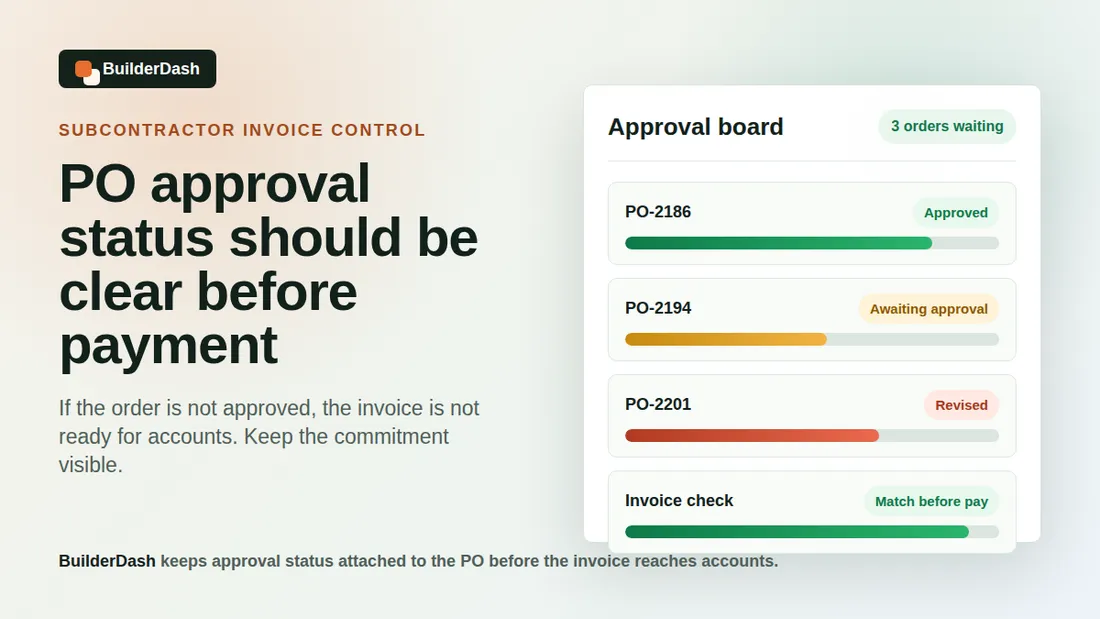
If approval is still pending, the cost should not be treated as a committed spend. If the approval already happened, accounts should be able to see it without asking three people to confirm the same thing again.
That is why a good PO workflow should make status obvious. When the status is clear, the office can decide quickly whether the invoice should be paid, queried, or held back for review.
Why job references need to be there from the start
The best time to attach the job reference is when the PO is created.
If that detail is added later, someone has to rebuild the history from chat messages, emails, and paper notes. That slows everything down and increases the chance of misposting.
For fit-out and refurbishment work, the reference often needs to be more specific than the project name. A floor, room, zone, package, or phase reference can make the difference between clean job costing and a messy month-end cleanup.
That is one reason contractors look for software to manage purchase orders for construction projects instead of a generic office purchasing tool. Construction needs context.
Where spend control usually breaks
Most overspend is not one huge disaster. It is a series of small gaps:
- the order is agreed in WhatsApp
- the PO is raised later
- the approval is assumed rather than recorded
- the supplier invoice arrives without the original order attached
- a variation is never linked back to the job
- partial invoices are paid without checking the remaining commitment
Each one is easy to excuse in isolation. Together, they weaken the job cost and leave accounts doing detective work.
BuilderDash is aimed at closing those gaps before they turn into a payment problem.
What accounts should be able to check quickly
Before an invoice is posted, the team should be able to confirm:
- is the PO approved?
- is the job reference correct?
- does the invoice match the agreed value?
- is this a partial or final invoice?
- has the scope changed?
- is supporting evidence attached?
If the answer to any of those questions is unclear, the invoice should be queried first.
That is not bureaucracy. It is basic financial control.
A practical workflow for construction teams
A simple, repeatable process usually works best:
- The site team identifies the need.
- The PO is raised with the correct job reference.
- The approver checks the scope and value.
- The PO is marked approved when the commitment is real.
- The work or materials are delivered.
- The invoice is matched back to the approved order.
- Any mismatch is queried before payment.
That process is boring in the right way. It gives the business a system instead of a collection of exceptions.
How BuilderDash helps
BuilderDash is designed to keep purchase orders, approvals, invoices, and job references in one place so the team does not have to rebuild the story later.
That means:
- site teams can keep work moving without relying on scattered messages
- accounts can see what was approved before the invoice arrives
- directors can see what has been committed across live jobs
The point is not to add admin. The point is to reduce the number of times someone has to ask, “Who approved this?”
What to look for before choosing software
If you are comparing software to manage purchase orders for construction projects, ask whether it can:
- keep the job reference visible from the start
- show approval status clearly
- support variations without losing the original record
- help accounts match invoices to the approved order
- make partial billing easy to check
- give directors a live view of committed spend
If the answer is no, it may still produce a PO, but it probably will not control spend.
The practical takeaway
The best PO software for construction is the one that keeps commitments traceable from site to accounts.
That is what software to manage purchase orders for construction projects should do: make the approval, the job reference, and the invoice line up before money leaves the business.
Related articles
Run your projects properly with BuilderDash.
One system for every enquiry, job, quote and invoice - built for project-based trades, not reactive call-outs.