How a Subcontractor Start Pack Keeps the First Day Under Control
 BuilderDash4 Aug 2026 5 min read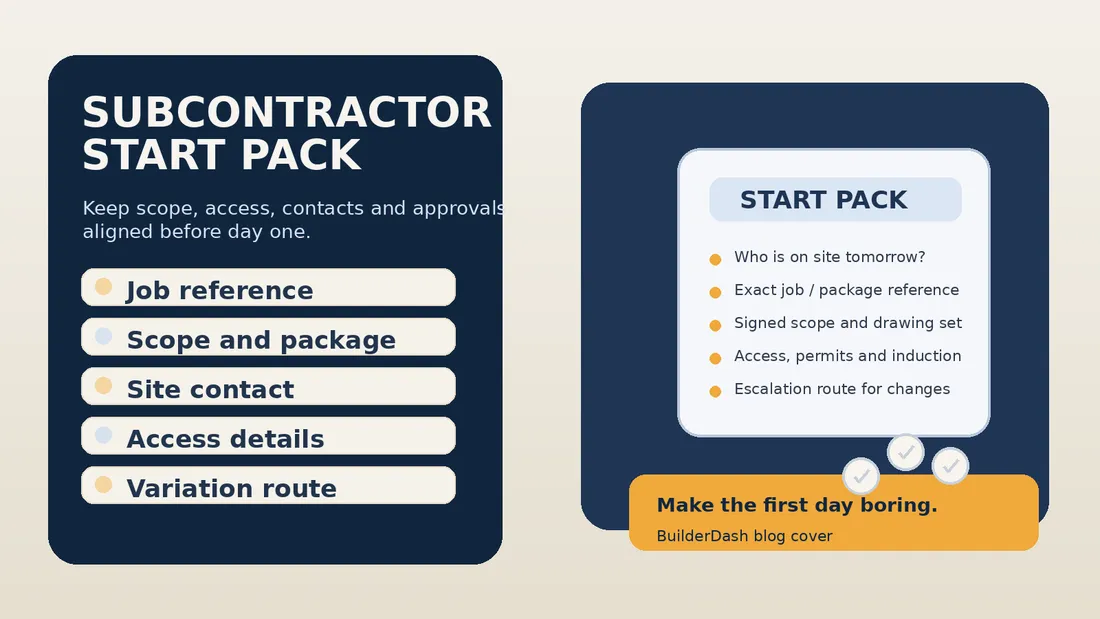
The first day on a subcontractor package usually exposes every gap in the handover.
Someone knows the scope. Someone else knows the access arrangements. The site team has a different contact name. Accounts may have the job number, but not the latest drawing or instruction. By the time the crew arrives, the business is already answering questions that should have been settled before anyone left the yard.
That is why a subcontractor start pack matters. It gives site, commercial, and accounts one agreed set of details before the work begins.
Why the first day goes wrong so often
Subcontractor work is usually organised quickly, which is useful right up until the paperwork starts drifting.
A start pack often fails for ordinary reasons:
- the job reference is not the same on every document
- the scope has been discussed, but not written down in one place
- access instructions live in a text message instead of the job record
- the site contact changed after the original request
- nobody has confirmed how a change or extra is supposed to be raised
None of those issues is dramatic on its own. Together, they create the kind of confusion that slows the job before the first tool is unpacked.
What a useful start pack should contain
A good start pack does not need to be long. It needs to be complete enough that the subcontractor can start without phoning around for basics.
At minimum, include:
- project and job reference
- package name and scope summary
- site address and access instructions
- start date and expected working hours
- site manager or supervisor contact
- commercial contact for queries
- drawing set or revision number
- any permits, inductions, or sign-in requirements
- variation route for anything outside scope
If the work is on a fit-out or refurbishment job, add the floor, room, zone, or area reference as well. That helps everyone point to the same place when the job is split across several spaces.
Keep scope and reference together
The biggest risk is not a missing phone number. It is a scope that cannot be matched back to the right job.
If the subcontractor is working from one description, the site team is using another, and the office has a third version in the job file, the business will spend time translating between them. That is how errors slip into the programme, the cost record, and the later invoice check.
A better rule is simple: if the scope changed, the reference should still be the same.
Use the original job reference and add a clear note for the package or variation. That makes it easier to trace the work later without inventing a new identity every time the job evolves.
Make access and induction part of the same record
Access issues can waste a morning before the subcontractor has even started.
If the crew needs a gate code, a parking instruction, a sign-in process, or a time-restricted induction, that information should sit in the same start pack as the scope. Otherwise, site has to field basic questions that could have been answered the day before.
This is especially useful on live refurbishment jobs where access changes as the programme moves. The right person on the right day matters just as much as the right material.
Give site one clear route for change
The moment a subcontractor starts asking, "Is this in scope?" the business needs a clear path for the answer.
That is not just an accounts issue. It is a project control issue.
If changes are handled ad hoc, the office ends up trying to work out whether something was instructed, priced, approved, or just mentioned in passing. A start pack should make the variation route obvious from day one.
The record should say:
- who can approve extra work
- how the change should be raised
- what evidence is needed
- whether the subcontractor should stop or continue while it is reviewed
That keeps the commercial team from being dragged into a story that was never captured properly at source.
Why the start pack helps job costing later
The start pack is not just an admin file. It shapes the quality of the cost record.
When the reference, scope, and approval details are clear up front, the later invoice or payment application is much easier to check. The office can see whether the cost belongs to the agreed package, whether a change was authorised, and whether the job is still aligned with the original commercial plan.
That matters because a weak handover tends to show up again later as:
- unclear invoice queries
- wrong job references
- disputed extra work
- time lost chasing missing context
- avoidable margin leakage
A simple start pack checklist
Before the subcontractor goes on site, check:
- The job reference is the same on the start pack, PO, and site record.
- The scope is written clearly enough to match the package.
- The correct site contact and commercial contact are listed.
- Access, induction, and working hours are confirmed.
- The drawing or revision reference is current.
- The variation route is clear if the work changes.
- Fit-out or refurbishment location references are included when needed.
If any of those points is missing, the pack is not really ready yet.
How BuilderDash helps
BuilderDash is useful here because it keeps the job reference, approval trail, and commercial context in one place instead of spreading them across email, chat, and memory.
That makes it easier to hand work over cleanly, keep subcontractors aligned, and stop the first day from turning into a long chain of avoidable clarifications. For UK contractors, that means less noise on site and a more reliable record back in the office.
Suggested internal links
- Why Consistent Project References Stop Construction Admin from Falling Apart
- Why Fit-Out Jobs Need Room and Zone References on Every PO
- What to Do When a Variation Instruction Is Not Logged Properly
- How to Build a Commercial Handover Sheet That Keeps Site and Accounts Aligned
Call to action
If subcontractor starts still rely on memory, WhatsApp threads, and verbal handover, move the important details into one start pack before day one. BuilderDash helps keep the scope, reference, and approval trail together so the job starts with control, not guesswork.
Run your projects properly with BuilderDash.
One system for every enquiry, job, quote and invoice - built for project-based trades, not reactive call-outs.