Construction Purchase Order Software: How Small Contractors Control Spend Before Invoices Arrive
 BuilderDash28 May 2026 7 min read
For many small construction businesses, the real cost problem does not start when an invoice lands in accounts. It starts earlier, when materials are ordered on site, a subcontractor is asked to do extra work, or a director approves a spend request in a WhatsApp thread and everyone assumes the paperwork will catch up later.
By the time the invoice arrives, the money has usually already been committed.
That is why construction purchase order software matters. It is not just a way to create tidy PO numbers. Used properly, it gives contractors a practical control point between site decisions and accounts payable. It helps answer a simple but important question: was this cost agreed, approved, linked to the right job, and expected before the invoice arrived?
Why purchase orders matter more in construction
Construction spend is awkward because it rarely sits neatly in one place. A single job might involve merchants, plant hire, specialist subcontractors, skips, labour-only teams, consumables, variations, and emergency purchases. Some costs are agreed in advance. Others happen quickly because the site needs to keep moving.
That is normal. The problem is when the business has no clear record of what was ordered, who approved it, and which job it belongs to.
Without a controlled PO process, accounts can end up receiving invoices with missing job references, unclear descriptions, no matching approval, or costs that the project manager was not expecting. That creates friction at the worst possible point: month end, supplier payment runs, and job costing reviews.
A good PO workflow moves the check earlier. Instead of asking “what is this invoice for?” after the fact, the business can ask “should this order be raised and approved?” before the cost becomes a surprise.
Where small contractors lose control
Most contractors do not lose control because people are careless. They lose control because the process is split across too many places.
A site manager messages a supplier. A subcontractor gets a verbal go-ahead. A director approves a cost while travelling between jobs. The invoice goes to accounts. The job reference is missing. Someone has to search emails, WhatsApp, photos, delivery notes, and memory to work out whether the invoice is right.
Common failure points include:
- Purchase orders raised after the invoice instead of before the order
- PO numbers shared in messages but not linked to the job record
- Materials ordered without a clear site or project reference
- Subcontractor invoices arriving without the agreed scope attached
- Directors approving spend informally, leaving accounts to chase context later
- Partial invoices being paid without checking what has already been billed
None of these issues need to be dramatic on their own. The damage comes from repetition. Small leaks in approval, coding, and invoice checking can make a job look fine during delivery but weaker once the final costs are pulled together.
What a clean construction PO workflow should include
For a UK contractor, a useful purchase order workflow does not need to be complicated. It needs to be consistent.
At minimum, each PO should show:
- The supplier or subcontractor
- The job, site, or project reference
- A clear description of what is being ordered
- The expected value or agreed rate
- The person requesting the spend
- The person approving it
- The approval status
- Any related invoice or delivery information
This gives accounts and project teams a shared record. When the invoice arrives, the business can check it against the original order rather than relying on memory.
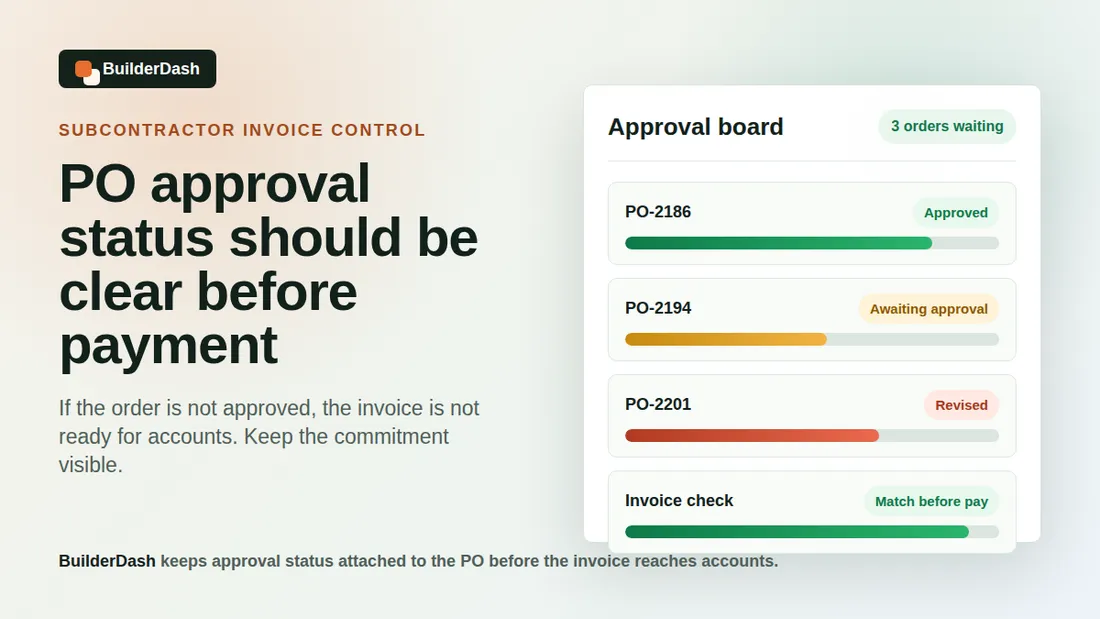
The important part is the approval status. A PO that has been requested is not the same as a PO that has been approved. A PO that has been approved for one amount is not the same as a subcontractor invoice for a higher amount. That distinction matters when margins are tight.
Why PO approval status helps accounts
Accounts teams should not have to become detectives every time a supplier invoice arrives.
If an invoice comes in with a matching approved PO, correct job reference, and expected value, it can move through the process faster. If it does not match, the issue is clear: missing approval, wrong job, unexpected amount, duplicate invoice, or partial billing that needs checking.
That does not mean every invoice becomes automatic. Construction still needs judgement. But the conversation becomes much sharper.
Instead of asking:
“Does anyone know what this is?”
The business can ask:
“This invoice is against PO 1048 for the Oak Road fit-out. It is higher than the approved value. Who needs to review it?”
That is a much better accounts workflow.
Purchase orders are part of job costing
Purchase orders are not only an accounts tool. They are also part of job costing.
If POs are connected to the right job from the start, directors and project managers can see committed costs earlier. They do not have to wait until invoices are processed to understand whether a job is drifting. That matters for small and mid-sized contractors because decisions often need to be made while the job is live, not after the month-end accounts are complete.
For example, if materials, plant, and subcontractor costs are all being committed against the same job reference, the business has a clearer view of expected spend. If those costs are scattered across emails and messages, job costing becomes a clean-up exercise instead of a control process.
How BuilderDash fits into this workflow
BuilderDash is built for the way UK trades, builders, fit-out contractors, and project teams actually work. The aim is not to add paperwork for the sake of it. The aim is to keep jobs, costs, invoices, and communication connected so the business can see what is happening before problems land in accounts.
For purchase orders, that means keeping the key information in one place:
- Which job the spend belongs to
- Who requested or approved it
- What the expected cost was
- Whether the invoice matches what was agreed
- What still needs review before payment
That gives contractors a better route from site activity to accounts control. Site teams can keep work moving, while directors and accounts have a clearer record of what has been committed.
A simple checklist before automating POs
Before choosing or rolling out construction purchase order software, a contractor should standardise a few basics:
- Every order needs a job or site reference
- Every PO needs an approval status
- Supplier and subcontractor invoices should quote the PO where possible
- Partial invoices should be checked against what has already been billed
- Accounts should know who owns the approval if something does not match
- Directors should avoid approving spend only in private messages
Software helps when the process is clear. It cannot fix a process where nobody knows who is allowed to approve what.
The real win: fewer surprises
The point of construction purchase order software is not to make the business look more corporate. It is to reduce surprises.
Fewer surprise invoices. Fewer missing job references. Fewer payment delays caused by unclear approvals. Fewer month-end arguments about whether a cost belonged to one job or another.
For small contractors, that is where better spend control starts. Not when the invoice arrives, but when the order is first raised, linked to the job, and approved properly.
BuilderDash helps contractors bring that workflow into one place, so purchase orders, approvals, invoices, and job costing are easier to manage before costs become harder to control.
Run your projects properly with BuilderDash.
One system for every enquiry, job, quote and invoice - built for project-based trades, not reactive call-outs.