How to Reduce End-of-Month Invoice Chasing in Construction
 BuilderDash28 May 2026 6 min read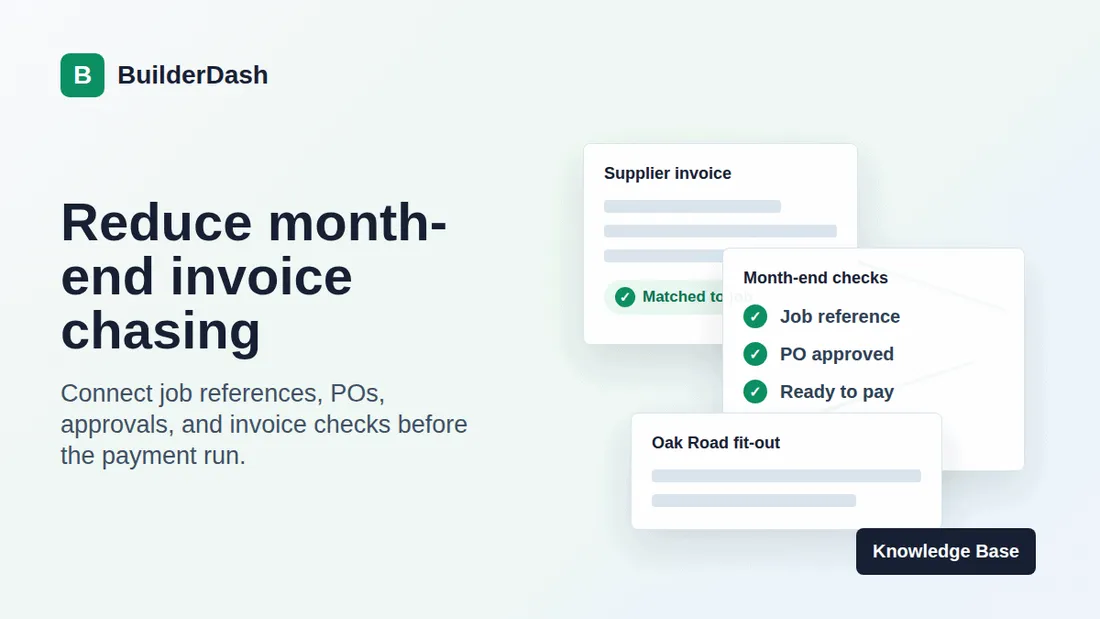
For many construction businesses, month end becomes a scramble. Supplier invoices arrive in different inboxes. Subcontractor invoices need checking. Job references are missing. Purchase orders do not always match. Someone in accounts has to ask site managers, directors, and project teams what each invoice relates to before the payment run can move forward.
That chasing is frustrating, but it is rarely just an accounts problem.
Most month-end invoice chasing starts earlier in the workflow. It starts when orders are raised without clear job references, when approvals happen informally, when subcontractor scope changes are not recorded, or when invoices arrive without enough context to check them quickly.
Reducing invoice chasing means moving more of that context upstream.
Why month end becomes messy
Construction costs do not arrive neatly. A contractor might receive invoices from merchants, plant hire companies, waste providers, labour-only subcontractors, specialist trades, and small suppliers all in the same week. Some invoices relate to one job. Others cover multiple sites. Some are part invoices. Some refer to work that was approved verbally because the job needed to keep moving.
That is normal in construction. The problem is when the business has no consistent way to connect the invoice back to the original job, purchase order, approval, or site instruction.
Accounts then has to chase answers such as:
- Which job does this invoice belong to?
- Was this cost approved?
- Is there a purchase order?
- Has part of this already been invoiced?
- Is the amount correct?
- Who needs to sign this off?
Every unanswered question slows down payment processing and makes job costing weaker.
The real cost of invoice chasing
Invoice chasing does not only waste admin time. It also delays decisions.
If invoices cannot be coded properly, job costing becomes less reliable. If costs are not checked against purchase orders or agreed subcontractor scope, margin issues can be missed until later. If directors are pulled into every unclear invoice, they become the bottleneck for routine accounts work.
The business ends up spending time reconstructing what happened instead of controlling what happens next.
For small and mid-sized contractors, that matters. Cash flow depends on knowing what has been committed, what has been invoiced, what is ready to pay, and what still needs review. Month end should be a review point, not a detective exercise.
Start with cleaner job references
The simplest improvement is often the most basic: every order and invoice needs a clear job, site, or project reference.
That reference should be used consistently across purchase orders, supplier invoices, subcontractor invoices, delivery notes, and internal approvals. If different people use different names for the same job, accounts will still have to chase.
For example, a fit-out job might be referred to as:
- Oak Road
- Oak Road Fit-Out
- Unit 4 Oak Road
- OR-24
- The cafe job
Those might all mean the same project to the site team, but accounts needs one standard reference. Without it, costs can be coded incorrectly or left waiting for clarification.
Get approval status clear before the invoice arrives
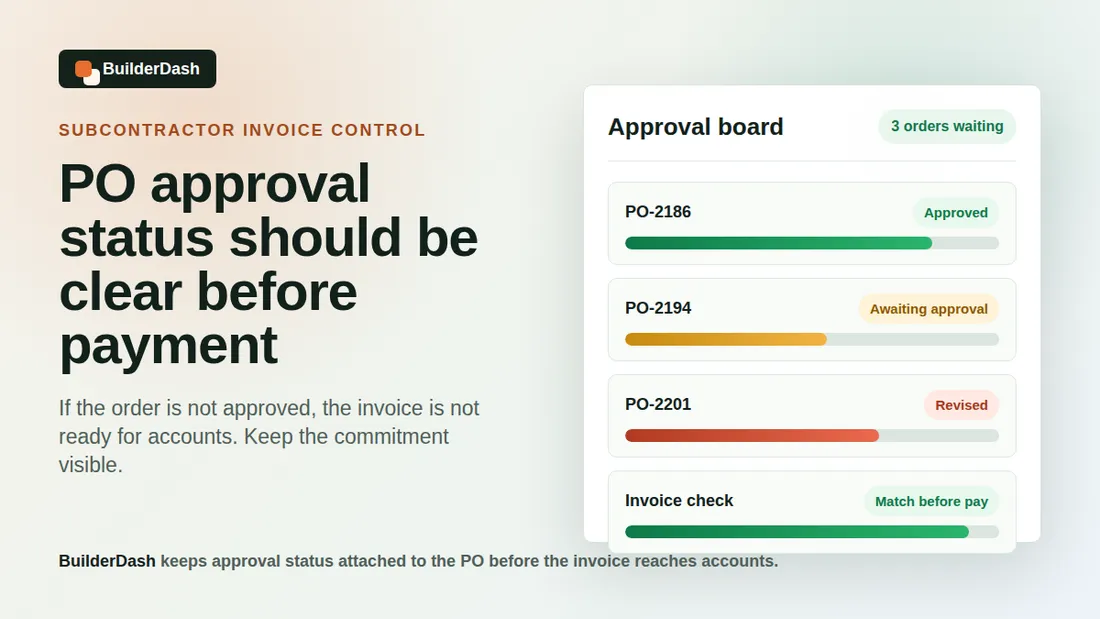
A common cause of month-end chasing is unclear approval status.
An invoice might relate to real work, but that does not mean it is ready to pay. Accounts still needs to know whether the cost was requested, approved, changed, completed, or queried. That is especially important for subcontractor invoices, where part billing and variations can create confusion.
A cleaner process separates:
- Requested costs
- Approved purchase orders
- Completed work
- Received invoices
- Queried invoices
- Approved-for-payment invoices
Those stages do not need to be overcomplicated. They just need to be visible. If accounts can see that an invoice is linked to an approved PO and the right job, the conversation is much shorter.
Match invoices against what was expected
The best time to control an invoice is before it becomes a payment problem.
When invoices arrive, they should be checked against the information already held in the business:
- Supplier or subcontractor name
- Job reference
- Purchase order number
- Approved value
- Description of the work or materials
- Delivery or completion evidence where relevant
- Any previous part invoices
If the invoice matches, it can move forward. If it does not, the reason should be clear. That might be a missing PO, wrong job reference, higher value, duplicate invoice, or work that needs project manager approval.
This is where connected records matter. If purchase orders sit in one place, invoice emails in another, and approvals in WhatsApp, the check becomes manual every time.
Reduce director bottlenecks
In many small construction businesses, directors end up being the final memory bank for accounts. They know who approved the work, what the supplier was asked to provide, and whether the invoice looks right.
That might work when the business is small, but it does not scale. It also pulls directors into low-value chasing when they should be focused on cash flow, delivery, customers, and future work.
A better workflow gives directors visibility without making them the only route through the process. They should be able to review exceptions, not answer every basic question from scratch.
How BuilderDash helps
BuilderDash helps by keeping job information, purchase orders, approvals, and invoice checks closer together.
For contractors, that means fewer loose ends at month end:
- Job references are easier to keep consistent
- Purchase orders can be linked to the right project
- Approval status is clearer before invoices arrive
- Invoice checks can use the context already captured
- Accounts and project teams work from the same record
The point is not to make accounts more complicated. It is to stop the same questions being asked again and again at the worst point in the month.
A practical month-end checklist
Before the next payment run, contractors can reduce chasing by checking a few basics:
- Are all supplier invoices linked to a job or site reference?
- Are subcontractor invoices matched to agreed scope or a purchase order?
- Are partial invoices clearly marked?
- Are queried invoices separated from approved-for-payment invoices?
- Are directors only reviewing exceptions?
- Are job costing records updated before the month is closed?
If those answers are hard to find, the process needs tightening.
Month end should confirm, not reconstruct
Good invoice control does not remove the need for judgement. Construction will always have changes, urgent purchases, and site decisions that need context.
But month end should confirm what the business already knows. It should not force accounts to rebuild the story behind every cost.
When job references, purchase orders, approvals, and invoice checks are connected earlier, month-end chasing drops. Accounts can process invoices with more confidence, project teams get cleaner job costing, and directors spend less time answering the same questions.
That is the practical value of a better construction invoice workflow: fewer loose ends, clearer approvals, and less pressure when the payment run is due.
Run your projects properly with BuilderDash.
One system for every enquiry, job, quote and invoice - built for project-based trades, not reactive call-outs.