
Why invoice queries get stuck
An invoice query rarely stalls because the team cannot see the problem.
It stalls because nobody can see who is meant to move it forward. One person notices the missing PO number, another asks the supplier for a corrected invoice, and a third assumes the commercial lead has already replied. The query is technically open, but practically ownerless.
That is where small delays turn into month-end noise. A shared inbox can collect messages, but it cannot tell the business who is accountable for the next step, when a reply is due, or whether the item should be queried, approved, or parked.
For UK contractors, that is a problem because the same query often touches several parts of the business at once:
- accounts need a clean answer before posting
- site needs to confirm what was actually supplied or instructed
- commercial teams need to protect the job margin
- suppliers need a clear response instead of a half-read thread
If the query does not have a named owner, all of those people end up waiting on each other.
What a named owner actually does
A named owner is not just the person who saw the email first.
They are the person responsible for driving the query to one of three outcomes:
- resolve it and let the invoice move forward
- park it with a clear reason and a visible review date
- escalate it if the issue affects scope, value, or payment timing
That sounds simple, but it changes the behaviour of the whole workflow. Instead of asking, "Has anyone looked at this?", the team can ask, "Who owns it, and what is the next action?"
That one change reduces duplicate chasing immediately. It also makes it much easier to explain why a cost was delayed, queried, or accepted.
The five fields every query should carry
A query needs enough information to be useful later, not just enough detail to start a conversation.
At minimum, the record should show:
- supplier or subcontractor
- job reference
- issue type
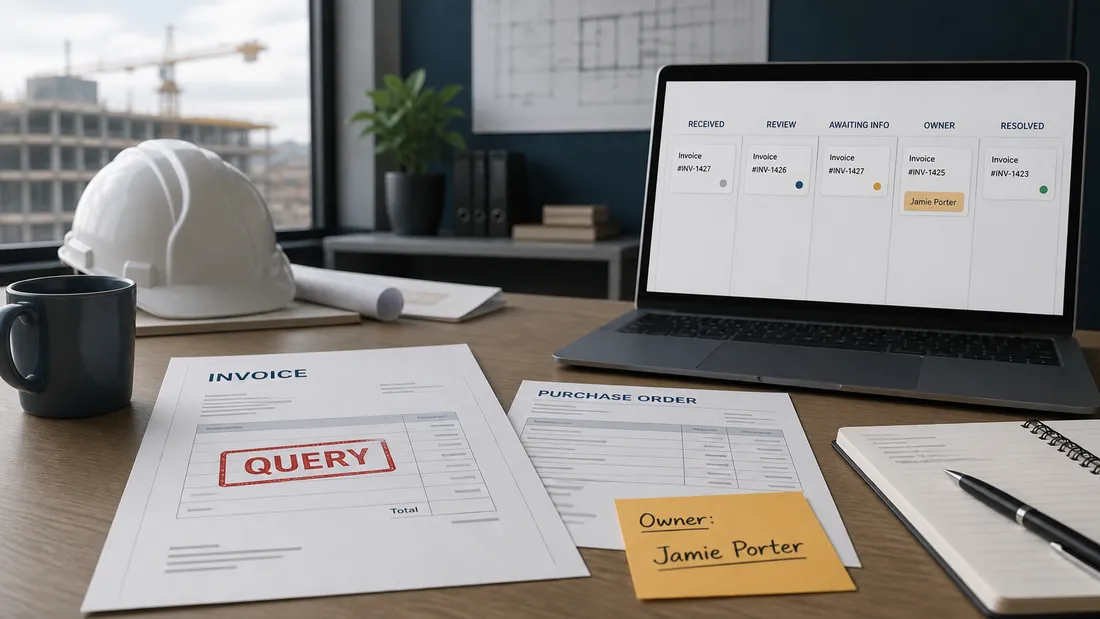
- named owner
- due date or next review date
If those five fields are visible, the business can understand the query without digging through inbox history.
You can add more detail when needed, such as:
- invoice number
- PO number
- agreed value
- disputed value
- supporting evidence
- current status
But the basic rule is simple: if the query cannot be summarised in one line, it is not yet ready to manage properly.
Common query types that need ownership
Most construction invoice queries fall into a few familiar buckets.
Missing PO or job reference
The invoice may be valid, but accounts still need to know which job to post it to and whether the commitment was approved.
Value mismatch
The invoice total may differ from the approved order, agreed rate, or partial claim value. Someone needs to decide whether it is a real error, a revised commitment, or a query that needs more evidence.
Missing backup
Delivery notes, timesheets, instructed variation records, and stage evidence often arrive later than the invoice. The owner needs to chase the missing support and keep the query visible until it arrives.
Partial or staged billing
Partial claims can be perfectly legitimate, but only if the remaining balance, previous claims, and approved scope are clear. If that context is missing, the invoice can be accurate and still not ready.
Disputed work
Sometimes the issue is not the maths. It is the scope. If the work was not instructed, not completed, or not accepted in the expected form, the query needs a clear owner who can coordinate the answer.
One owner, one deadline, one next action
The biggest improvement usually comes from a simple rule: every query must have one owner, one deadline, and one next action.
That does not mean every issue is solved instantly. It means the team knows what happens next.
For example:
- owner: commercial manager
- next action: confirm whether the variation was instructed
- deadline: Wednesday 3pm
- status: pending supplier evidence
That is much stronger than a thread that says "can you check this?" and then disappears for four days.
If the answer is waiting on someone else, name that person too. A good query record can show the internal owner while still noting who is holding the external response.
Why this helps accounts, not just site
Invoice queries often get treated as an accounts problem because accounts are the people who see the bill first.
In reality, the cleanest answer often lives somewhere else:
- site knows whether the work was actually received
- commercial knows whether the value matches the commitment
- project management knows whether scope changed
- directors know whether the cost needs escalation
When the query carries a named owner, accounts do not need to become detectives. They can see who is handling it and whether the invoice is ready to post, needs a response, or should stay parked.
That makes month-end easier, but it also makes the day-to-day workflow calmer. Fewer people get pulled into the same question twice.
A simple query workflow for construction teams
If you want a practical structure, use the same route every time:
- Log the query as soon as the issue is spotted.
- Assign one owner before anyone starts chasing.
- Record the reason it is blocked or questioned.
- Add the next action and due date.
- Close it only when the invoice can move forward or the cost is formally parked.
That routine is boring in the best way. It stops query handling from depending on memory, inbox searches, or who happens to be in the office that day.
What good looks like in practice
A well-run invoice query should be easy to explain in under a minute.
Someone should be able to answer:
- what is wrong
- who owns it
- what is needed next
- when it will be reviewed
- whether it affects posting or payment
If they cannot answer those questions quickly, the query is not under control yet.
The goal is not to eliminate all queries. Construction work is messy, and invoices will always need checking. The goal is to stop the query from becoming a mystery.
Suggested internal links
- How to Reduce End-of-Month Invoice Chasing in Construction
- How to Stop Spend Slipping Through Email Approval Chains on Construction Jobs
- How to Build a Weekly Job Commercial Snapshot for Small Construction Firms
- Why Construction Accounts Need a Single Exception Register
Call to action
If invoice queries are still living in shared inboxes, give each one a named owner before it disappears into a thread. BuilderDash helps you keep the issue, the next action, and the deadline in one live record so accounts can move faster without losing control.
Run your projects properly with BuilderDash.
One system for every enquiry, job, quote and invoice - built for project-based trades, not reactive call-outs.