The Construction Month-End Close Checklist for Small Contractors
 BuilderDash10 Aug 2026 3 min read
A month-end close in construction should tell you one thing: what is still open, what is safe to post, and what needs a decision before the numbers land in accounts.
When that is not clear, teams start leaning on inboxes, memory, and last-minute phone calls. That is how supplier invoices get parked, subcontractor claims arrive after the payment run, and job costs drift away from the live position.
A simple month-end close checklist gives you the same view every time.
Freeze the jobs you are closing
Pick the reporting cut-off and stick to it. List the jobs that are in scope, the cost codes that matter, and the people who can approve changes.
For each live job, ask:
- What has been ordered?
- What has been delivered?
- What has been invoiced?
- What has been approved but not yet posted?
- What is still awaiting a project manager, site lead, or QS decision?
If you cannot answer those questions quickly, the close will be messy.
Match POs to the real job cost
Purchase orders are only useful if they still reflect what was actually agreed on site.
At month end, check:
- PO value vs committed spend
- variations raised after the PO
- split invoices against one order
- invoices without a PO number
- work approved informally but not yet recorded
This is where small overspends hide. If the PO says one thing and the site reality says another, fix the record before the numbers go to accounts.
Clear subcontractor claims before they become a backlog
Subcontractor applications and partial invoices can sit in limbo for days if nobody knows who owns the next step.
For each claim, confirm:
- the claimed value
- the certified or approved value
- any retention held back
- any dispute or query
- whether the payment run can include it
If you are still chasing the paperwork at the point of the payment run, the close is already late.
Reconcile supplier statements and missing invoices
Statements are useful because they reveal what your inbox does not.
Use them to spot:
- invoices that were never received
- duplicate invoices
- credit notes that have not been posted
- delivery notes with no matching invoice
- lines that look wrong on quantity or rate
This is the fastest way to stop month-end surprises turning into next-month reversals.
Review committed cost, not just posted cost
Posted cost is backward-looking. Committed cost tells you what the job is already on the hook for.
A proper close should surface:
- open POs
- approved variations not yet invoiced
- subcontractor work in progress
- materials delivered but not billed
- plant hire still running
If committed cost is missing, margin looks better than it really is.
Check retentions and release dates
Retentions are easy to forget because they do not feel urgent until cash is tight.
At month end, make sure you know:
- what retention is held
- when it is due
- whether the release date depends on practical completion, defects, or a later milestone
- whether the record matches the contract
This matters for cash flow and for avoiding awkward calls later.
Decide what gets posted now and what stays open
The close should end with clear decisions, not more loose notes.
Each exception should fall into one of three buckets:
- post now
- query and hold
- carry forward with an owner and deadline
That is the difference between a close checklist and another inbox.
How BuilderDash helps
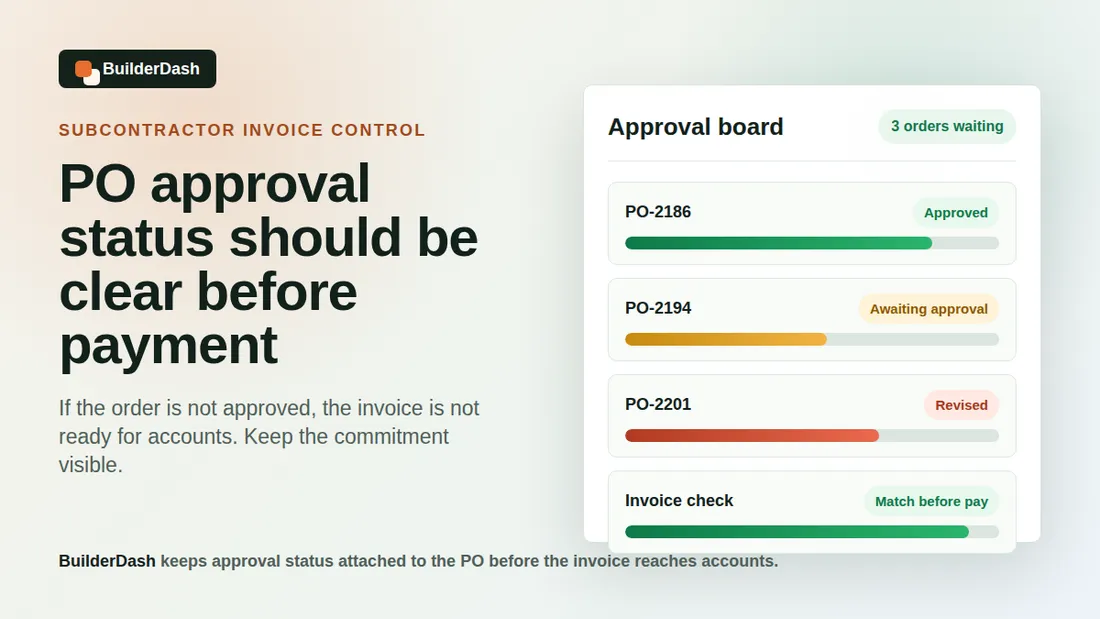
BuilderDash keeps purchase orders, approvals, invoices, subcontractor applications, and job references in one place, so month-end does not depend on someone remembering where the latest version lived.
Instead of rebuilding the story from email threads, the team can see:
- what has been committed
- what has been approved
- what still needs a decision
- what should move into accounts
Suggested internal links
- What to Do When an Invoice Arrives Without a PO Number
- How to Reduce End-of-Month Invoice Chasing in Construction
- How to Make Payment Runs Ready on Time
- How to Reconcile Supplier Statements at Month End
- How to Track Retention Release Dates
Call to action
If month end still depends on inbox triage, a shared spreadsheet, and memory, tighten the close now. BuilderDash gives your team one place to see the live job position before the numbers are locked in.
Run your projects properly with BuilderDash.
One system for every enquiry, job, quote and invoice - built for project-based trades, not reactive call-outs.