How to Stop Spend Slipping Through Email Approval Chains on Construction Jobs
 BuilderDash26 Aug 2026 6 min read
Email is still where a lot of construction spend goes to get lost.
A site manager replies to a thread, a commercial lead forwards the same message, accounts waits for a clearer answer, and the supplier starts chasing because nobody is sure whether the order is live. The business may have made a decision, but the decision is trapped in a chain of replies instead of sitting in a record that everyone can trust.
That is the real problem with email approval chains. They feel quick at the moment, but they are weak as a control system. They blur the line between request, review, approval, and dispatch. Once that happens, it becomes much easier for a PO, variation, or subcontractor invoice to move forward without the right sign-off attached.
Why email chains fail as a control
Email is good for conversation. It is poor for governance.
On a live job, the same message can be:
- forwarded to another person without context
- replied to with a vague yes that does not record value or scope
- split across several threads when people are out of office
- missed entirely because the subject line changed
- treated as approval even when the reply was only an acknowledgment
That is how money slips through. Not because people are careless, but because the workflow allows the approval to become a conversation instead of a decision.
Construction businesses usually notice the gap only later, when the supplier invoice arrives, the variation is disputed, or the job cost report no longer explains where the spend came from.
The three places spend usually slips
Most email-chain problems show up in the same three places.
Purchase orders
The request starts in email, gets approved in email, and then gets issued from a separate system or spreadsheet. If the approval and the PO are not tied together, the business can no longer prove that the order sent out is the same one that was reviewed.
Variations
A variation is often agreed in principle by email long before the paperwork catches up. That is fine if the job keeps moving, but it becomes a problem if the cost is committed before the variation has a clean owner, value, and status.
Subcontractor invoices
Invoices land with a message like “please approve” and then sit in a thread while people debate whether the work was instructed, who accepted it, and whether the value matches the latest agreed scope. By the time accounts touches it, nobody wants to own the answer.
If those three items are not routed through one clear workflow, the business is not controlling spend. It is just collecting evidence after the fact.
Build one approval path for every commitment
The fix is not to stop using email altogether. The fix is to stop using email as the system of record.
Every commitment should move through the same basic path:
- Request raised with a job reference and value.
- Review completed against scope, budget, and authority.
- Approval recorded in the job record.
- PO, variation, or invoice decision linked to that approval.
- Any exception made visible before the cost is posted or paid.
That path is simple enough for site and accounts to follow, but strict enough to stop a reply chain from becoming the only proof that a decision was made.
Give each document type its own approval rule
The workflow should be consistent, but not identical for every document.
For purchase orders
A PO approval should always show:
- the supplier or subcontractor
- the job reference
- the agreed scope or description
- the value or rate basis
- who approved it
- whether it was a new order or a revision
If any of those fields are missing, the approval is too weak to trust later.
For variations
Variations need a little more care because they often start before the full commercial picture is known.
The record should show:
- what changed
- who instructed it
- whether the change is priced or provisional
- whether the value is approved, pending, or disputed
- what original commitment it changes
That way the business can still keep the job moving without pretending the extra spend is settled when it is not.
For subcontractor invoices
Subcontractor invoices should not be approved just because they arrived in the right inbox.
The reviewer should be able to see:
- the package or trade
- the approved PO or payment basis
- the work period or claimed period
- any linked variation
- whether the amount matches the agreement
- who gave the final sign-off
That gives accounts something usable instead of another email to interpret.
Make approval status visible before the invoice arrives
The best time to stop uncontrolled spend is before the invoice lands.
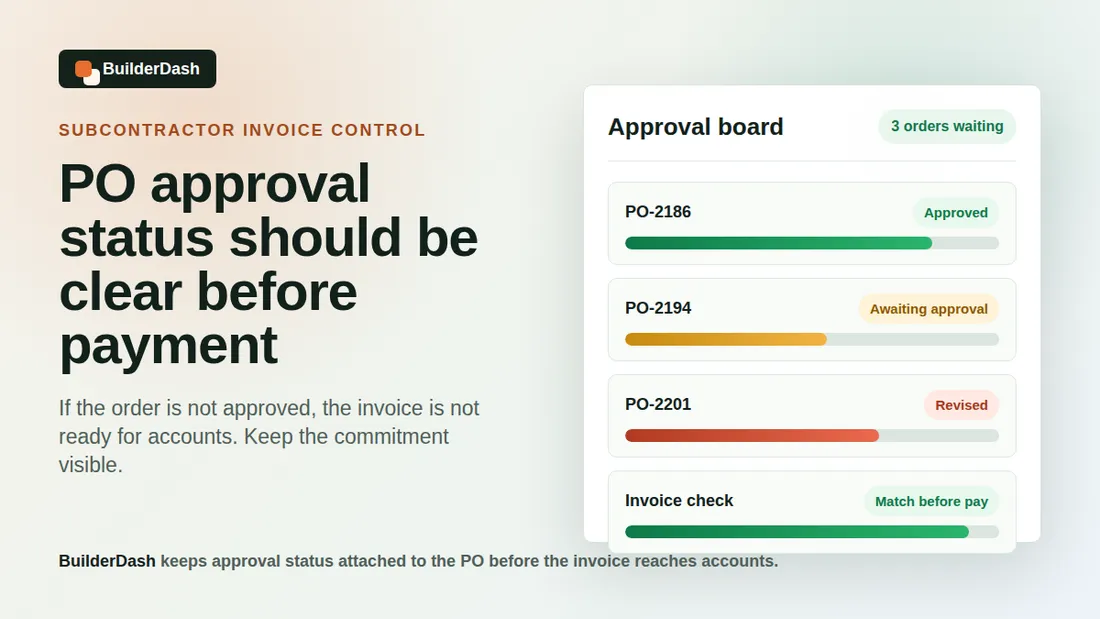
If the business can see whether a PO is pending, approved, issued, revised, or closed, then there is less chance of people approving the same item twice or assuming a verbal yes is enough. The same applies to variations and subcontractor claims. Visibility is what prevents a late-night inbox search from becoming the approval process.
A simple rule helps here: if the approval status is not visible in the job record, it is not yet complete.
Stop using forward chains as the approval trail
Forwarding an email might move the message, but it does not improve the record.
By the time a thread has been forwarded three times, the business can lose:
- the original request
- the exact value being approved
- the date the decision was made
- the person who made it
- any caveats attached to the yes
That is risky because the thread begins to look like proof when it is really just history. A proper approval trail should capture the decision once, then keep the related documents linked to it.
If a manager replies “approved” in email, that should be enough to trigger the record update, not enough to replace it.
Use one owner for each stage
One reason email chains drift is that nobody owns the next move.
It should always be clear who is responsible for:
- raising the request
- checking the commercial detail
- approving the commitment
- sending the PO or marking the variation
- posting or querying the invoice
When that ownership is visible, the business is less likely to leave a cost hanging in an inbox. It also becomes much easier to chase the right person when something is missing.
What good looks like in practice
A clean approval workflow on a construction job usually looks boring.
That is a good thing.
Good looks like:
- the request is in the record before anyone approves it
- the approval is tied to the correct job and value
- the PO, variation, or invoice uses the same reference
- email is used to notify, not to host the source of truth
- accounts can see whether the item is approved, pending, or disputed
- the job team can explain the decision without digging through old threads
That is enough to stop spend slipping through gaps that nobody intended to create.
Related reading
- Construction Purchase Order Software: How Small Contractors Control Spend Before Invoices Arrive
- How to Reduce End-of-Month Invoice Chasing in Construction
- How to Reconcile Supplier Statements Before Month End
- What to Check Before a Construction Payment Run
- Tracking Spend Is Not the Same as Controlling Spend
Call to action
If approvals still live in long email chains, BuilderDash can help you route the decision through one live record instead. Keep PO, variation, and invoice sign-off together so the right person sees the right cost before it slips through the cracks.
Run your projects properly with BuilderDash.
One system for every enquiry, job, quote and invoice - built for project-based trades, not reactive call-outs.