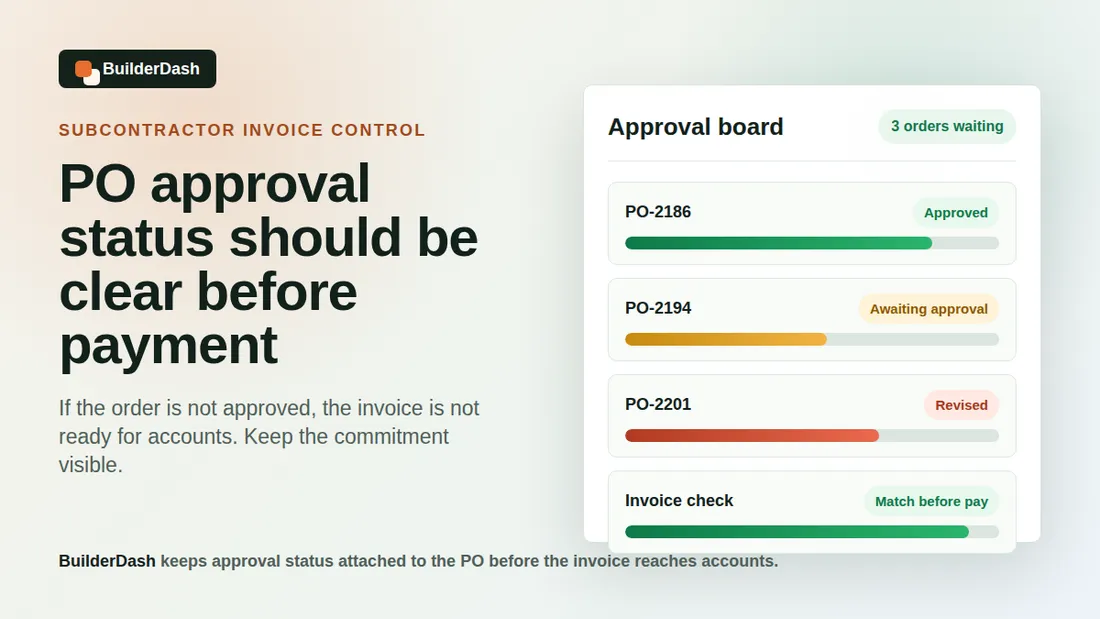
How to Keep Delivery Notes Linked to the Right Job Before Month End
 BuilderDash28 Aug 2026 5 min read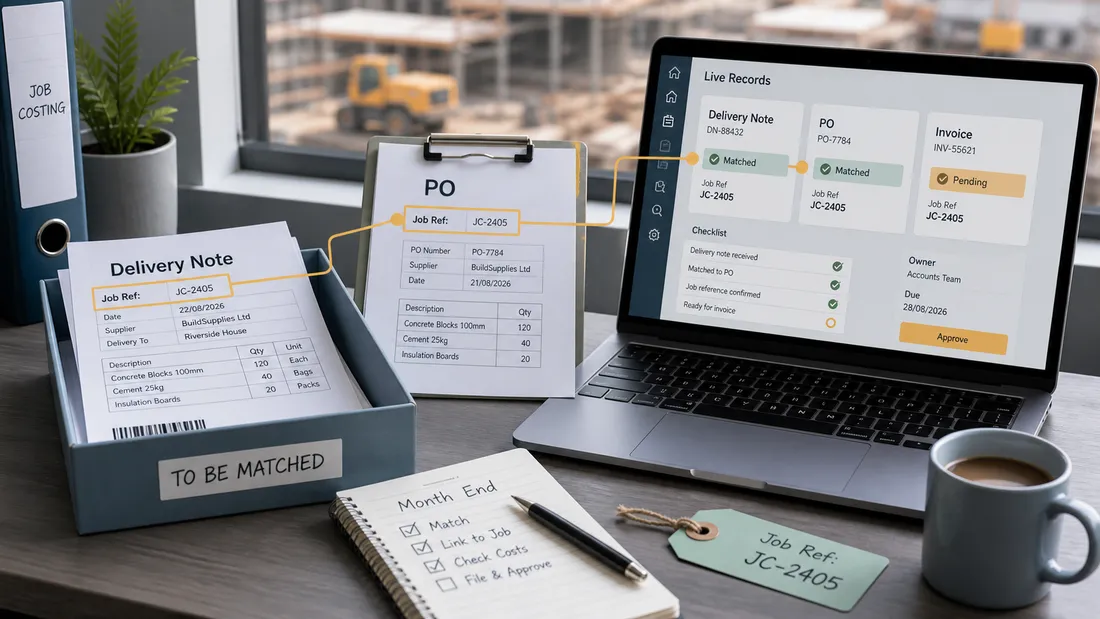
Why delivery notes go missing from the cost trail
A delivery note should be one of the simplest documents in a construction workflow.
It shows what arrived, when it arrived, and who signed for it. The problem is that the note often gets separated from the context that makes it useful. A site operative signs a sheet at the gate, the note stays in a van, the office sees only the invoice, and the job reference gets guessed later from memory.
That is when the trail starts to break.
If the delivery note is not linked to the right job and purchase order while the job is still fresh, accounts ends up trying to reconstruct the record after the fact. Month end then turns into a search through emails, photographs, and half-remembered conversations.
For small and mid-sized UK contractors, that creates three familiar problems:
- costs land on the wrong job
- invoices cannot be matched cleanly
- site and office disagree about what was actually delivered
The fix is not more chasing. The fix is a tighter habit at the point of receipt.
Match the note before the paperwork leaves site
The best time to attach a delivery note to the right job is the moment it is signed.
The person receiving the delivery should be able to check four things straight away:
- the job reference
- the purchase order number
- the supplier name
- the goods or materials that actually arrived
If any of those are unclear, the note should be flagged immediately instead of left to be sorted out later in the office.
That simple check prevents a lot of avoidable confusion. It is much easier to correct a missing reference while the delivery is still in front of you than after the invoice has already reached accounts.
Use one reference rule across site and office
Delivery notes become far more useful when the business uses one reference rule everywhere.
That means the same job code, site name, or package reference should appear on:
- the purchase order
- the delivery note
- the invoice
- any query or discrepancy record
If people use different labels for the same job, matching becomes slower and less reliable. A van delivery marked "Phase 2 rear extension" might be the same job as "PRJ-24-118" in accounts, but nobody should have to guess that later.
A consistent reference rule lets the office check the paperwork without re-interpreting the project from scratch.
Record the delivery note while the detail is still fresh
Delivery paperwork loses value quickly if it is left in the wrong place.
The note should be captured as soon as possible and stored with enough context to explain it later. At minimum, record:
- supplier
- delivery date
- job reference
- PO number
- who received it
- what was delivered
If the note covers several jobs or several packages, split that clearly at the time of entry. Do not leave the office to work out which line belongs where.
That is especially important for mixed loads, split deliveries, and small merchant runs where the same van may support more than one live job.
Watch for the three common failure modes
Delivery notes usually go wrong in predictable ways.
The note is signed but never filed
The job team knows the goods arrived, but accounts never sees the supporting paperwork.
The job reference is missing or vague
The delivery gets recorded, but not in a way that helps the invoice match later.
The delivery covers more than one job
The note is filed somewhere, but no one records how the cost should be split.
All three are avoidable if the same person or workflow owns the handoff from site to office.
Make discrepancies visible before the invoice arrives
A missing box, a damaged pallet, or a short delivery should never wait until the invoice review to be discovered.
If the delivery note does not match the order, the discrepancy should be logged while the issue is still live. That gives the supplier a chance to respond before the paperwork hardens into a dispute.
It also helps the commercial team decide whether the cost should be:
- approved
- queried
- partially accepted
- re-delivered
When that decision is made early, the invoice becomes easier to process later because the job record already shows what happened.
Keep the delivery note tied to the PO, not just the invoice
One of the easiest mistakes is to treat the invoice as the main document and the delivery note as a supporting extra.
In practice, the delivery note should point back to the original PO and job record first. The invoice then becomes the final financial step, not the first place where the business tries to work out what arrived.
That matters because invoices are often delayed, split, or copied from the original order. The delivery note is the physical evidence that the goods reached site, so it should stay attached to the commercial record from the start.
A practical workflow for month end
A simple month-end routine can stop paperwork from drifting.
- Capture the delivery note on the day it arrives.
- Check the job reference and PO before the note leaves site.
- Flag any shortages, substitutions, or split-job deliveries straight away.
- Keep the note linked to the order and job record.
- Review unmatched delivery notes before invoices are posted.
That rhythm gives accounts a cleaner base to work from and stops the month-end pile-up from becoming a guessing game.
What good looks like in practice
A well-managed delivery note should be easy to explain without opening five different tabs.
Someone should be able to answer:
- which job it belongs to
- which PO it supports
- what was delivered
- whether anything was missing
- whether the invoice can be matched cleanly
If those answers are not obvious, the note is not yet doing its job.
The aim is not to create more admin. The aim is to keep the trail intact so the office can post, query, or approve with confidence.
Suggested internal links
- What to Do When an Invoice Arrives Without a PO Number
- Project Codes and Site References for Construction Job Costing
- Why Construction Invoice Backups Should Travel With the Invoice
- How to Reduce End-of-Month Invoice Chasing in Construction
Call to action
If delivery notes are still being separated from the job record, tighten the process before month end. BuilderDash helps you keep the delivery note, the PO, and the job reference together so site and office can trust the cost trail.
Run your projects properly with BuilderDash.
One system for every enquiry, job, quote and invoice - built for project-based trades, not reactive call-outs.