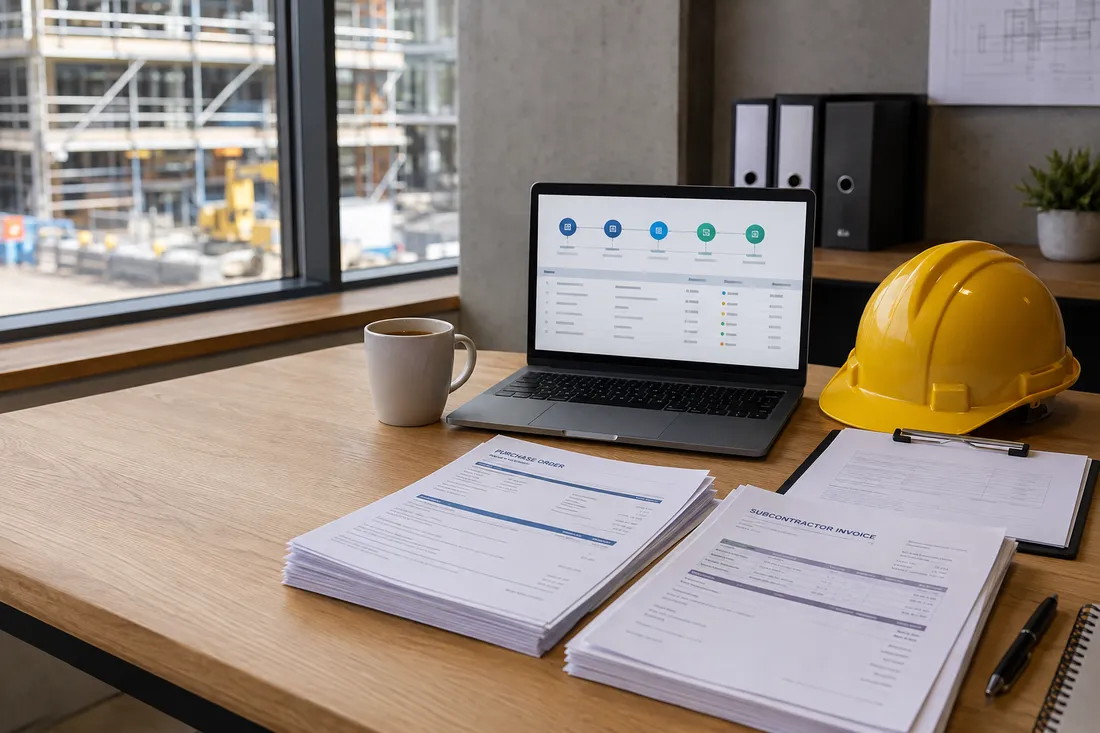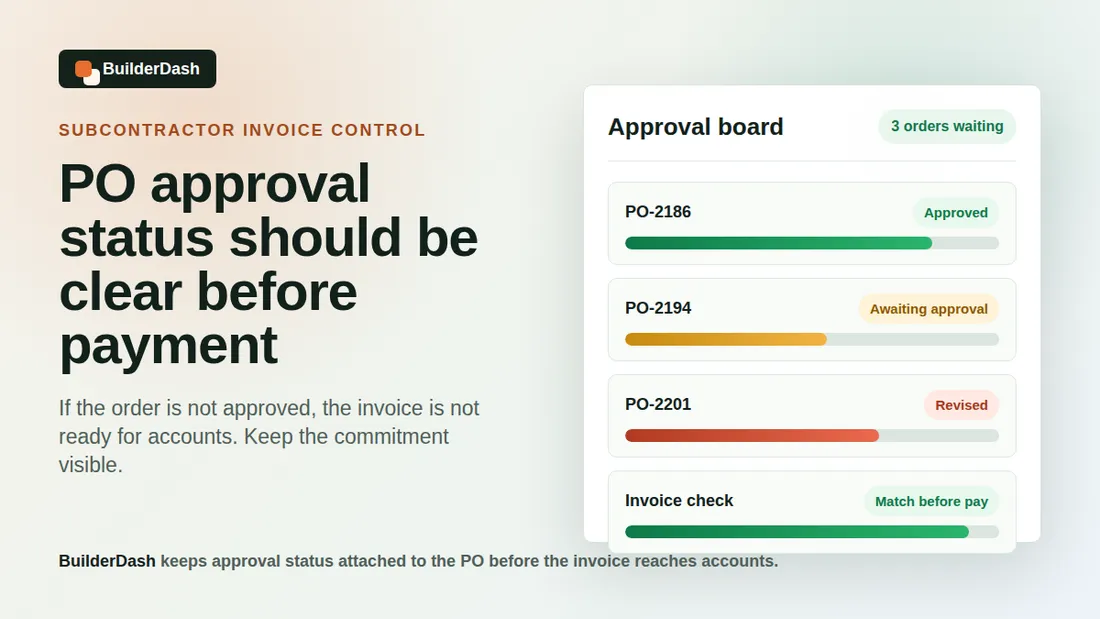
Why Construction Invoice Backups Should Travel With the Invoice
 BuilderDash9 Jul 2026 5 min read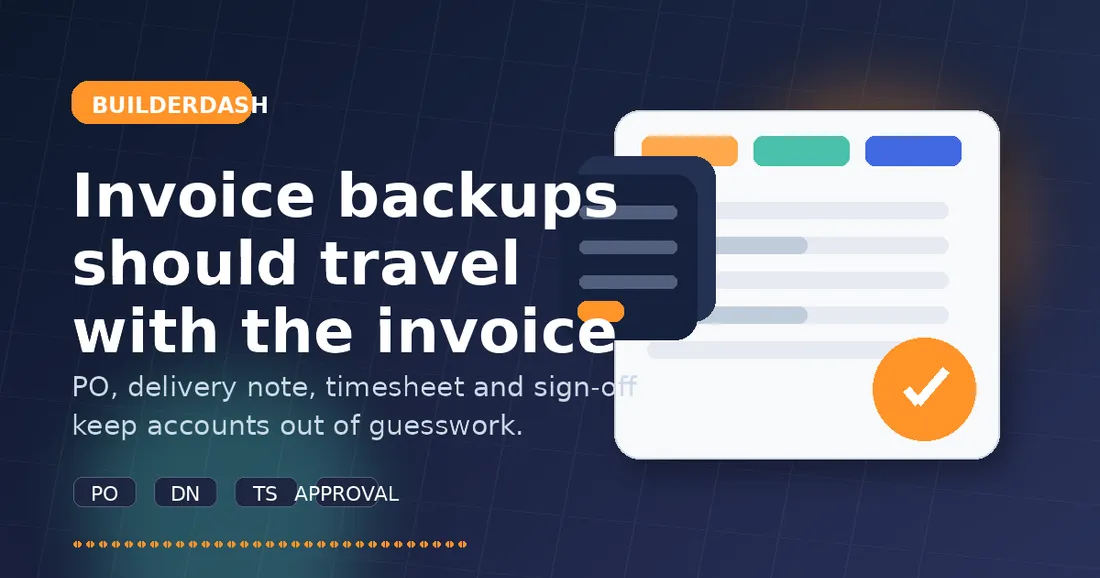
An invoice on its own does not tell accounts enough.
In construction, the number on the invoice is only the end of the story. The office still needs to know what was ordered, what was delivered, what was signed off, and whether the value matches the job or the agreed scope. If the backup documents are missing, the team ends up working backwards from a total instead of checking a record.
That is how small errors turn into avoidable queries. A delivery note sits with site. A timesheet sits in a van. A PO lives in an inbox. By the time the invoice reaches accounts, nobody can see the whole picture quickly enough.
What counts as a backup document
A good backup document is anything that proves the invoice value is justified.
For construction work, that usually means:
- the purchase order or written instruction
- the delivery note or goods received record
- the timesheet or daywork sheet
- the subcontract valuation or stage approval
- the plant off-hire confirmation
- the variation approval
- the site sign-off or photo evidence
- the contract rate or agreed quotation
The exact mix depends on the type of cost. A materials invoice will usually need different support from a labour-only claim or a plant hire bill. The principle stays the same: the person approving the invoice should be able to see why the amount is due.
Why the invoice alone is a weak control
If accounts receives only the invoice, the business has to trust that someone else has already checked the detail.
That is risky for several reasons:
- the invoice may refer to the wrong job
- the delivery may be partial
- the claim may include an unapproved extra
- the rate may not match the PO
- the site may have accepted part of the work but not all of it
- the invoice may be a copy of an earlier submission
None of those problems is unusual. The issue is that they are hard to spot when the backup evidence is scattered across WhatsApp, email and paper files.
Build the check around the evidence, not the inbox
A cleaner workflow starts before the invoice lands.
Instead of asking, "Who can approve this now?", ask:
- What evidence should be attached to this cost?
- Which job or site should it hit?
- Who on site can confirm the value?
- Is anything missing before accounts sees it?
That approach stops the office from becoming the place where all missing information is discovered too late.
For example:
- a merchant invoice should be tied to the delivery note and PO
- a labour-only invoice should be tied to the signed timesheet
- a plant invoice should be tied to the hire period and off-hire date
- a subcontractor application should be tied to the agreed scope and stage sign-off
If the evidence is incomplete, the invoice should be queried before it reaches payment.
A practical backup checklist
Before posting an invoice, check whether the record answers these questions:
- What was ordered or instructed?
- What was actually delivered or completed?
- Which job, site or phase does it belong to?
- Who approved it?
- Does the invoice value match the support?
- Is any part of the amount disputed or on hold?
- Is there enough evidence for someone else to understand the decision later?
If the answer to any of those questions is unclear, the invoice is not ready.
That does not always mean the cost is wrong. It means the business has not yet collected enough proof to treat it as settled.
Keep the backup attached to the commercial record
The real control problem is not just missing paperwork. It is missing context.
If the invoice is posted without the supporting documents attached, the next person has to rebuild the story from scratch. That causes repeated questions about the same invoice, especially at month end when people are trying to reconcile supplier statements, committed cost and cash flow at the same time.
The backup should live with the commercial record so anyone can see:
- what was agreed
- what was received or completed
- what was approved
- what is still queried
- what is ready to pay
That makes the record useful long after the original site conversation has been forgotten.
Where construction teams lose the trail
The trail usually breaks in a few familiar places:
- site keeps the delivery note and never forwards it
- a subcontractor sends the invoice before the daywork sheet is signed
- the buyer approves the PO but the variation never gets attached
- the office receives a PDF, but the photos or site notes stay on a phone
- someone remembers the approval, but not the date or value
When that happens, accounts starts chasing evidence instead of processing the invoice.
The cost of that delay is not only time. It also makes job costing less reliable because the business cannot always show why a cost was accepted, held or queried.
What good looks like in accounts
A clean invoice record should let someone answer the following without phoning site:
- What is this charge for?
- Which job does it belong to?
- Which evidence supports it?
- Who approved it?
- Is the amount fully accepted?
- If not, what part is still under query?
If those answers are available in the same place as the invoice, payment runs become simpler and margin reviews become more trustworthy.
How BuilderDash helps
BuilderDash is useful here because the invoice, the approval and the supporting evidence should sit in one workflow.
That means the office does not have to hunt through separate inboxes or message threads to understand whether a cost is ready. It can check the job reference, the backing documents and the approval status together before anything is posted.
For small and mid-sized contractors, that is usually the difference between controlled processing and constant follow-up.
Suggested internal links
- What a Clean Subcontractor Invoice Workflow Looks Like
- Why Delivery Notes Matter Before Materials Invoices Are Approved
- How to Handle Disputed Supplier Invoices Without Losing Cost Control
- What to Check Before a Construction Payment Run
- How to Use Project Codes and Site References to Keep Invoices in the Right Job
Call to action
If the invoice still depends on someone remembering where the backing documents are, the workflow is too loose.
Use BuilderDash to keep the PO, delivery note, timesheet, sign-off and invoice together so accounts can see the evidence before the cost is posted.
Run your projects properly with BuilderDash.
One system for every enquiry, job, quote and invoice - built for project-based trades, not reactive call-outs.