Why a Live Job Card Beats Email Threads on Busy Fit-Out Projects
 BuilderDash6 Aug 2026 5 min read
On a busy fit-out, email threads feel convenient right up until somebody needs the latest answer.
The site manager has one version in their inbox. The commercial manager has another reply chain with a different attachment. Accounts can see the purchase order, but not the instruction that changed it. The subcontractor is working from a screenshot. By the time anyone notices, the team is no longer discussing the job. They are discussing which message is the job.
That is why a live job card beats a long email thread.
What email threads are good at
Email is fine for sending a note, attaching a document, or confirming that something exists.
It is not fine at:
- showing the current status at a glance
- keeping scope, approvals, and comments together
- making the latest revision obvious
- giving the office one place to check before paying or chasing
Once a fit-out project has multiple rooms, trades, and revisions, an email thread becomes a record of conversation rather than a record of control.
Why fit-out work makes the problem worse
Fit-out jobs move quickly and often change in small, overlapping ways.
One room is ready. Another is waiting on access. A client comment changes a finish. A subcontractor asks whether a detail is in scope. A variation gets approved in principle but not yet in writing. Meanwhile, everyone keeps replying to the same thread because it is already there.
That creates a common failure mode:
- the subject line no longer matches the work
- the latest attachment is buried below old revisions
- one reply confirms a change while another reverts it
- the site team starts from memory because the thread is too long to read
On a fit-out, that is enough to turn a small change into a costing dispute.
What a live job card should carry
A live job card does not need to be complicated. It needs to be the single place people trust when they want the current state of the job.
At minimum, it should show:
- the project reference
- the room, floor, zone, or package
- the latest scope note
- the current approval status
- the open questions
- the last instruction or revision
- who owns the next action
- any linked documents or drawings
If that information is visible in one place, the team spends less time reconstructing the story from old replies.
Keep the live card, not the whole inbox history
The point of a live job card is not to replace every email.
It is to stop email from being the place where the job lives.
Use email to notify people. Use the live job card to decide what is true right now.
That matters because fit-out jobs often involve:
- a quick client change that affects several trades
- a revised drawing that only applies to one zone
- a purchase order that needs updating before the work proceeds
- a question about whether an item is a variation or part of the original scope
If each of those sits in a different reply chain, nobody has a reliable view of the job.
The practical rule: one change, one record
The simplest way to keep control is to make every change land in the same live record.
When something changes, update the job card with:
- what changed
- who asked for it
- whether it is approved
- whether it affects cost, time, or scope
- what the next step is
That makes the record useful to site, commercial, and accounts at the same time.
It also stops people from treating every extra message as a separate source of truth.
Why this helps the office as much as site
The office usually feels the pain later.
If the team can see the live job card, they can check the latest status before:
- sending a reminder
- approving a payment
- querying an invoice
- closing a variation
- updating a job cost report
That reduces the common back-and-forth where accounts ask for context the site team already gave three days earlier, but in a different thread.
A simple fit-out checklist for the live job card
Before the job moves on, check that the card answers these questions:
- What area or zone is this for?
- What is the latest instruction?
- Has the change been approved?
- Does the change affect cost or programme?
- Who needs to act next?
- Where is the supporting document?
- Is the record still current, or is there a newer revision?
If any of those answers lives only in email, the job card is not really live yet.
How BuilderDash helps
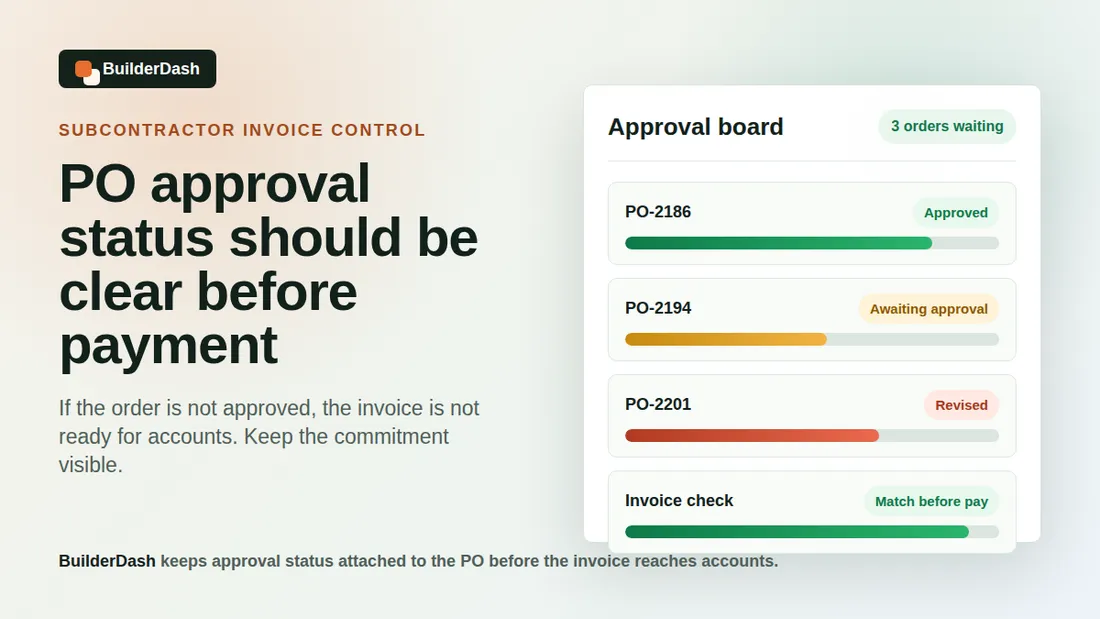
BuilderDash is useful when the team wants the job reference, approval trail, and live status in one place instead of spreading them across inboxes and message chains.
That does not remove the need for communication. It just gives the business one record that site and office can rely on when the pressure rises and the threads get long.
Suggested internal links
- How to Make Project References Survive the Site-to-Office Handoff
- How a Subcontractor Start Pack Keeps the First Day Under Control
- Why Fit-Out Jobs Need Room and Zone References on Every PO
- What to Do When a Variation Instruction Is Not Logged Properly
Practical takeaway
Email is useful for alerting people.
A live job card is better for running the job.
On a busy fit-out, that difference matters because the team needs one current record for scope, approval, and follow-up. Once that record exists, the inbox can go back to being a notification tool instead of the place where the project gets assembled from scratch.
Call to action
If your fit-out jobs are still being managed through long email chains, BuilderDash can help keep the live job card, scope notes, and approval trail together so everyone is working from the same version.
Run your projects properly with BuilderDash.
One system for every enquiry, job, quote and invoice - built for project-based trades, not reactive call-outs.