Why Quote Expiry Dates Matter Before You Raise a Purchase Order
 BuilderDash22 Aug 2026 6 min read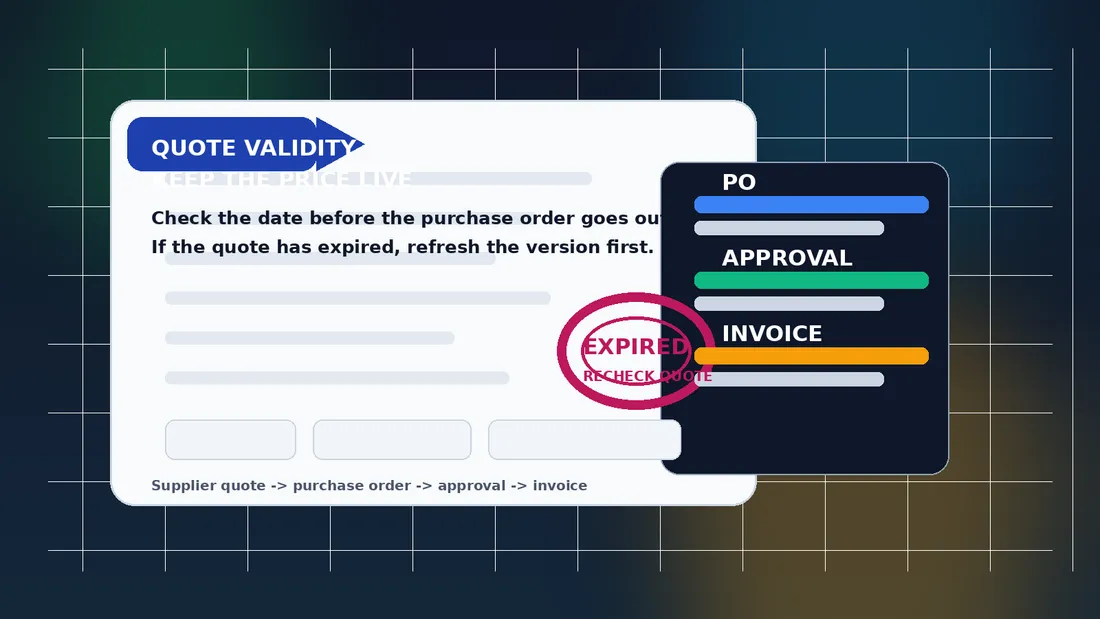
A quote is only useful if it is still valid when the work is actually ordered.
That sounds obvious, but it is easy for a construction business to miss. A price may be agreed in principle, then sit in an inbox while the job is delayed, the scope changes, or the buyer waits for sign-off. By the time the purchase order is raised, the quote may already be out of date.
If nobody checks the expiry date, the business can end up committing to stale pricing, unclear lead times, or an old version that no longer matches the real scope.
Why quote expiry is more than an admin date
In construction, a quote expiry date is not just a line at the bottom of a PDF.
It tells the team something practical:
- how long the supplier will hold the price
- whether the lead time assumptions still make sense
- whether the quote needs a fresh version before the order is placed
- whether the approval trail is based on current information or an out-of-date assumption
That matters because the order is the point where a quote becomes committed spend. If the quote has expired, the business should not treat it as a live commercial agreement without checking what changed.
The risk is highest on jobs where work moves in stages. A quote can be accepted in principle, but the actual order is issued later by site, commercial, or accounts. By then, the original document may no longer reflect the real buying decision.
What a useful quote record should contain
A quote is easier to control when it is captured as a proper record rather than left as an attachment with no context.
At minimum, the record should show:
- supplier name
- quote reference or version number
- issue date
- expiry date or validity period
- scope covered by the price
- exclusions or assumptions
- lead time, where relevant
- job or project reference
- the person who reviewed or accepted it
If that information is missing, the team has to guess whether the price is still safe to use.
That guess often shows up later as an invoice query, a variation argument, or a surprise difference between the approved cost and the billed cost.
The common failure modes
Most quote expiry problems are not dramatic. They are small hand-off failures.
The usual ones are:
- the quote expires while the job waits for approval
- a revised quote is sent by email, but the old version stays attached to the job
- site reuses a price from WhatsApp without checking the date
- the PO goes out after expiry, but nobody notices until the invoice arrives
- the buyer assumes the supplier will honour the old price, but no one has confirmed it
Each of those issues is avoidable. The fix is to treat validity as part of the buying workflow, not as a note hidden in the corner of the quote.
Decide what happens when a quote has expired
Every contractor needs a simple rule for expired quotes.
The rule should answer one question: is the price still valid, or does it need refreshing before the order is issued?
A practical approach is:
- Check the expiry date before the order is raised.
- If the quote is still valid, attach it to the approval and purchase order record.
- If it has expired, stop and ask for a refreshed quote or written extension.
- If the supplier has changed the price, save the revised version as the new record.
- If the quote is still being used for reference, mark it clearly as superseded or expired.
That keeps the business from ordering on autopilot.
It also gives accounts something better to work with later. When the invoice arrives, the team can see which quote version was actually used to approve the spend.
Keep revisions linked to the original quote
Expired quotes are not the only issue. Revisions can be just as messy.
A supplier may send a refreshed price because materials have moved, labour availability has changed, or the lead time has slipped. If the revision is not linked to the original quote, the office may end up with two plausible prices and no clear record of which one was accepted.
That is where the approval trail matters.
The team should be able to see:
- the original quote
- the revised quote
- what changed
- who accepted the change
- when the final approval happened
Without that, the business can lose the story behind the number. That makes later invoice checking harder and weakens the job cost record.
What accounts and job costing need to see later
Once the order has gone out, the quote record should still be useful.
Accounts and commercial teams should be able to answer:
- which quote version the order was based on
- whether the quote was still valid at the time of approval
- whether the invoice matches the accepted price
- whether any price movement was approved before ordering
- whether any difference needs a query or a variation record
That is the real value of quote control. It is not just about getting a good price today. It is about being able to explain the cost later without digging through old inbox threads.
If the quote trail is clean, job costing is cleaner too. The team can separate a valid price change from a posting error.
A simple quote validity checklist
Before you raise the purchase order, ask:
- Is the quote still within its validity period?
- Does the scope match the work that is actually being ordered?
- Have exclusions and assumptions been reviewed?
- Has the supplier issued a newer version?
- Does the lead time still fit the job programme?
- Has the right person approved the current version?
- Will the same record still make sense when the invoice arrives?
If the answer to any of those is no, the quote is not ready to underpin a committed cost.
How BuilderDash helps
BuilderDash helps construction teams keep the quote, approval, purchase order and invoice connected in one place.
That makes it easier to see when a quote has expired, which version was accepted, and whether the approval trail still matches the buying decision. It also reduces the chance that site, commercial and accounts are each working from a different version of the same cost.
For contractors trying to keep control without slowing the job down, that is the point: one live record, fewer assumptions, and a clearer path from quote to payment.
Suggested internal links
- Construction Purchase Order Software: How Small Contractors Control Spend Before Invoices Arrive
- Tracking Spend Is Not the Same as Controlling Spend
- How to Reduce End-of-Month Invoice Chasing in Construction
- What to Check Before a Construction Payment Run
Call to action
If your quotes, approvals and purchase orders still live in separate inboxes, start by making quote validity visible before the order goes out. BuilderDash helps keep the latest version, the approval trail and the job reference together so the team can commit spend with less guesswork.
Run your projects properly with BuilderDash.
One system for every enquiry, job, quote and invoice - built for project-based trades, not reactive call-outs.