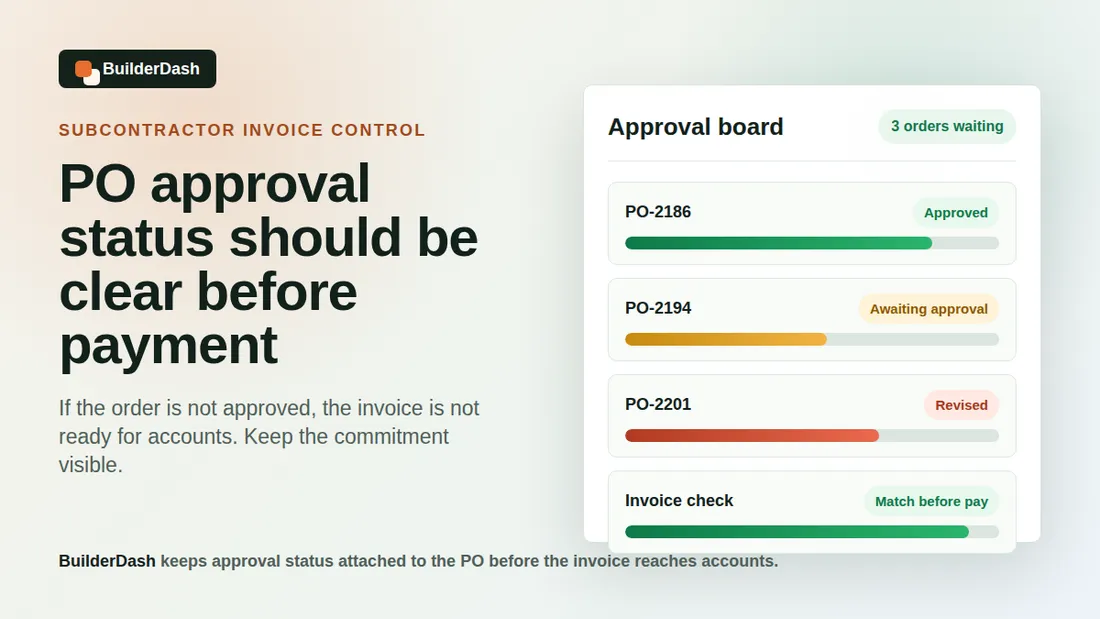

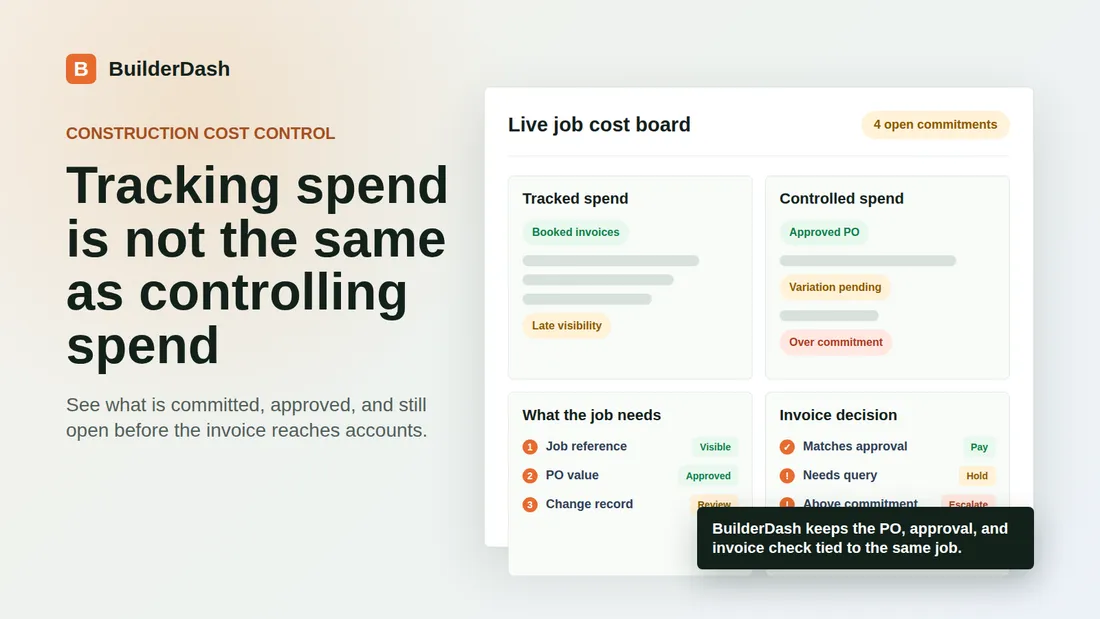
Spend reports are useful. They are not the same thing as control.
Many construction businesses can see what has already been booked into accounts. Fewer can see what has been committed, what has been approved, what is still waiting for a decision, and what is likely to arrive next. That gap is where margin slips away.
A job can look healthy in a spreadsheet while the real commercial position is already under pressure. The purchase order may have been raised, the site team may have agreed a variation, and the supplier may already be preparing an invoice. If those steps are not tied together, the business is only tracking spend after the fact.
What tracking spend actually tells you
Tracking spend gives you a historical view.
It answers questions such as:
- What has been invoiced?
- What has been posted to a cost code?
- What total has reached accounts?
- Which suppliers have been paid?
That is valuable, but it is still backward-looking. By the time the invoice appears in the ledger, the commercial decision has usually already been made somewhere else.
If the business relies on that view alone, it can miss:
- Unapproved purchase orders that are already live.
- Variations agreed on site but not captured centrally.
- Partial invoices that hide the remaining commitment.
- Goods received that have not yet been invoiced.
- Orders that will hit the job cost later in the month.
The report is not wrong. It is just late.
What controlling spend requires
Controlling spend means the business can see the decision before the cost lands.
That needs a live record of:
- The request.
- The approved value.
- The purchase order.
- The job or site reference.
- The approver.
- The status of any variation.
- The invoice when it arrives.
Once those pieces are connected, the team is not guessing whether a cost is legitimate. It can see whether the cost was authorised, whether it still fits the approved commitment, and whether it should move to payment or be queried.
Why spreadsheets struggle with commitment control
Spreadsheets are fine for review. They are weak at live control.
The problem is not that spreadsheets cannot hold figures. The problem is that they do not naturally preserve the working relationship between the commercial records. A spreadsheet can show a total, but it does not easily show:
- Which PO created the commitment.
- Which approval changed the value.
- Which invoice belongs to which order.
- Which part of the total is already accepted.
- Which part is still open.
In a busy contractor, that information is often spread across inboxes, WhatsApp threads, phone calls, and shared drives. By the time someone pieces it together, the project is already carrying the risk.
The difference between actual, committed, and approved spend
A useful way to think about control is to separate three figures.
Actual spend is what has already been posted.
Committed spend is what the business has already agreed to buy, even if the invoice has not arrived yet.
Approved spend is what the business has formally authorised through its own process.
Those three numbers are not the same. A job can have modest actual spend and still be heavily committed. That often happens when materials, subcontractors, and variations are moving faster than accounts can see them.
If directors only look at actual spend, they may think the job is safe. If they can also see commitments and approvals, they get a much truer picture of the remaining margin.
Where control breaks down on site
Control usually leaks at the handoff points.
Typical failure modes include:
- A site manager agrees extra work informally, but the variation is not logged.
- A supplier treats a request as an order before the approval is complete.
- A PO exists, but the wrong job code was used.
- An invoice arrives with no supporting reference and gets parked.
- A partial invoice is approved without checking the remaining balance.
- A director is asked to approve something they cannot easily see.
None of that means the business is careless. It usually means the process depends too much on memory and too many one-off messages.
Build control around the purchase order
The purchase order is the point where spend becomes real.
If the PO is clear, the rest of the workflow becomes much easier to manage. A practical PO should carry:
- The supplier name.
- The job or site reference.
- The approved value.
- The requester.
- The approval status.
- Any notes on scope, exclusions, or variation limits.
When that information is visible before the invoice arrives, accounts can check whether the charge matches what was actually authorised. That helps prevent both overspend and unnecessary invoice chasing.
Keep changes visible, not casual
Most cost problems start with a small change that never gets treated as a commercial event.
Maybe the fitter needs an extra delivery. Maybe the subcontractor has uncovered unexpected work. Maybe the supplier has added a charge for access, waste, or a special delivery. If the business only records the final invoice, the extra value appears without context.
The fix is to treat changes as revisions, not comments.
That means:
- The original order stays visible.
- The change is recorded against the same job.
- The revised value is approved separately.
- The supplier receives the updated instruction.
- The invoice check can compare old and new values.
That way the business can see the margin impact instead of discovering it after month end.
Why invoice checks matter before payment
Invoice checks are the final control point.
If the invoice does not match the approved PO, the business should know why before it is paid. The question is not only whether the arithmetic is correct. It is whether the invoice belongs to the job, the site, the agreed scope, and the current approved value.
A good check looks for:
- Missing or wrong job references.
- Charges above the approved value.
- Charges that relate to an unapproved variation.
- Duplicate lines or repeated delivery charges.
- Partial billing that leaves an open balance.
- Evidence that the work or goods were actually received.
This is where tracking turns into control. The business is not just recording spend. It is deciding whether the spend belongs.
How BuilderDash helps
BuilderDash helps contractors keep the working records together.
Instead of seeing the PO, approval, job reference, and invoice as separate events, the team can keep them linked to the same job. That makes it easier to understand what has already been committed and what still needs a decision.
For the office, that means less time reconstructing the commercial history from inboxes. For site teams, it means less back-and-forth about whether something was actually authorised. For directors, it means a clearer view of the cost position before the month is already over.
A quick reality check
Ask these questions about your current process:
- Can you see committed spend, or only booked spend?
- Do PO approvals happen before the order goes live?
- Are variations logged as changes, or just discussed?
- Can accounts tell which invoices are partially billed?
- Can directors see the open commitments by job?
If the answer to any of those is no, the business is probably tracking spend without truly controlling it.
Suggested internal links
- How to control purchase order overspend and variations in construction
- What construction businesses should standardise before automating accounts
- Why project codes and site references matter on materials invoices
Suggested call to action
If you want a clearer view of approvals, commitments, and invoice status on each job, use BuilderDash to keep the commercial record in one place before the cost lands in accounts.
Run your projects properly with BuilderDash.
One system for every enquiry, job, quote and invoice - built for project-based trades, not reactive call-outs.