Why Subcontractor Payment Applications Need a Clear Approval Trail Before Accounts Posts Them
 BuilderDash13 Jul 2026 6 min read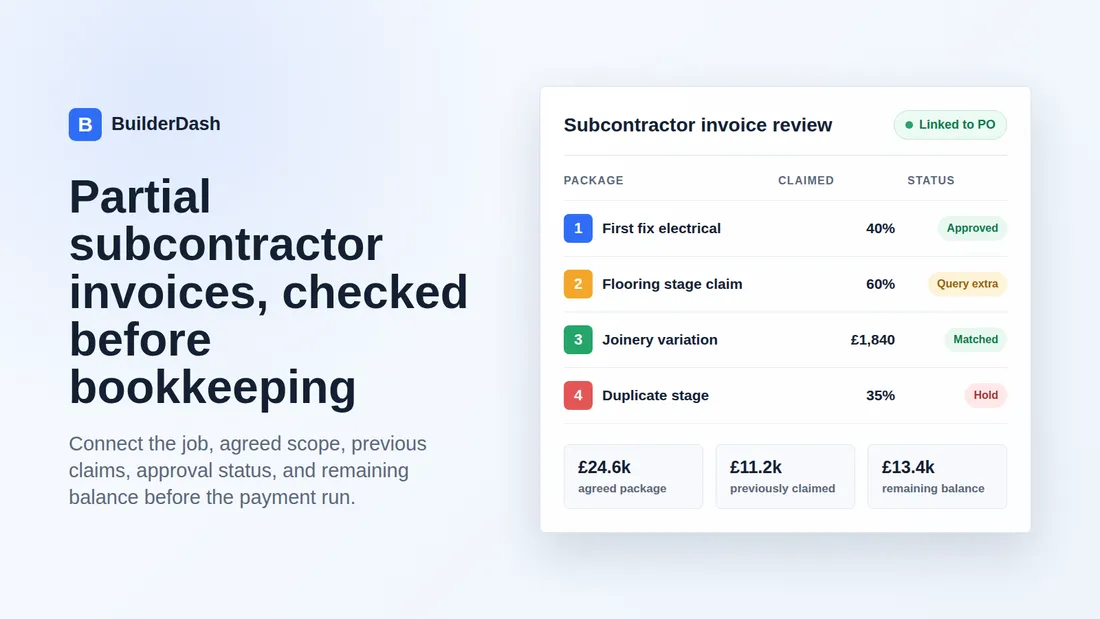
Subcontractor payment applications rarely stall because the maths is difficult.
They stall because the approval trail is messy. One person remembers saying yes on site. Another person expects a message in WhatsApp. Accounts is waiting for a sign-off that never made it out of a phone call. By the time the claim reaches the payment run, nobody can prove what was approved, when, or by whom.
For UK construction firms, that creates avoidable friction. Payment slows down, job costs become harder to trust, and the team spends time reconstructing decisions that should have been recorded at the point they were made.
What a clear approval trail should show
A clean approval trail does not need fancy process. It means there is a visible record of:
- who raised the payment application
- what scope or package it relates to
- which site manager, QS or director approved it
- whether the approval was full or partial
- when the approval happened
- what evidence supported the decision
- what still needs to happen before accounts can post it
If any of those points are missing, the application may be in the system but the approval is still informal.
That is the gap that causes delay.
Why informal sign-off causes problems later
Construction teams often approve work in the right spirit but the wrong format.
A site manager may confirm the value on a call. A QS may reply "OK" to a photo in WhatsApp. A director may nod at a meeting. The decision is real, but it is not easy for accounts to act on later.
That leads to a few predictable failures:
- accounts holds the application because there is no record to rely on
- the subcontractor chases the wrong person
- the approved amount is forgotten when the application arrives
- part-approved applications get posted as if the whole amount was clear
- the commercial team cannot explain why a payment was delayed
The issue is not that people failed to decide. It is that the decision was not captured in a way the rest of the business can use.
Keep the decision separate from the chasing
One of the most common mistakes is letting the approval and the follow-up live in the same loose conversation.
An application may be approved in principle, but still need a missing timesheet, variation confirmation or site sign-off before it is ready. If that follow-up lives only in an inbox, the approval and the action get blurred together.
Better practice is to keep the decision and the chase linked but distinct.
The approval record should answer:
- what was approved
- what was not approved
- who approved it
- what evidence was used
- what remains outstanding
The follow-up should answer:
- who is chasing the missing item
- when it is due back
- whether the application can be partially posted
- whether the subcontractor has been told what is outstanding
That separation helps both site and accounts work from the same facts.
Make partial approvals visible
Subcontractor payment applications are often not all-or-nothing.
You may approve the labour element but still be waiting on a variation. You may accept most of a claim but dispute a day rate, a plant charge or a scope item. If the system only shows "approved" or "not approved", the team loses the useful middle ground.
Partial approval should be explicit. It should show:
- the accepted value
- the disputed value
- the reason for the dispute
- what needs to happen before the balance can be paid
That keeps the job cost honest and helps accounts avoid overpaying just to clear the inbox.
Attach the site evidence before the application reaches accounts
Approval is much easier when the supporting evidence is attached early.
Depending on the trade, that might include:
- site sign-off
- photos
- timesheets
- delivery notes
- variation confirmation
- measurement sheets
- agreed rates or daywork records
The key point is not the document type. It is whether the approval can be checked quickly without asking site to go back and find the original conversation.
If the evidence is already linked to the application record, accounts can post faster and with less back-and-forth.
Give one clear owner for each application
Approval workflows often slow down because nobody owns the next step.
Site may have the evidence. Commercial may need to review the value. Accounts may be waiting for a final status. Each team is involved, but the application still needs one owner who is responsible for moving it forward.
That owner should be able to answer:
- has the application been reviewed?
- is the approval complete?
- if not, what is missing?
- who is following it up?
- can accounts hold, part-pay or release it?
When that ownership is visible, the application stops floating between teams.
What accounts needs to see at posting time
By the time a payment application reaches accounts, the question should not be "can someone ring site?"
It should already show:
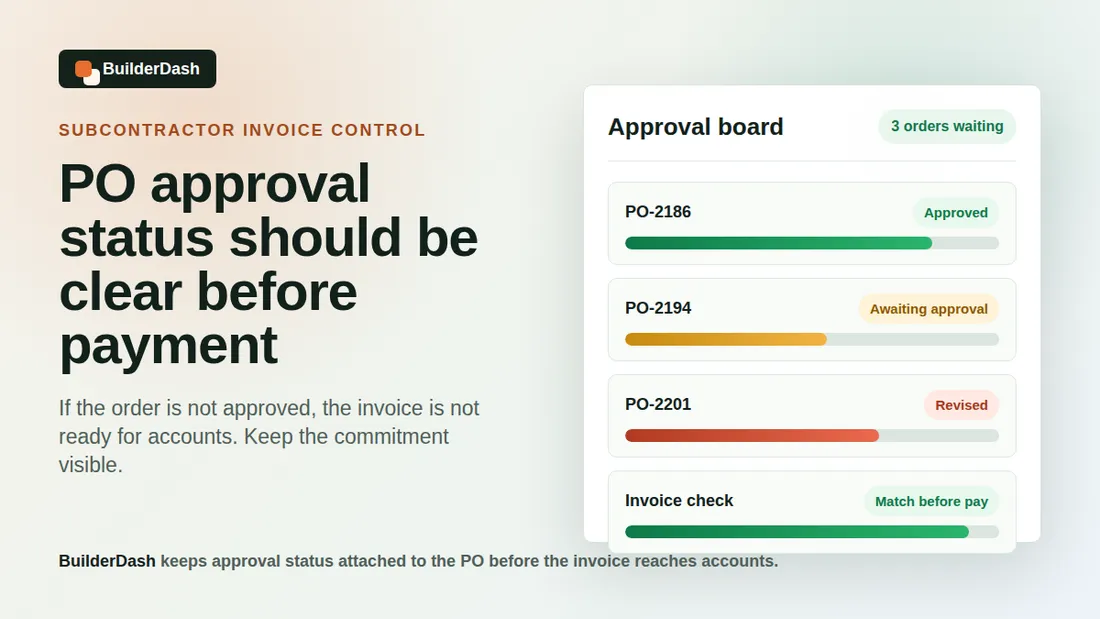
- whether it is approved
- who approved it
- whether any part is disputed
- what evidence is attached
- whether payment is blocked or partly clear
- what date the approval was given
That lets accounts post the right value without rebuilding the story from scratch.
It also gives directors and commercial managers a cleaner picture of where the delay sits: with the work, with the sign-off, or with the paperwork.
A simple approval trail that works
A practical workflow for subcontractor payment applications looks like this:
- Payment application arrives with the job reference and supporting evidence.
- Site or commercial reviews the work against what was agreed.
- The approval decision is recorded immediately.
- Any disputed balance is separated from the accepted value.
- Missing evidence is logged with one named owner.
- Accounts can see whether the application is ready, partial or blocked.
- The record stays open until the final sign-off or correction arrives.
That is enough to keep the process moving without making it heavy.
What good looks like in practice
A clean approval trail means:
- no one is guessing who approved the application
- partial approvals are obvious
- sign-off dates are visible
- site evidence is attached to the record
- accounts can post without chasing a fresh explanation
- disputes do not disappear into chat threads
The point is not to slow approval down. It is to make approval usable by the rest of the business.
How BuilderDash helps
BuilderDash helps construction teams keep subcontractor payment applications, approval status and supporting evidence together in one place.
That gives site, commercial and accounts the same view of what has been approved, what is still waiting, and what can be posted. It reduces the chance that a real sign-off gets lost between conversations and makes payment runs easier to manage.
For teams that already spend too much time chasing missing confirmation, that visibility is what turns approval from a memory into a workable process.
Suggested internal links
- Why PO Approval Status Should Be Checked Before a Subcontractor Invoice Is Paid
- What a Clean Subcontractor Invoice Workflow Looks Like
- What to Check Before a Construction Payment Run
- How to Stop Invoice Queries Going Missing Between Site and Accounts
Suggested call to action
Use BuilderDash to keep the application, the approver, the sign-off date and the next action together before accounts posts the cost.
Run your projects properly with BuilderDash.
One system for every enquiry, job, quote and invoice - built for project-based trades, not reactive call-outs.