How to Build a Weekly Job Commercial Snapshot for Small Construction Firms
 BuilderDash24 Aug 2026 6 min read
What a weekly commercial snapshot should answer
A weekly commercial snapshot is not a full month-end pack.
It is the small, repeatable view that tells you whether live jobs are still under control before the numbers harden into history. For a small construction firm, that matters because the people raising spend, approving it, and paying it are often the same handful of people. If the view is messy, the business only notices the problem after the invoice arrives or the cash has already moved.
The goal is simple: one weekly view that shows what has been committed, what has been approved, what is still waiting, and what might affect cash flow next.
Keep the snapshot to one page of decisions
The best weekly snapshot is not a report nobody reads.
It should answer a few commercial questions quickly:
- What open purchase orders still exist?
- What spend has already been approved?
- What invoices are waiting on a decision?
- Which approvals are overdue?
- What is likely to hit cash flow next?
If the answer to those questions is buried in separate spreadsheets, inboxes, and job folders, the snapshot is not doing its job.
Small firms do not need more detail. They need faster clarity.
Include the five numbers that matter most
The weekly snapshot should always show the same core measures.
1. Open purchase orders
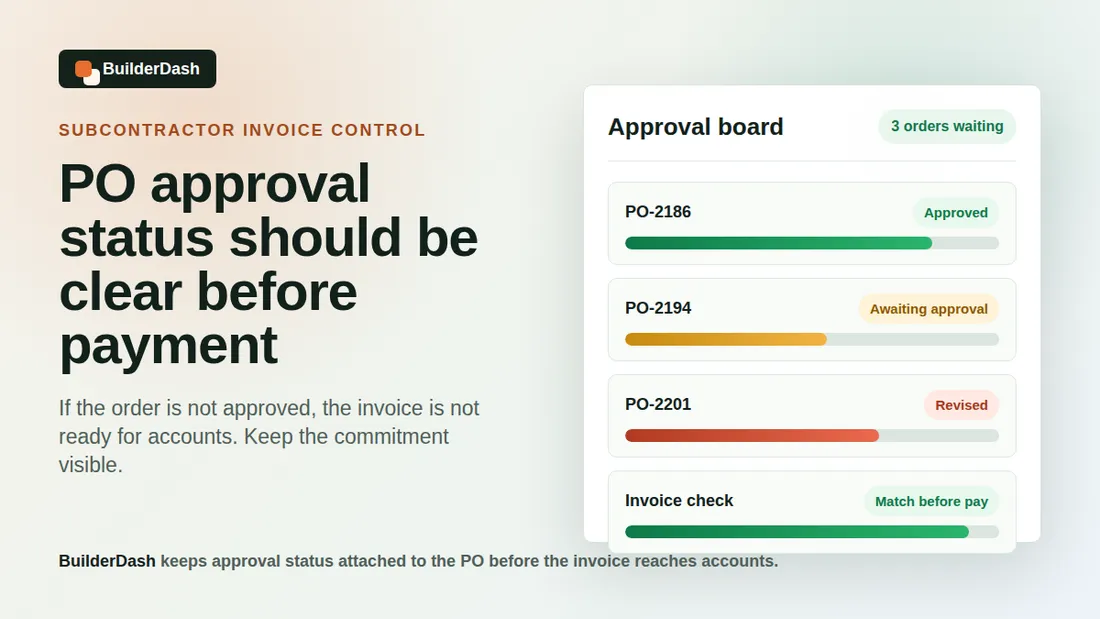
Open POs show what the business has committed but not yet fully received, invoiced, or closed.
That number matters because it shows future pressure on the job before the invoice lands. A live open-PO figure helps the business see whether spend is creeping up on a package or whether a job still has plenty of headroom.
2. Approved spend
Approved spend is the cost the business has already said yes to.
That is different from posted cost and different again from cash paid. For a weekly snapshot, approved spend is one of the clearest signs of where the job really stands, because it captures commitments that are already real even if they have not yet hit accounts.
3. Invoices waiting
Invoices waiting are the bills that have arrived but are not ready to pay.
They may be missing a PO, waiting on a job reference, stuck on a query, or held because the value does not match what was approved. If the business does not track these weekly, the queue grows quietly and month end becomes a rush to understand what is blocked.
4. Overdue approvals
Overdue approvals are one of the easiest ways for small firms to lose commercial control.
If an approval sits too long, the site team keeps moving, the supplier keeps chasing, and accounts has no clean answer when the invoice lands. A weekly list of overdue approvals gives the business a simple chase list before the delay turns into a dispute.
5. Cash flow visibility
Cash flow visibility is what turns the snapshot from a list into a control tool.
You do not need a perfect forecast. You need enough visibility to know what is likely to go out this week, what is due soon, and whether the business is carrying more commitment than it can comfortably fund.
Use the same structure every Friday
Consistency is what makes the snapshot useful.
Pick one day each week, then review the same fields in the same order:
- Open POs by job.
- Approved spend by job.
- Invoices waiting on action.
- Approvals overdue by owner.
- Cash due in the next seven days.
That rhythm is important because it stops the weekly review becoming an ad hoc conversation. When the structure is fixed, people know what to update and what to bring to the meeting.
Separate committed cost from cash paid
One of the biggest mistakes in small construction businesses is treating cash movement as the only thing that matters.
Cash matters, but committed cost is what tells you where margin is going. A job can look fine in the bank account and still be overcommitted on paper.
Your weekly snapshot should separate:
- approved but not yet invoiced
- invoiced but not yet paid
- disputed or queried
- paid and closed
That gives the business a better view of what is already spoken for, not just what has left the bank.
Make the overdue work visible by owner
If an approval is late, the snapshot should show who is holding it.
That might be a director, a project manager, a commercial lead, or accounts. The point is not to name and shame. The point is to make the next action obvious so the delay can be cleared before it affects the job.
A useful overdue list should show:
- the job
- the supplier or subcontractor
- the value
- the reason it is waiting
- the owner
- the date it needs attention by
When those fields are visible, chase work becomes a short task instead of a scavenger hunt.
Add a simple cash-flow warning line
For small firms, cash flow does not need to be complicated to be helpful.
Add one line to the snapshot that shows:
- cash due out in the next seven days
- cash expected in the next seven days
- the net position after the two
That is enough to show whether the business is walking into a tight week. It also helps directors see the commercial picture before they approve additional spend or release a payment.
Keep site and accounts on the same version of the truth
The weekly snapshot only works if site, commercial, and accounts are looking at the same live record.
If site is working from memory, accounts is working from email, and commercial is working from a spreadsheet that was last updated on Tuesday, the snapshot is already stale.
That is why the best weekly view is one system, one set of statuses, and one owner for each action. When the record is shared, the business can talk about the same numbers instead of debating which copy is right.
A practical weekly review flow
You do not need a long meeting.
A practical review can be:
- Check open POs that are still active.
- Confirm whether approved spend matches the live job picture.
- Clear invoices that are waiting on simple information.
- Chase overdue approvals by owner.
- Flag any job where cash flow or committed cost looks tight.
That flow keeps the meeting operational. It tells the team what needs action, not just what happened last week.
What good looks like
Good weekly commercial visibility is boring in the best way.
It means:
- nobody is surprised by a supplier invoice
- approvals do not sit in limbo without an owner
- open POs are visible before they become overspend
- cash flow is discussed before the week gets tight
- the team can see the same live numbers without rebuilding them
That is enough for a small construction firm to stay ahead of the work without building a heavy finance process.
Suggested internal links
- How to Run a Weekly Committed Cost Review on Live Jobs
- What to Check Before a Construction Payment Run
- Why Construction Accounts Need a Single Exception Register
- How to Stop Invoice Queries Going Missing Between Site and Accounts
Call to action
If your weekly commercial view still lives across emails, spreadsheets, and memory, tighten it before the next payment cycle. BuilderDash helps small construction firms keep open POs, approved spend, invoices waiting, overdue approvals, and cash flow visibility in one weekly snapshot.
Run your projects properly with BuilderDash.
One system for every enquiry, job, quote and invoice - built for project-based trades, not reactive call-outs.