
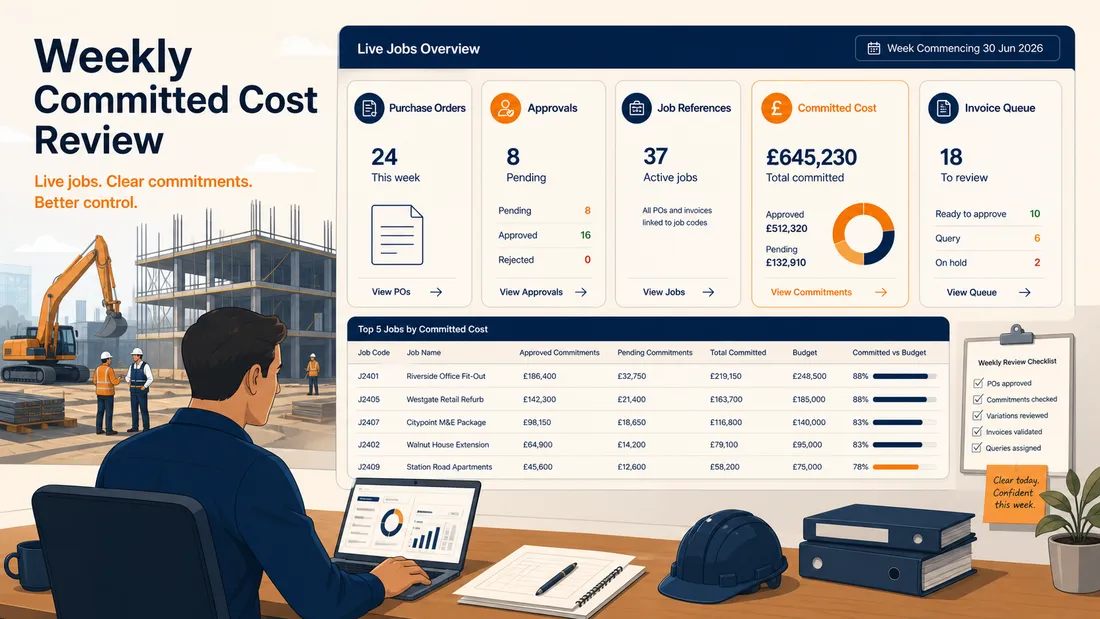
A weekly committed cost review is one of the simplest ways to keep a live job honest.
Most construction businesses already track what has been invoiced. Fewer have a regular habit of checking what has been approved, what is still open, and what is likely to land next. That is where margin slips away. The job can look healthy in accounts while the real commercial position is already under pressure.
The point of a weekly review is not to create extra admin. It is to catch the small commercial changes that are easy to miss when everyone is busy on site.
What a weekly review should answer
At a minimum, the review should tell you:
- What has been approved this week?
- What has been ordered but not yet invoiced?
- What has been invoiced against an approved commitment?
- What has changed since the last review?
- What needs action before the next payment run?
If those answers are not clear, the business is usually relying on memory, inbox searches, or a spreadsheet that has already fallen behind the job.
Start with approved commitments, not booked spend
Actual spend is useful, but it is late.
By the time a cost reaches accounts, the business has already made a buying decision somewhere else. A proper weekly review starts with approved commitments:
- purchase orders
- subcontractor commitments
- approved variations
- revised scope agreed on site
- any open line items that are expected to become invoices
That view shows what the job is already committed to pay, even if the invoice has not arrived yet.
Check what has changed since last week
The weekly review should not be a static report. It should show movement.
Look for:
- new POs raised since the last meeting
- revisions to existing orders
- scope changes that were agreed informally
- partial invoices that only cover part of the commitment
- invoices still waiting on a job reference or approval
- items that were queried last week and still need an owner
If a job has changed but the commercial record has not, the budget view is already out of date.
Use the same questions on every live job
The value of a weekly review comes from consistency.
Use the same checks on every project:
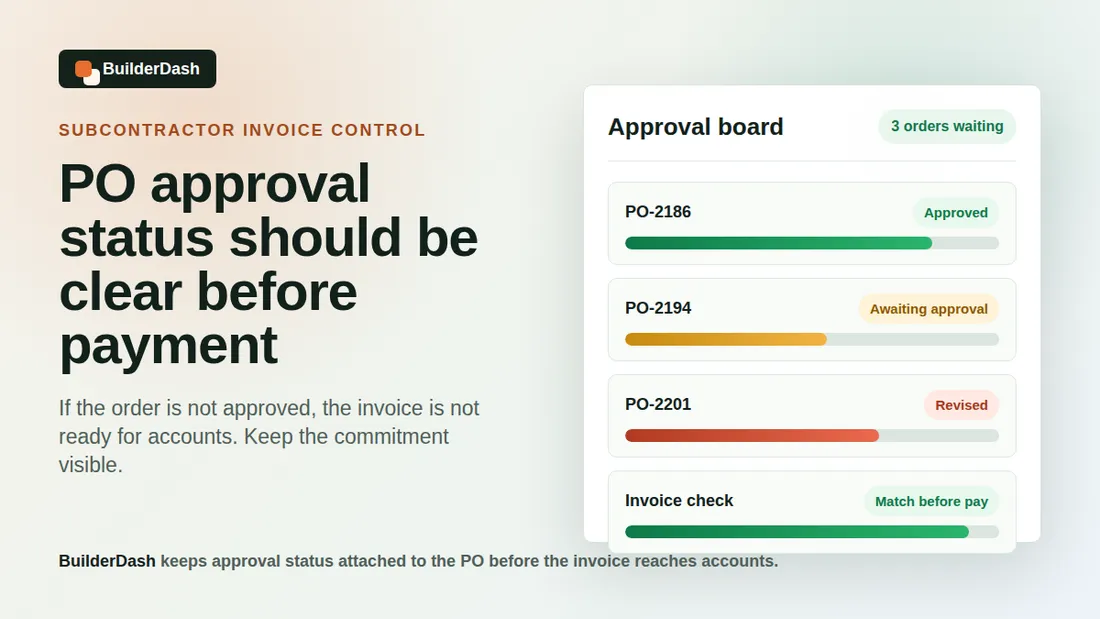
- Is the PO approved?
- Does the PO still match the current scope?
- Has any variation been recorded?
- Has the supplier invoiced yet?
- Does the invoice match the approved value?
- Is anything still blocked by missing evidence or a query?
That makes the review repeatable and easier to delegate. It also stops directors having to reconstruct the whole story from scratch each time.
Separate committed cost from cash flow
A weekly review is not just about cash leaving the business.
Some costs are already committed even if they are not yet payable. Others are visible as invoices but should still be queried because the PO, site record, or approval is incomplete. The business needs both views:
- committed cost for margin control
- invoice status for payment control
If those are mixed together, directors can think a job is safer than it really is, or accounts can be pushed into paying something that still needs review.
Make variations visible early
Variations are where weekly reviews earn their keep.
A small change on site can look harmless in the moment. An extra delivery, a second visit, a revised quantity, or a change in access can all add up. If the change is only captured when the invoice arrives, the team has lost the chance to challenge it properly.
Each variation should answer:
- What changed?
- Who approved it?
- What is the revised value?
- Does the supplier have the revised instruction?
- Is the original commitment still visible for comparison?
That keeps the commercial trail intact instead of hiding the change in a message thread.
Assign one owner for the follow-up list
A weekly review only works if actions are owned.
The meeting should end with a short list of follow-ups:
- get missing invoices
- confirm an updated PO value
- ask for a revised site reference
- resolve a queried amount
- chase a credit note
- update the job forecast
Each item needs one owner and one deadline. Without that, the review becomes a conversation rather than a control point.
What this looks like in practice
A practical weekly rhythm might be:
- Monday: review open commitments on each live job
- Tuesday: chase missing approvals or documents
- Wednesday: update variations and revised PO values
- Thursday: check invoice status before the payment run
- Friday: confirm what is still open and what will roll forward
That is enough to keep the commercial picture current without turning the office into a reporting factory.
How BuilderDash helps
BuilderDash helps a contractor keep the working record together.
Instead of splitting the story across emails, spreadsheets, WhatsApp, and folder names, the business can keep the approved PO, job reference, status, variation notes, and invoice check against the same live job. That makes a weekly review faster to run and easier to trust.
It also means the review can focus on decisions instead of hunting for documents.
Suggested internal links
- How to control purchase order overspend and variations in construction
- Why PO approval status should be checked before a subcontractor invoice is paid
- What construction businesses should standardise before automating accounts
Suggested call to action
If your live jobs only get a proper commercial check at month end, move that review to every week. BuilderDash helps keep approved POs, open commitments, variations and invoice status in one place before the margin slips.
Run your projects properly with BuilderDash.
One system for every enquiry, job, quote and invoice - built for project-based trades, not reactive call-outs.