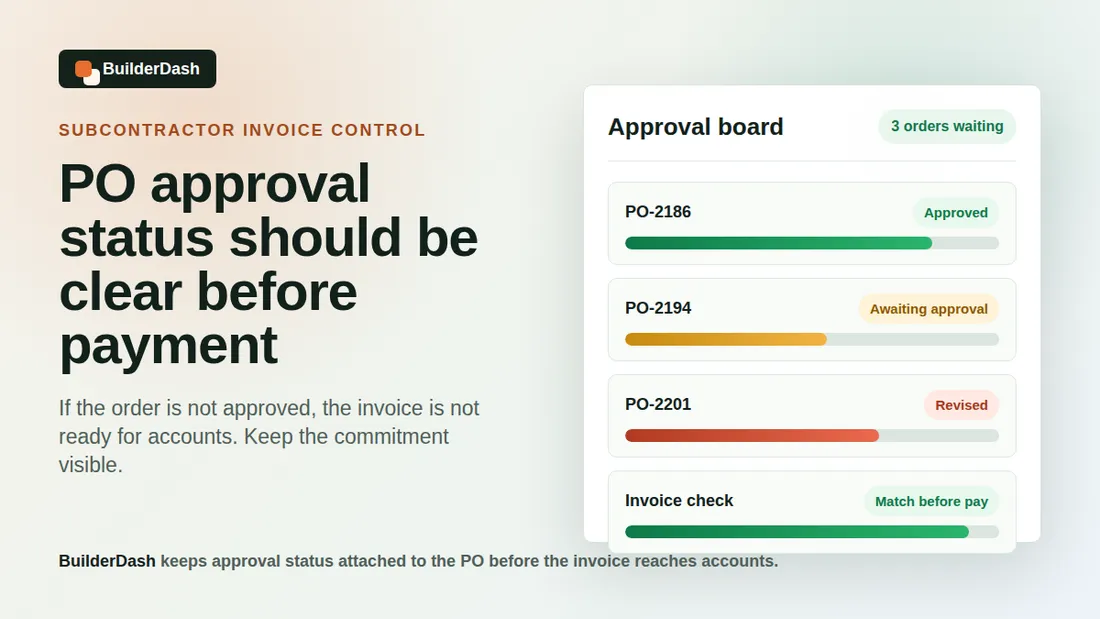
How to Control Purchase Order Overspend and Variations in Construction
 BuilderDash9 Jun 2026 8 min read
A purchase order can look like firm cost control until the work changes.
The site needs extra materials. A subcontractor is asked to complete additional work. Access restrictions increase labour time. A delivery quantity changes. Someone agrees the revised cost in a phone call or WhatsApp message, but the original purchase order remains untouched.
When the invoice arrives above the PO value, accounts sees an overspend. The project team sees an agreed variation. The director may see a cost that was never properly approved.
The problem is not simply that the invoice is higher than the order. The real problem is that the business failed to update its commitment before the invoice arrived.
Why PO overspend needs an operational workflow
Construction costs rarely stay perfectly static. Fit-out, refurbishment, maintenance, and subcontract works all involve changes. A useful purchase order process must therefore control both the original instruction and any authorised movement from it.
Without that process, an over-value invoice creates several questions:
- Was the extra work actually requested?
- Who agreed the revised price?
- Does the cost belong to the same scope or a separate variation?
- Is the additional amount recoverable from the client?
- Was there enough budget on the job?
- Has an earlier partial invoice already used some of the PO value?
- Should accounts approve, query, or hold the invoice?
Those questions should be answered when the cost changes, not during the payment run.
Keep the original purchase order visible
Do not overwrite the history of the original order.
The business should retain the initially approved value, scope, supplier or subcontractor, job reference, requester, approver, and approval date. That record shows what the business intended to commit before the change.
If the cost later rises from £5,000 to £6,200, simply changing the PO value to £6,200 removes useful context. The revised total may be valid, but the business also needs to know:
- The original commitment was £5,000.
- An additional £1,200 was requested.
- The reason for the change.
- Who approved the increase.
- When it was approved.
That distinction helps project managers understand cost movement and gives accounts a clear basis for checking the eventual invoice.
Treat a variation as a controlled change
A variation does not need a heavy administrative process, but it should be more than an informal message.
For each change, record:
- The related PO number.
- The job or project reference.
- A short description of the changed scope.
- The reason for the change.
- The additional or reduced value.
- Any supporting quotation, instruction, or evidence.
- Whether the cost is client-recoverable.
- The person requesting the change.
- The person approving it.
- The revised committed value.
This creates a traceable link between the original instruction, the changed work, and the invoice that follows.
For minor quantity changes, a revised PO may be enough. For a material scope change, a separate variation record or additional PO may be clearer. The right choice depends on how the business reports job costs, but the change should always be visible.
Set sensible overspend tolerances
Not every small invoice difference needs director approval.
A supplier invoice may vary because of a minor quantity adjustment, a delivery charge, or an agreed price movement. If every £5 difference creates a senior approval task, people will bypass the process or approve exceptions without looking.
Set a tolerance that reflects the type and value of the order. The business might allow a small percentage or fixed amount for defined cost categories while requiring formal approval for larger changes.
The rules should answer:
- Which roles can approve a small overspend?
- Does the tolerance apply to materials, subcontractors, plant, and services equally?
- Which changes always require a revised PO?
- Is the tolerance based on the original PO or the remaining uninvoiced balance?
- When must a director or commercial lead review the change?
A tolerance is not permission to ignore cost movement. It is a practical routing rule for separating minor differences from genuine variations.
Check the remaining PO value, not only the headline total
Partial invoices make overspend harder to spot.
Imagine a £10,000 subcontract order. The first invoice is £4,000 and the second is £3,500. The final invoice is £3,000. Each invoice may look plausible on its own, but the cumulative total is £10,500.
The useful comparison is not simply invoice value against original PO value. It is:
- Original approved value.
- Approved variations.
- Total previously invoiced.
- Current invoice value.
- Remaining uninvoiced commitment.
Accounts and project teams need the cumulative position. Otherwise a series of individually reasonable invoices can exceed the approved commitment without a clear warning.
Separate supplier price changes from scope changes
An invoice can exceed a PO for different reasons, and they should not all be handled in the same way.
A price change means the same goods or work now cost more. A scope change means the business ordered something additional or different. A quantity change may sit between the two.
The distinction matters because a scope variation may be recoverable from the client, while a supplier price increase may reduce project margin. A quantity increase might reveal an estimating issue, waste, or a legitimate site requirement.
Use a simple reason code or description so the cost movement can be reviewed later:
- Additional client instruction.
- Design or specification change.
- Site condition.
- Quantity increase.
- Supplier price change.
- Delivery or access charge.
- Correction to original order.
Better categorisation turns PO changes into useful commercial information rather than a collection of unexplained overspends.
Approve the change before instructing the work
The strongest control happens before the supplier or subcontractor proceeds.
In practice, urgent site decisions sometimes move faster than formal approval. The workflow should still make the responsibility clear. The person requesting extra work should submit the revised value and reason promptly, and the appropriate approver should confirm the commitment before the cost becomes difficult to reverse.
Where an immediate verbal instruction is unavoidable, record it the same day. Do not wait for the invoice to reconstruct what happened several weeks later.
This protects the supplier too. A clear written instruction reduces disputes about whether extra work was authorised and what value was agreed.
Link client variations to supplier commitments
For fit-out and refurbishment contractors, an additional supplier or subcontractor cost may relate directly to a client variation.
The internal record should show whether the cost is:
- Included in the original client scope.
- Recoverable through an agreed client variation.
- Submitted to the client but not yet agreed.
- A contractor cost that will not be recovered.
This does not replace proper contract administration. It gives the project and finance teams a practical view of the commercial position.
If the supplier commitment increases before the client variation is agreed, the business is taking a margin and cash flow risk. That risk should be visible to the person approving the extra spend.
Give accounts a clear invoice-checking rule
When an invoice exceeds the available PO value, accounts should not have to guess whether it is acceptable.
A clear workflow might be:
- Compare the invoice with the original PO, approved variations, and previous invoices.
- Accept differences within the agreed tolerance where the evidence is complete.
- Route larger differences to the project manager or commercial owner.
- Require a revised PO or approved variation before releasing the invoice.
- Record the decision with the invoice rather than in a separate message.
This keeps accounts focused on checking the record. It also keeps commercial approval with the people who understand the work.
How BuilderDash helps control revised commitments
BuilderDash connects purchase orders, approval status, job references, invoice checks, and supporting information in one workflow.
When a cost changes, the revised commitment can be recorded against the correct job and reviewed by the right person. When the invoice arrives, the business can compare it with the approved order position rather than searching through messages for evidence of an informal agreement.
That gives project teams a clearer view of committed cost, helps accounts identify genuine exceptions, and makes job costing more useful before bookkeeping catches up.
The aim is not to prevent every change. Construction work changes. The aim is to make sure changes are visible, authorised, and reflected in the cost record before they become invoice surprises.
A practical PO overspend check
Review five recent invoices that exceeded their original PO value and ask:
- Was the additional cost known before the invoice arrived?
- Was the reason for the increase recorded?
- Was the revised value approved by the right person?
- Could accounts see previous invoices against the order?
- Was any client-recoverable variation linked to the cost?
- Did the job cost report show the revised commitment promptly?
If the answers depend on individual memory or old messages, the business does not yet have a reliable variation workflow.
Control the commitment before the invoice
A purchase order is not finished when it is first approved. It remains a live commitment until the goods or work are complete and all invoices have been checked.
Good cost control means preserving the original order, recording authorised changes, monitoring the cumulative invoiced value, and escalating genuine overspend before payment is due.
That approach gives directors, project teams, and accounts the same version of the cost. More importantly, it shows the effect on job margin and cash flow while there is still time to act.
Related reading: How small contractors control spend before invoices arrive, how to spot partial subcontractor invoices, and what to standardise before automating construction accounts.
BuilderDash can help: Use BuilderDash to keep original purchase orders, approved changes, invoice checks, and revised job commitments connected before overspend reaches accounts.
Run your projects properly with BuilderDash.
One system for every enquiry, job, quote and invoice - built for project-based trades, not reactive call-outs.