How to Build a Purchase Order Approval Chain That Keeps Jobs Moving During Holiday Cover
 BuilderDash29 Jul 2026 5 min read
One absent approver can slow a live job down more than a shortage of materials.
If the only person who can approve a purchase order is on leave, in a meeting, or tied up on another project, site teams start waiting, suppliers start chasing, and the office starts making awkward judgment calls from memory. That is how a simple sign-off process becomes a bottleneck.
The fix is not to remove control. It is to build an approval chain that still works when the usual approver is not available.
Why approval chains break in practice
Most construction businesses do not run out of control because they approve too much. They run into trouble because the approval rule is unclear.
The common failure modes are simple:
- one person approves everything
- nobody knows who can approve by value
- holiday cover is not written down
- site asks for a quick answer and the office improvises
- the PO is raised, but the approval never reaches the record
When that happens, the team can no longer tell whether a cost was properly authorised or merely discussed in passing.
Set the chain by value, not by habit
A useful approval chain starts with value thresholds.
You do not need a complicated policy. You need a rule that people can remember and apply consistently.
For example:
- small, routine orders can go to a project lead or site manager
- mid-range spend may need a project manager or commercial manager
- higher-value commitments may need director sign-off
The exact limits will differ from one business to another. The important part is that the rule is explicit, written down, and visible before anyone places the order.
Separate request, review, and approve
Approval gets messy when one person is expected to do everything in one step.
A better workflow is:
- The site or project team raises the request.
- The reviewer checks the cost, supplier, and job reference.
- The approver signs off the value.
- The order is sent only after the approval is recorded.
That split matters because it gives the business a clearer audit trail. If something later needs to be queried, everyone can see who raised it, who checked it, and who approved it.
Build in holiday cover from the start
Holiday cover should not be an exception process.
If the normal approver is away, the chain should already show who steps in next. That deputy might be a project director, a commercial manager, or another named approver with the right authority.
A good cover rule should answer three questions:
- who can approve in the regular flow?
- who can cover that person when they are away?
- does the deputy have the same limit, or a lower one?
If those answers are not clear, the job will still move, but it will move through informal messages instead of a controlled process.
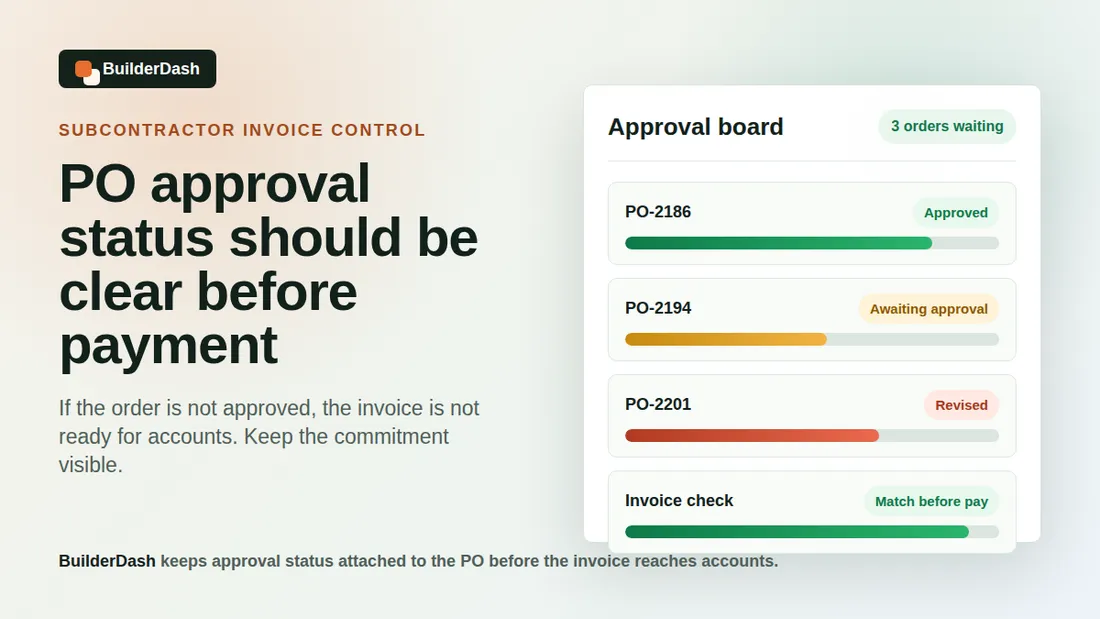
Make the approval visible on the PO
A PO approval chain only works if the result is easy to see later.
When accounts open the record, they should not have to search email threads or ask the site team who said yes. The PO should show:
- the requested value
- the approved value
- the approver
- the date and time of approval
- any notes that explain the decision
That record helps with invoice matching later, but it also stops the office from re-litigating decisions that were already made.
Treat out-of-office cover as a normal control
Many businesses still rely on a “just send it to me on WhatsApp” approach when someone is away.
That works until the team is busy, the message gets buried, or nobody can prove what was agreed. A written approval chain is better because it keeps cover decisions attached to the job, not to a private phone.
It also helps the person covering the role. They know what they are authorised to approve, and they do not have to guess whether they are overstepping the mark.
Keep the chain linked to the job record
A purchase order is only useful if it is tied to the job it belongs to.
The approval chain should carry the same reference from request through to posting so the office can see which project, package, or cost code it belongs to. If the reference changes halfway through, the approval history becomes harder to trust.
That is especially important on live jobs with multiple packages, overlapping suppliers, and changing site conditions. The more moving parts a project has, the more valuable a clear approval chain becomes.
What BuilderDash helps with
BuilderDash helps keep the request, approval, and job record together so the business can see who can authorise what, even when the usual approver is away.
That means the site team can keep moving, the office can keep control, and the approval trail stays readable when the invoice arrives later.
Suggested internal links
- Why Directors Should Not Be the Accounts Department Bottleneck
- Construction Purchase Order Software: What Actually Controls Spend
- What to Standardise Before Automating Construction Accounts
- Why PO Approval Status Should Be Checked Before a Subcontractor Invoice Is Paid
Practical takeaway
If the business only works when one person is available to approve everything, the approval process is already too fragile.
Write down the value limits, name a deputy, keep the approval visible on the PO, and make sure the job reference stays with the record. That way holiday cover becomes a normal part of the workflow instead of a reason for work to stop.
Call to action
If purchase order approvals are still being handled by memory, ad hoc messages, or one overworked inbox, BuilderDash can help you keep the request, the approver, and the job cost record in one place.
Run your projects properly with BuilderDash.
One system for every enquiry, job, quote and invoice - built for project-based trades, not reactive call-outs.