How to Reconcile Subcontractor Applications for Payment Before They Reach Accounts
 BuilderDash13 Jul 2026 7 min read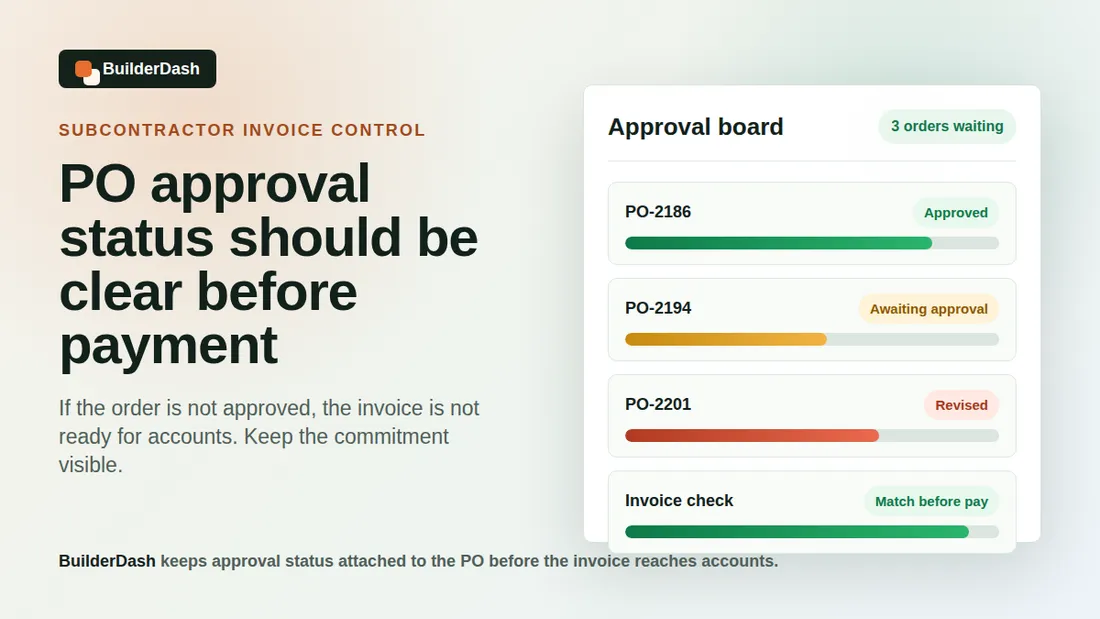
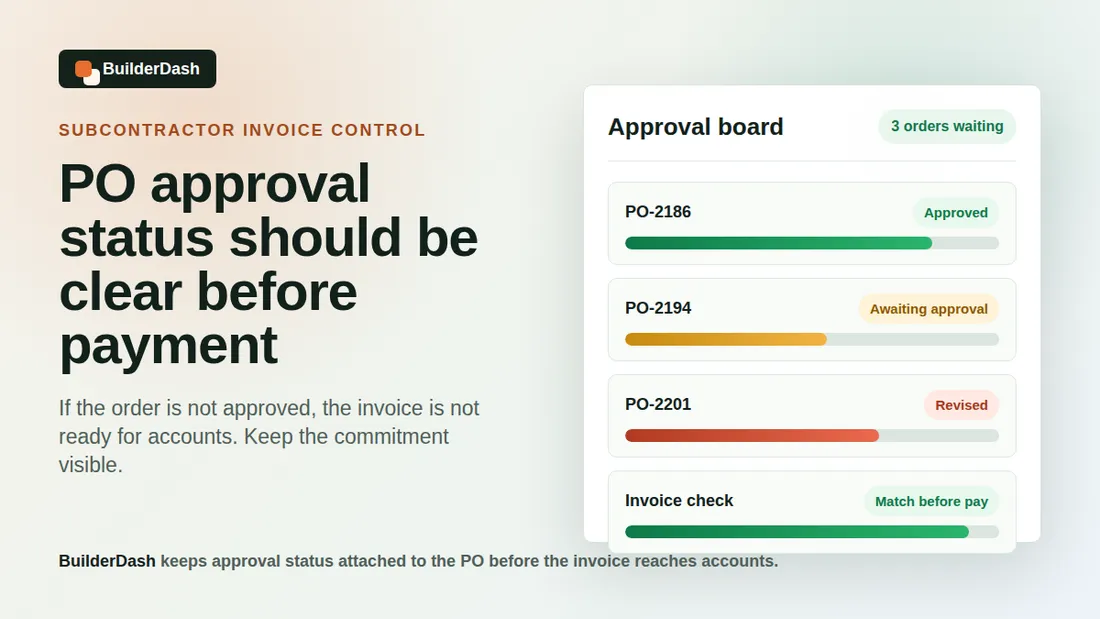
Subcontractor applications for payment should move through the business as a clear decision, not as a loose trail of messages, signatures, and half-remembered agreements. When the approval record is thin, accounts has to stop and reconstruct the story before anything can be posted. That slows down payment, creates unnecessary follow-up, and makes the job cost picture harder to trust.
For UK contractors, fit-out firms, refurbishment teams, and subcontract packages on active sites, the fix is not more admin for its own sake. It is a cleaner approval trail that tells accounts exactly what was claimed, what was accepted, what was still questioned, and who made the decision.
What you are actually reconciling
An application for payment is not just another invoice with different wording. It is a request for a certified value based on work claimed, often before final invoicing catches up. That means the office is not only checking arithmetic. It is checking whether the claim reflects what was agreed on site, what has genuinely been completed, and whether any part of the value still needs review.
If the record only shows a total amount, the team can miss the detail that matters:
- the claimed value may be higher than the accepted value
- a variation may be included but not yet approved
- part of the work may be complete while another part is still open
- the approver may have accepted the application subject to a correction
- accounts may only see the final number, not the reason behind it
Reconciling the application means making those distinctions visible before the record reaches accounts.
The checks that should happen first
A good approval trail is built from a small number of repeatable checks. They do not need to be complicated, but they do need to happen in the same order every time.
Start with:
- the subcontractor name and package
- the application number or period
- the job or project reference
- the claimed value
- the accepted value
- any disputed or held value
- the approver name and role
- the date of approval
- the supporting evidence attached to the decision
Once those basics are captured, accounts can tell whether the application is ready to post, ready only in part, or still waiting on information.
That is the difference between a workable process and a folder full of disconnected documents.
Where approval trails usually break
Most problems do not come from a lack of intent. They come from people approving work in different places and leaving the record incomplete.
Common failure points include:
- a site manager confirms the work verbally, but nothing is logged
- a QS approves a value in chat, but the message is hard to find later
- the application is reviewed, but the reason for a reduction is not written down
- the office receives the paperwork before the approver has attached evidence
- the subcontractor is told to amend the claim, but the original version is still the one sitting in accounts
Once that happens, the business has to spend time joining the dots again. Even if the right decision was made, the wrong record means the rest of the workflow still stalls.
Keep the claim, the decision, and the next step separate
A clean workflow works best when three things are visible at the same time:
- What was claimed.
- What was approved.
- What still needs to happen before posting or payment.
Those are related, but they are not the same.
The claim is the subcontractor’s request. The decision is the commercial or site approval. The next step is the action that gets the record ready for accounts.
If those three things are mixed together in one email thread, the team has to re-read the whole conversation every time somebody wants an answer. If they are separated cleanly, the invoice or application can move through the business with far less friction.
How to handle partial approval properly
Partial approval is normal on construction jobs. It should not be treated like a failure.
A claim may include a value that is accepted, a value that is still disputed, and a value that simply needs a different supporting document. If the record only allows a yes-or-no status, the team loses the useful middle ground.
Better practice is to record:
- the accepted amount
- the disputed amount
- the reason for the reduction
- the person responsible for the follow-up
- whether the accepted balance can be posted now
That gives accounts a clear instruction and stops a partly agreed claim from sitting unresolved because nobody is sure what to do with it.
It also protects job costing. The accepted part can be posted without pretending the disputed part has disappeared.
What accounts needs to see at posting time
By the time the application reaches accounts, the question should not be "who do we ask about this?"
It should already show:
- whether the application is approved
- whether it is approved in full or in part
- which amount can be posted
- who approved the decision
- when the approval happened
- what evidence backs it up
- whether any follow-up is still outstanding
That is enough for accounts to post the right value without restarting the approval process from scratch.
It also means a director or commercial manager can see where the delay sits. The hold-up might be with the work itself, the approval decision, or the paperwork around it. Those are different problems and they need different fixes.
Keep the evidence attached to the decision
An application for payment is much easier to reconcile when the evidence sits with the record rather than in a separate inbox.
Depending on the package, that evidence might be:
- site sign-off
- progress photos
- agreed rates
- measurement sheets
- timesheets
- daywork records
- variation confirmation
The important thing is not the document type. It is whether the approver and accounts can check the claim quickly without having to hunt for the original conversation.
If the evidence is attached at approval stage, the record is easier to trust later when the payment run or job review comes around.
One owner should move the application forward
Applications often get delayed because everyone assumes someone else is looking after the next step.
Site may have checked the work. Commercial may have reviewed the value. Accounts may be waiting for a final status. The task is shared, but the record still needs one named owner who is responsible for moving it forward.
That owner should be able to answer:
- is the application complete?
- if not, what is missing?
- is the value approved, reduced, or held?
- has the subcontractor been told what happens next?
- can accounts post the accepted amount now?
Without that ownership, the application just sits between teams.
Why this matters for cash flow and job costing
When subcontractor applications are reconciled cleanly, the business gets two benefits at once.
Cash flow improves because accounts is not stuck chasing approval information at the last minute. Job costing improves because the approved value is clearer than a rough estimate or a half-finished note.
That matters on live jobs where commercial decisions happen quickly. A record that clearly shows the accepted value, the remaining query, and the owner for follow-up gives the business a better view of committed cost without inflating the admin burden.
The goal is not to make the process heavier. It is to make the decision visible enough that everyone else can act on it.
A simple workflow to put in place
A practical approval trail for subcontractor applications for payment looks like this:
- The application arrives with the job reference and supporting evidence.
- Site or commercial checks the claim against what was agreed and what has actually been completed.
- The approval decision is recorded immediately.
- Any reduction, query, or partial approval is written down clearly.
- One owner is assigned to any missing item or correction.
- Accounts can see whether the accepted amount is ready to post.
- The record stays open until the balance is resolved or closed.
That workflow is simple enough to repeat, which is what makes it useful.
How BuilderDash helps
BuilderDash helps construction teams keep the approval trail, the application, and the job cost context together in one place.
That gives site, commercial, and accounts the same view of what was claimed, what was approved, and what still needs attention. It reduces the chance that a real decision gets lost between conversations and makes posting the accepted value much faster.
Suggested internal links
- What a Clean Subcontractor Invoice Workflow Looks Like
- What to Check Before a Construction Payment Run
- How to Stop Invoice Queries Going Missing Between Site and Accounts
- How Partial Subcontractor Invoices Affect Job Costing
Suggested call to action
Talk to BuilderDash about keeping approvals, invoices, and job cost data in one place.
Run your projects properly with BuilderDash.
One system for every enquiry, job, quote and invoice - built for project-based trades, not reactive call-outs.