How to Spot Partial Subcontractor Invoices Before They Hit Bookkeeping
 BuilderDash30 May 2026 7 min read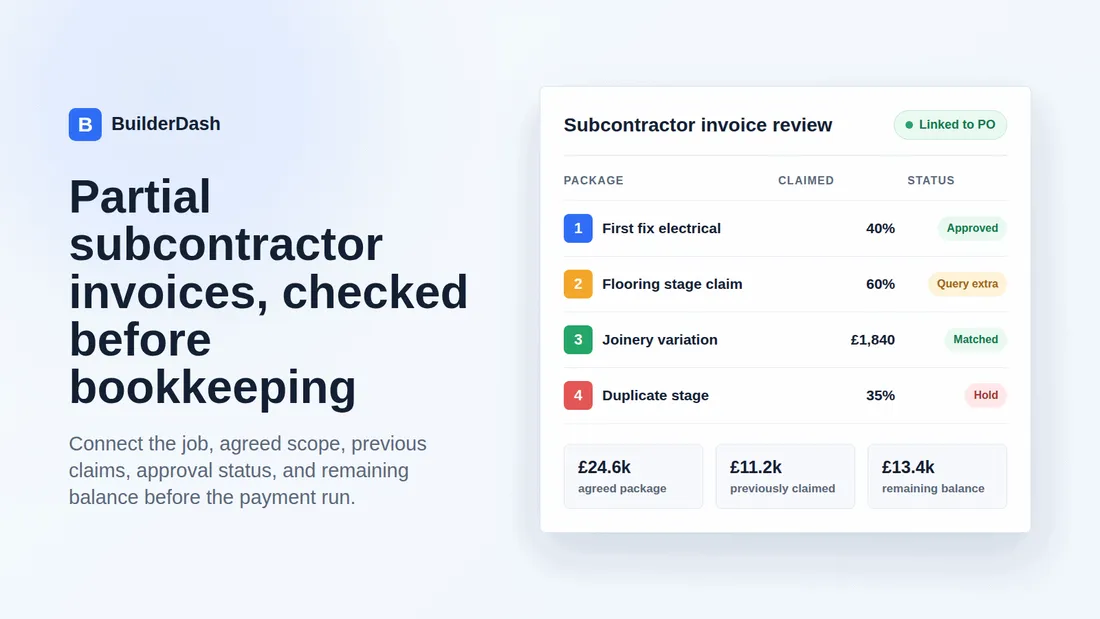
Partial invoices are normal in construction. A subcontractor may invoice for a stage payment, a percentage of completed work, materials on site, labour already supplied, or part of a variation while the rest of the job is still moving.
The issue is not the partial invoice itself. The issue is what happens when the business cannot quickly see whether the invoice is the first claim, a second claim, a duplicate, a variation claim, or the final balance.
If that check only happens once the invoice reaches bookkeeping, it is already late. Accounts may code the cost to the right job, but still miss whether the amount is correct against the agreed scope. Project managers may remember the work, but not the previous claim. Directors may approve payment because the subcontractor is known, even though the job cost position is incomplete.
For UK fit-out, refurbishment, maintenance, and subcontract-led construction work, partial invoice control needs to happen before the payment run.
Why partial invoices cause confusion
Subcontractor costs rarely arrive in one clean final invoice. A package might be agreed at a fixed value, then claimed in stages. Another package might include dayworks, extras, retentions, or a disputed variation. On a fast-moving job, the subcontractor may send an invoice before the site team has updated the office on what has actually been completed.
That creates common questions:
- Is this invoice part of the original agreed value?
- Has the subcontractor already claimed for this stage?
- Is this a variation or part of the base package?
- Is the previous invoice paid, approved, queried, or held?
- Is there retention or a balance still to come?
- Which job, site, phase, or purchase order does it relate to?
When those answers are not visible, accounts has to chase the project team. The invoice may sit in an inbox, get approved on memory, or be entered into bookkeeping with incomplete context.
The risk is weak job costing
Partial invoices can make job costing look better or worse than reality.
If a subcontractor has completed half the work but invoiced most of the value, the job may be carrying cost earlier than expected. If the work is mostly complete but the invoice has not arrived, the job may look healthier than it is. If a variation is mixed into a normal stage claim, the original order value and the actual cost can drift apart without anyone noticing.
The result is not just an accounts admin problem. It affects decisions on margin, cash flow, payment timing, and whether the contractor is still in control of the package.
Good job costing depends on knowing three things:
- What was agreed
- What has been approved
- What has already been invoiced
Partial invoices are where those three records often stop lining up.
Start with the agreed scope or purchase order
Every partial invoice should be checked against the agreed scope, subcontract order, or purchase order before it is treated as ready for bookkeeping.
That does not mean every small contractor needs a complicated commercial system. It does mean the business needs a clear reference point for the expected value and description of the work.
At minimum, the check should confirm:
- Subcontractor name
- Job or site reference
- Purchase order or agreed package value
- Stage or percentage being claimed
- Previous invoices received against the same work
- Any approved variations
- Any retention, contra charge, or hold point
Without that baseline, a partial invoice is just a number in an inbox.
Separate stage claims from variation claims
One of the easiest ways to lose control is allowing stage claims and variations to blur together.
A subcontractor invoice might include a normal stage payment and an extra item on the same document. That extra item may be valid, but it should still be checked against an approval, instruction, or variation record. If it is simply absorbed into the invoice total, the business loses sight of whether the original package has changed.
For example, a flooring subcontractor might submit:
- 40% stage claim for the agreed flooring package
- Additional preparation work
- Extra trims requested on site
- Materials uplift due to a changed specification
Those items should not all be treated the same. The stage claim belongs against the original package. The extras need their own approval trail.
Watch for duplicate claims
Partial invoices create more opportunities for duplicate claims than final invoices.
A duplicate may not be an exact copy. It might use a different invoice number, a slightly different description, or a different percentage claim. It might be sent again because the subcontractor has not been paid yet, or because an office administrator reissued it.
Useful checks include:
- Has the same stage already been invoiced?
- Does the invoice value match a previous claim?
- Does the description repeat a previous line item?
- Has a credit note or revised invoice replaced the earlier one?
- Is the subcontractor chasing payment or submitting a new claim?
These checks are hard when previous invoices sit in email threads and approvals sit in messages. They become much easier when the invoice is linked to the job and purchase order record.
Make invoice status visible
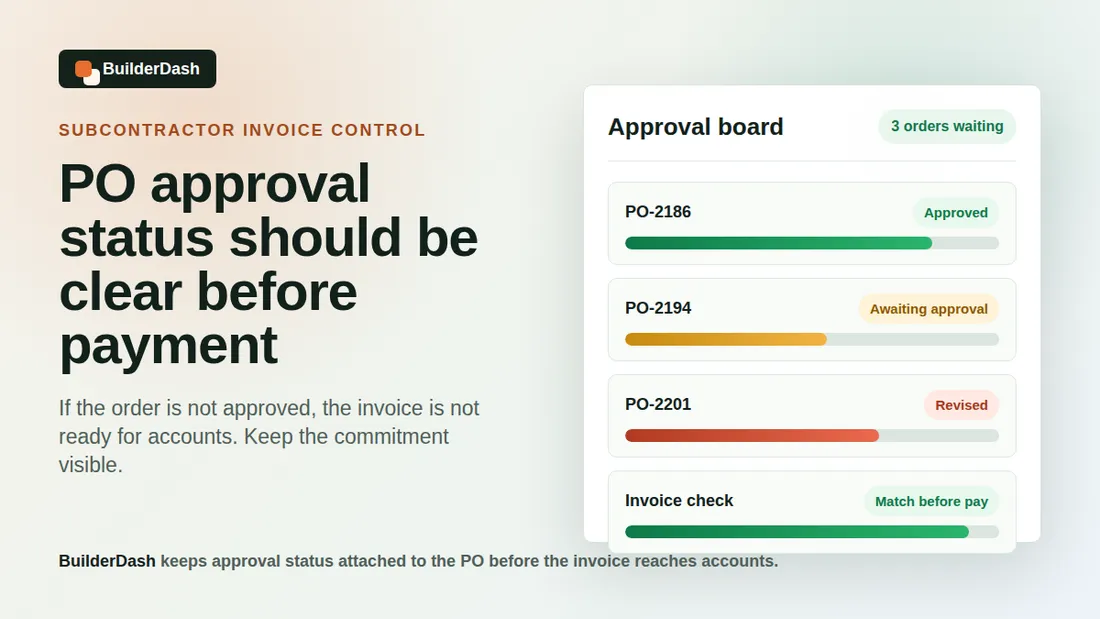
Partial invoices need a clear status so the business knows what can move forward.
Useful statuses include:
- Received
- Awaiting project review
- Queried
- Approved against agreed scope
- Approved as variation
- Held for retention or dispute
- Ready for bookkeeping
- Ready for payment
The status does not need to be over-engineered. It just needs to stop unclear invoices being treated as if they are clean and approved.
For accounts, the important point is simple: if an invoice is partial, the approval should explain what part it covers.
Keep project managers involved without slowing accounts
Project managers and site leads often know whether the work was done, but they should not have to rebuild the full cost history every time a subcontractor invoice arrives.
A better workflow gives them the relevant context at the point of review:
- The original order or agreed value
- Previous invoices against the package
- Open queries
- Approved variations
- Remaining balance
- Job reference and cost code
With that information visible, the project manager can make a practical decision: approve, query, hold, or request correction.
How BuilderDash helps
BuilderDash helps contractors keep purchase orders, approvals, invoice checks, and job references connected in one workflow.
For partial subcontractor invoices, that means the invoice can be checked against the information the business already holds, rather than starting a new chase each time. Accounts can see the job reference. Project teams can review against the agreed value. Directors can focus on exceptions rather than every routine invoice.
The aim is not to make subcontractor invoice control slower. It is to make the important checks easier to do before costs reach bookkeeping.
A practical checklist for partial invoices
Before sending a partial subcontractor invoice to bookkeeping, check:
- Is the job or site reference clear?
- Is there a purchase order, subcontract order, or agreed package value?
- Does the invoice say which stage, percentage, or work section it covers?
- Have previous invoices against the same package been checked?
- Are variations separated from the original scope?
- Are retentions, holds, or contra charges clear?
- Has the project manager approved the claim with the right context?
- Is the invoice status clear enough for accounts to process it?
If those checks cannot be answered quickly, the invoice is not ready. It may still be valid, but it needs review before it becomes part of the financial record.
Catch the issue before bookkeeping
Bookkeeping should record the agreed position. It should not be the first place where the business works out what the invoice means.
Partial subcontractor invoices need context: agreed scope, job reference, approval status, previous claims, and any variations. When those records are connected early, the business can reduce duplicate payments, protect job costing, and keep payment runs moving with fewer last-minute questions.
That is the practical value of a cleaner subcontractor invoice workflow. It gives accounts, project teams, and directors the same view before the cost is posted.
Related reading: Construction purchase order software and reducing end-of-month invoice chasing.
BuilderDash can help: Use BuilderDash to connect subcontractor invoice checks with purchase orders, approvals, job references, and previous claims before costs reach bookkeeping.
Run your projects properly with BuilderDash.
One system for every enquiry, job, quote and invoice - built for project-based trades, not reactive call-outs.