

Partial invoices are easy to miss because they often look like ordinary progress claims.
The real risk is not just that a supplier or subcontractor has billed part of the work. It is that bookkeeping sees a clean number before the commercial record confirms whether the value is correct, whether the balance is still open, and whether the same cost will appear again later.
A simple check at the point the invoice arrives is usually enough to stop the wrong amount being posted.
What a partial invoice really tells you
A partial invoice is not automatically a problem.
It may be a legitimate stage claim, a part delivery, a measured value application, or a split invoice where the supplier has billed only what was completed this week. The issue comes when the office treats it as a normal invoice without checking what remains outstanding.
Before anything is posted, ask:
- Is this part of a larger PO or agreed order?
- Has the supplier billed against one stage, one delivery, or one batch?
- Is there a remaining balance that still has to arrive later?
- Does the claimed amount match the work or goods actually received?
If those answers are unclear, the invoice needs a commercial check rather than a bookkeeping tick.
Check the invoice against the original commitment
The fastest way to spot a partial invoice is to compare it with the original commitment.
That means checking:
- the purchase order value
- the approved quote or scope of works
- the delivery note or site sign-off
- any variation or revised instruction
- the previous payments already made against the job
If an invoice is for only part of the agreed amount, bookkeeping needs to know whether the balance is still due, already billed elsewhere, or simply missing from the paperwork.
That matters because a partial claim can otherwise distort:
- committed cost
- actual cost to date
- remaining budget
- cash flow forecasts
- supplier statements at month end
Separate a genuine part-claim from a broken process
Not every partial invoice is a clean commercial claim.
Sometimes it is simply a sign that the process broke down on site. A supplier may have split a delivery because stock was short. A subcontractor may have billed only the first phase because the second phase was never formally varied. A foreman may have approved the work in conversation but never passed the context to accounts.
A useful rule is this: if the invoice cannot be matched back to a clear scope, it should not be treated as ready just because the value looks reasonable.
Give bookkeeping a simple decision rule
Bookkeeping should not have to guess whether a partial invoice is acceptable.
A clear internal rule helps the team decide quickly:
Post it
Post the invoice only when the job reference, approved scope, and remaining balance are all clear.
Hold it
Hold the invoice when the value might be right but the supporting record is missing.
Query it
Query the invoice when the supplier has billed part of the work but the office cannot see what the claim relates to.
The key is consistency. If one part invoice is posted on trust while another is held for evidence, the job cost record stops being reliable.
What evidence should travel with the claim
The more partial the invoice, the more important the backup.
Useful evidence usually includes:
- the original PO
- the agreed stage or drawdown schedule
- a delivery note
- a measured valuation
- a signed site instruction
- a variation record
- a note showing what remains outstanding
If the invoice is only for part of the work, that missing evidence is what tells accounts what the rest of the story is.
What site teams should send before the invoice arrives
The office can only work with what it receives.
Site and commercial teams make life much easier when they send:
- the correct job or site reference
- the reason the invoice is partial
- the balance still expected
- the approval trail for the completed part
- the date the remaining work or supply is expected
That short handover prevents the accounts team from trying to reconstruct the position from memory or from an email chain that has already gone stale.
How BuilderDash helps
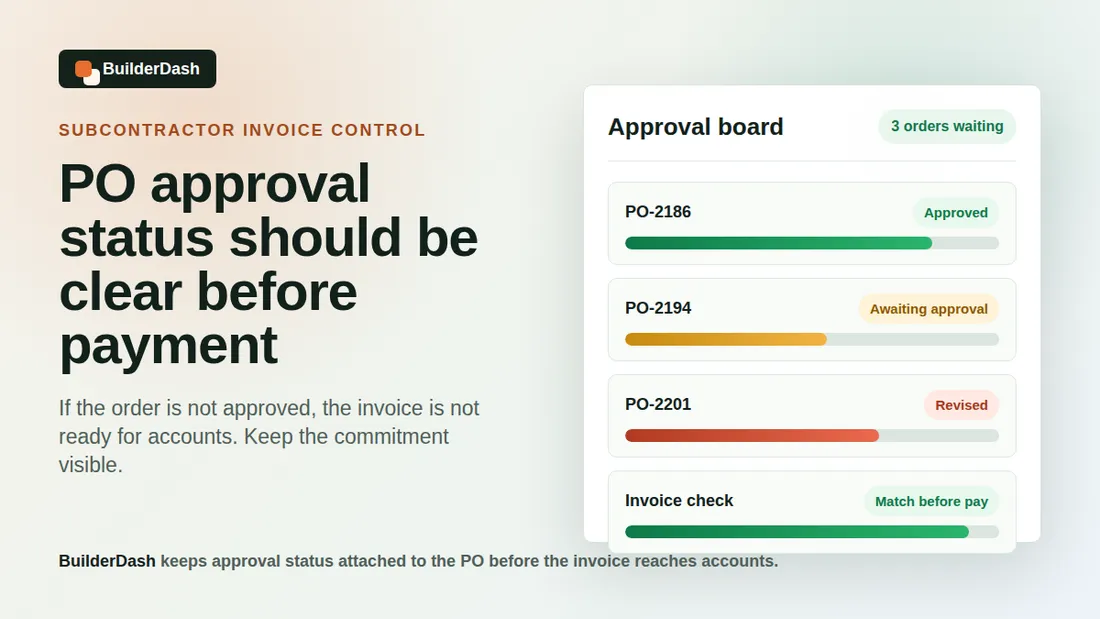
BuilderDash helps keep the original commitment, approval, and invoice check in one place so partial claims do not get posted as if they were complete.
That makes it easier to see what has been billed, what is still outstanding, and what needs a query before the cost hits bookkeeping. For UK contractors, that means cleaner job cost records, fewer month-end surprises, and less time spent unpicking half-finished claims.
Suggested internal links
- What to Do When an Invoice Arrives Without a PO Number
- What a Clean Subcontractor Invoice Workflow Looks Like
- How to Reconcile Supplier Statements Before Month End
- How to Reduce End-of-Month Invoice Chasing in Construction
Call to action
If partial invoices keep reaching bookkeeping before the team has checked the balance and supporting evidence, tighten the rule at the point of receipt. BuilderDash is built to keep the PO, approval, and invoice check together so the right amount is posted the first time.
Run your projects properly with BuilderDash.
One system for every enquiry, job, quote and invoice - built for project-based trades, not reactive call-outs.