How to Stop Duplicate Purchase Orders on Live Construction Jobs
 BuilderDash12 Aug 2026 7 min read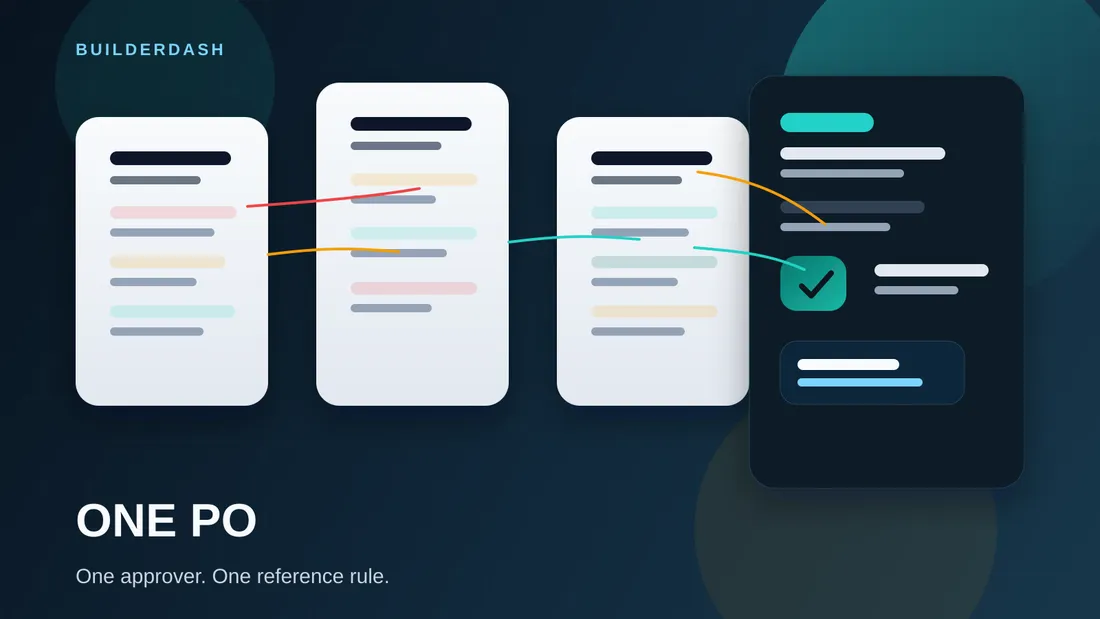
Live construction jobs do not usually create duplicate purchase orders on purpose.
They happen because the same commitment is being confirmed in different places at different times. Site thinks the order is live. Office is still waiting for a clean message. The supplier has taken the call but not seen the record. Then someone raises another PO "just to be safe", and the job ends up with two live commitments for the same work.
A duplicate PO is not just messy paperwork. It confuses accounts, weakens job costing, and makes it harder to tell which order the supplier should follow.
Why duplicate POs happen
Duplicate orders are usually a control problem, not a people problem.
On a typical job, the same spend can pass through several hands:
- a site manager asks for the work or materials
- an office user raises the first order
- a director or commercial lead approves it
- the supplier confirms it by phone or email
- someone on site forwards the request again because they cannot see the first record
If those confirmations live in separate inboxes, chats, notebooks, and supplier calls, the business cannot easily tell whether the PO already exists.
That is how two people end up creating two records for one commitment.
The real risk is not the second number
A duplicate PO is rarely dangerous because of the number itself. It is dangerous because the business starts treating one job commitment as if it were two.
That causes predictable problems:
- the supplier receives conflicting order numbers
- accounts sees two commitments for the same work
- job cost reports overstate the live commitment
- invoice matching becomes harder
- one PO gets updated while the other is forgotten
- someone approves the same spend twice because the first trail is hidden
By the time the invoice arrives, the team is often spending time trying to work out which PO was "the real one" instead of checking the cost properly.
Use one live record for each commitment
The most reliable fix is to keep one live record per commitment and make it visible to everyone who might create a second version.
That record should show:
- the supplier or subcontractor
- the job or project reference
- the scope or description
- the approved value
- the current status
- who approved it
- when it was approved
- whether it has already been sent to the supplier
If the record is easy to find, the team does not need to make a fresh PO "just in case".
One approver keeps the trail readable
Duplicate POs often appear when more than one person thinks they are responsible for the final say.
One person approves in principle on site. Another confirms the same spend in the office. A director green-lights a call. A project manager then raises a separate order because they did not know the earlier approval was already live.
To stop that, each type of commitment needs one named approver.
The approver does not have to do every check themselves, but they do need to be the clear owner of the final yes. That way:
- site knows who to ask
- office knows whose approval counts
- suppliers know which order is active
- accounts knows which record to trust
Without that clarity, duplicate orders are almost inevitable on busy jobs.
One reference rule prevents multiple versions
The easiest way to create a duplicate is to let the same job be described in several slightly different ways.
For example:
- Unit 4 fit-out
- 4th floor unit four
- Oak Street unit 4
- OS-4 fit-out
- client cafe package
Those names may all mean the same thing to the people involved, but they do not help the system or the office spot a duplicate.
A simple reference rule solves a lot of this:
- Every live job gets one standard reference.
- Every PO uses that reference in the same place.
- Any revised or repeated order points back to the original commitment.
- Nobody creates a new number just because the wording changed.
That does not remove judgment. It removes ambiguity.
Check the status before raising a new PO
The safest time to catch a duplicate is before the new order is raised.
Before creating a PO, ask:
- Has this supplier already been instructed?
- Is there already a live PO on this job?
- Was the order approved verbally but not yet written down?
- Is this a revised order or a brand-new commitment?
- Can the existing PO be updated instead of duplicated?
If the answer is not obvious, the team should check the live record before adding another number.
That is especially important on active jobs where work is moving quickly and the same request can be repeated by different people on the same day.
Make supplier confirmation part of the same workflow
Suppliers often help create duplicates without meaning to.
They may confirm a call, accept an email, and then wait for the official PO. If the first order is not visible to the office, someone may send a second one because they think the supplier has not been instructed.
The cleaner approach is to keep supplier confirmation with the same live record.
The record should show:
- when the supplier was first told
- which PO number they received
- whether they acknowledged it
- whether any revision replaced the first version
That prevents the business from guessing whether the supplier is already live on the job.
Treat revisions and duplicates differently
A revised PO is not the same as a duplicate PO.
A revision means the same commitment has changed. A duplicate means the same commitment was created twice. If the business does not separate those two cases, the records become hard to trust.
The question should always be:
- did the scope change, or
- did we accidentally record the same scope twice?
That distinction matters for approvals, margin, and invoice checks later.
What accounts needs to see
Accounts should not have to compare six messages to work out whether an invoice belongs to PO 1042 or PO 1088.
By the time the invoice arrives, the record should already show:
- which PO is active
- whether a second PO was created in error
- whether the original order was revised
- who approved the latest version
- whether the supplier was told which number to use
If that is not clear, the invoice should be held until the job team resolves the record.
A simple anti-duplicate checklist
The most practical routine is the one the team can repeat every day:
- Search the live job reference before raising a new PO.
- Check whether the supplier has already been instructed.
- Confirm whether the request is new, revised, or already live.
- Use the same reference rule on every order.
- Make one approver responsible for the final yes.
- Send the supplier only one active PO number.
- Close or supersede the old record if a revision replaces it.
That is enough to stop most accidental duplicates without creating a heavy process.
Why this matters for BuilderDash users
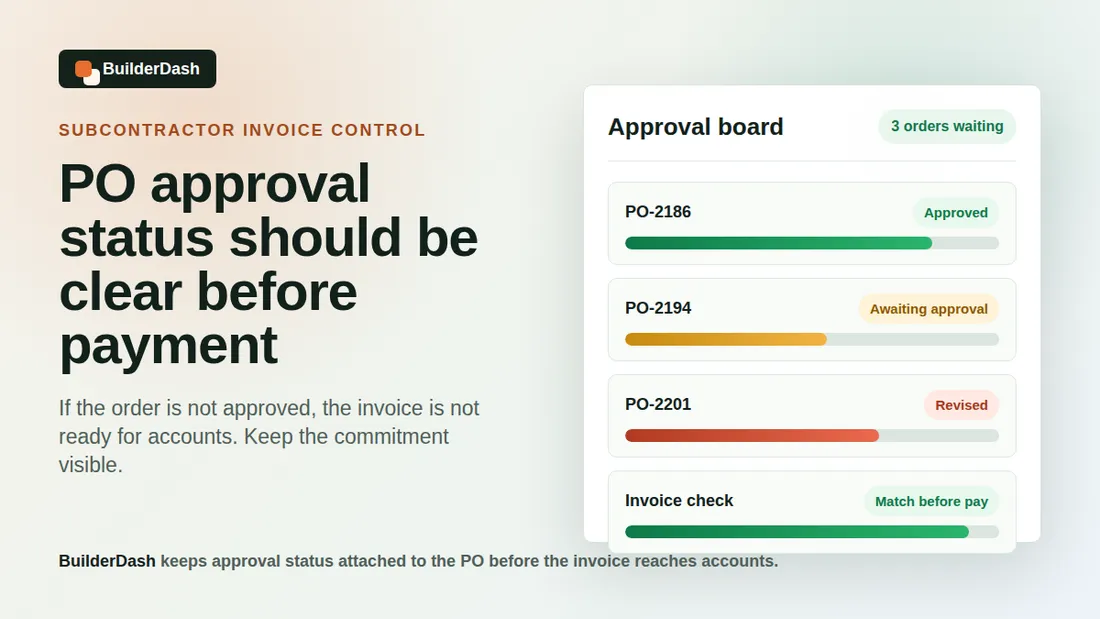
BuilderDash is useful here because the job reference, approval trail, and current PO status live together instead of being split across different tools.
That makes it easier to see whether a commitment already exists, whether it has been approved, and whether a revised order should replace the original record instead of creating another one.
For small and mid-sized contractors, that means fewer duplicate commitments, fewer invoice queries, and a cleaner view of what each job actually owes.
Suggested internal links
- How to Control Purchase Order Overspend and Variations in Construction
- What to Do When an Invoice Arrives Without a PO Number
- Why Construction Invoice Backups Should Travel With the Invoice
- Why Subcontractor Payment Applications Need a Clear Approval Trail Before Accounts Posts Them
Call to action
If duplicate POs are still slipping through because site, office, and suppliers are working from different confirmations, tighten the workflow now. BuilderDash helps you keep one live record, one approver, and one reference rule so the same commitment does not get raised twice.
Run your projects properly with BuilderDash.
One system for every enquiry, job, quote and invoice - built for project-based trades, not reactive call-outs.