How to Keep Project References, Purchase Orders and Invoices Aligned
 BuilderDash18 Aug 2026 2 min read
On a busy fit-out or refurbishment job, the invoice problem is rarely the price. It is the paperwork mismatch. One supplier uses a short site name, the site team uses a verbal nickname, and the office gets an invoice with no clear job number. That is how simple approvals turn into a chase.
Why the reference trail matters
A clean reference trail lets the office trace a cost from quote to purchase order to delivery note to invoice. If those documents do not match, the approver has to guess. Guessing is what creates slow approvals, misfiled costs and awkward month-end clean-up.
What good looks like on a live job
Every job should have one reference that stays the same from the first quote to the final invoice. The reference needs to appear on the purchase order, the supplier’s paperwork, and the invoice itself. If a variation is agreed, it should be added to the same record instead of floating around in email.
A simple workflow that works
- Create the job reference before any order is placed.
- Put the reference on every purchase order and in the subject line of related emails.
- Ask suppliers to copy the reference onto their invoices.
- Match the invoice against the purchase order, delivery note and any approved variation.
- Only approve when the value, cost code and budget line all make sense.
Where teams usually go wrong
- The site team calls the job one thing while the office has a different code.
- The invoice carries the head office reference instead of the live project reference.
- A variation is agreed verbally but never added to the paper trail.
- Approval happens before the cost is checked against the budget.
- Month end exposes a stack of invoices that nobody can place quickly.
How BuilderDash helps
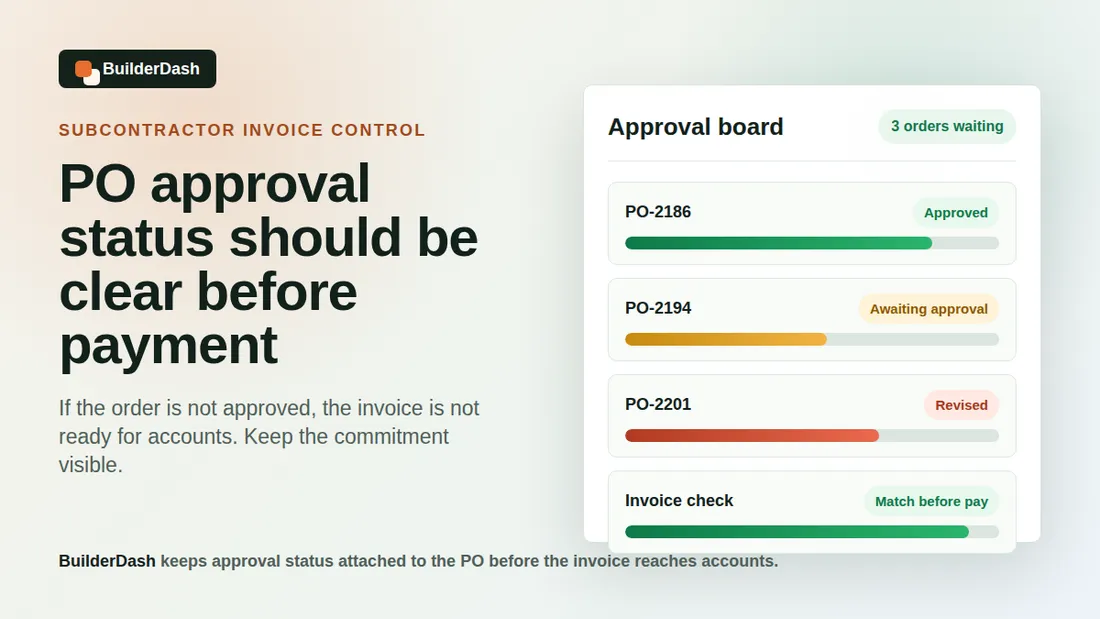
BuilderDash keeps purchase orders, approvals and invoice checks attached to the same job record. That makes it easier to see committed spend earlier, approve with less back-and-forth, and keep job costs readable while work is still live.
Suggested internal links
- Construction Purchase Order Software: How Small Contractors Control Spend Before Invoices Arrive
- How to Reduce End-of-Month Invoice Chasing in Construction
- Tracking Spend vs Controlling Spend on Construction Jobs
- Payment Runs: Getting Invoice Readiness Right in Construction
Quick checklist before approval
- The job reference is present on the invoice.
- The PO number matches the live job.
- Any variation has been approved and recorded.
- The amount matches the order, or the difference is explained.
- The right cost code or cost centre is attached.
- The approver is the right person for that job.
- The file will be easy to find again at month end.
Final thought
If your job references stay clean, invoice approvals get faster without adding more admin. That is the kind of routine that keeps cash flow visible and job costs honest.
CTA: If you want one place to keep POs, approvals and invoice control together, BuilderDash is built to keep the reference trail in order from issue to payment.
Run your projects properly with BuilderDash.
One system for every enquiry, job, quote and invoice - built for project-based trades, not reactive call-outs.